There are no items in your cart
Add More
Add More
| Item Details | Price | ||
|---|---|---|---|

{{DATE}}
With rising retail participation and SEBI's launch of Specialised Investment Funds, understanding derivatives is now a baseline skill for finance professionals. NISM-Series-XIII Common Derivatives Certification is SEBI's direct answer, and it is mandatory across broking, AMCs, research, and SIF distribution. It is the single exam that turns an MFD into a Certified SIF Distributor. More than 6,000 distributors have now cleared it, yet demand still surpasses supply, with SIF assets crossing ₹12,329 crore. This guide explains why it matters, what the syllabus covers, and how to clear it on your first attempt.
Derivatives are no longer reserved for institutional desks. They sit at the core of India's capital markets, and with SEBI's Specialised Investment Funds now live, they have moved into the everyday work of distributors and advisers.
You can demonstrate your expertise with them by obtaining the NISM Series XIII certification. It is required for a growing number of jobs in asset management firms, research firms, broking houses, and SIF distribution. It is the sole examination that designates you as a Qualified SIF Distributor and opens up the most important new product category in the Indian market for a mutual fund distributor. It's more than just a box to tick off. It's the difference between observing an SIF opportunity and actually participating in it.
Three common habits are shared by applicants who successfully pass the NISM-Series-XIII on their first try.
Without deviation, they adhere to the module sequence. Currency derivatives come in second place, interest rate derivatives in third, and equity derivatives come in first place. Studying out of order creates gaps that show up as wrong answers on test day since the NISM Series XIII curriculum is interwoven.
They conceptualise prior to taking practice examinations. A simulated test determines whether one is ready; it does not produce readiness. Prior to finishing the course, taking one results in misleading marks and increased exam anxiety.
The interest rate derivatives module is given the highest priority. It feels the least familiar to most applicants; therefore, they undervalue it. It carries enough question weight to determine whether you succeed or fail.
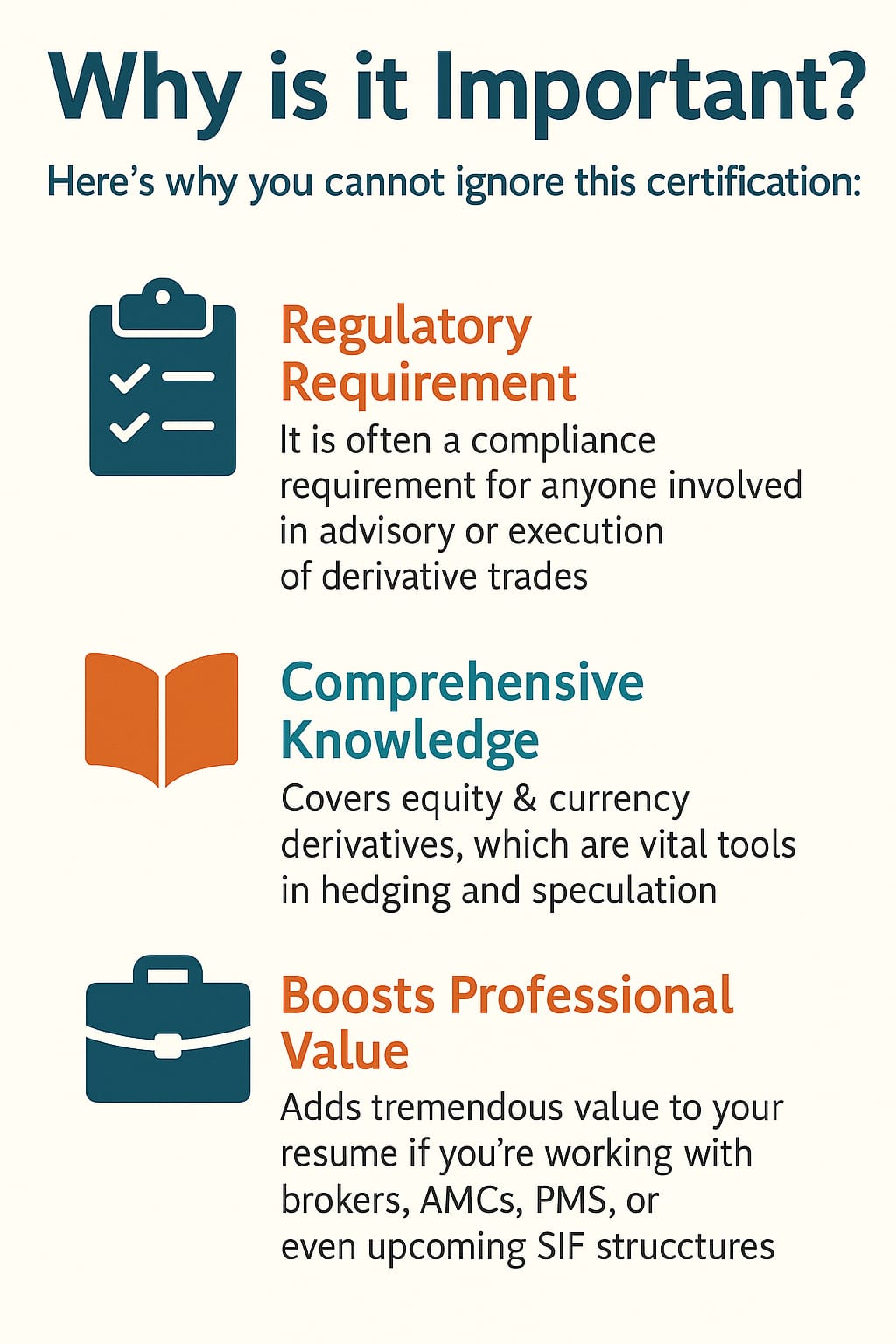
NISM-Series-XIII is conducted by the National Institute of Securities Markets under SEBI's regulatory framework. It tests your conceptual understanding of equity, currency, and interest rate derivatives, and your ability to apply that knowledge responsibly in a workplace.
This is not a trading exam. It does not put technical analysis, market timing, or profit strategies to the test. It determines whether a financial professional has a firm grasp of derivative instruments to properly represent products, explain risks to clients, and comply with SEBI regulations.
Who must clear NISM-Series-XIII:
Parameter | Details |
Full Name | NISM-Series-XIII: Common Derivatives Certification Examination |
Also Known As | NISM XIII, SIF Exam, SIF Examination NISM |
Total Questions | 150 |
Maximum Marks | 150 (1 mark per question) |
Duration | 180 minutes (3 hours) |
Passing Score | 60%, which is 90 out of 150 |
Negative Marking | 25% per wrong answer |
Certificate Validity | 3 years |
Mode | Online, computer-based at NISM test centres |
Exam Fee | ₹3,000 (payment gateway charges extra) |
The 25% negative marking rule shapes every exam-day decision. Four wrong answers cancel one correct answer. Accuracy is the strategy, not speed or coverage.
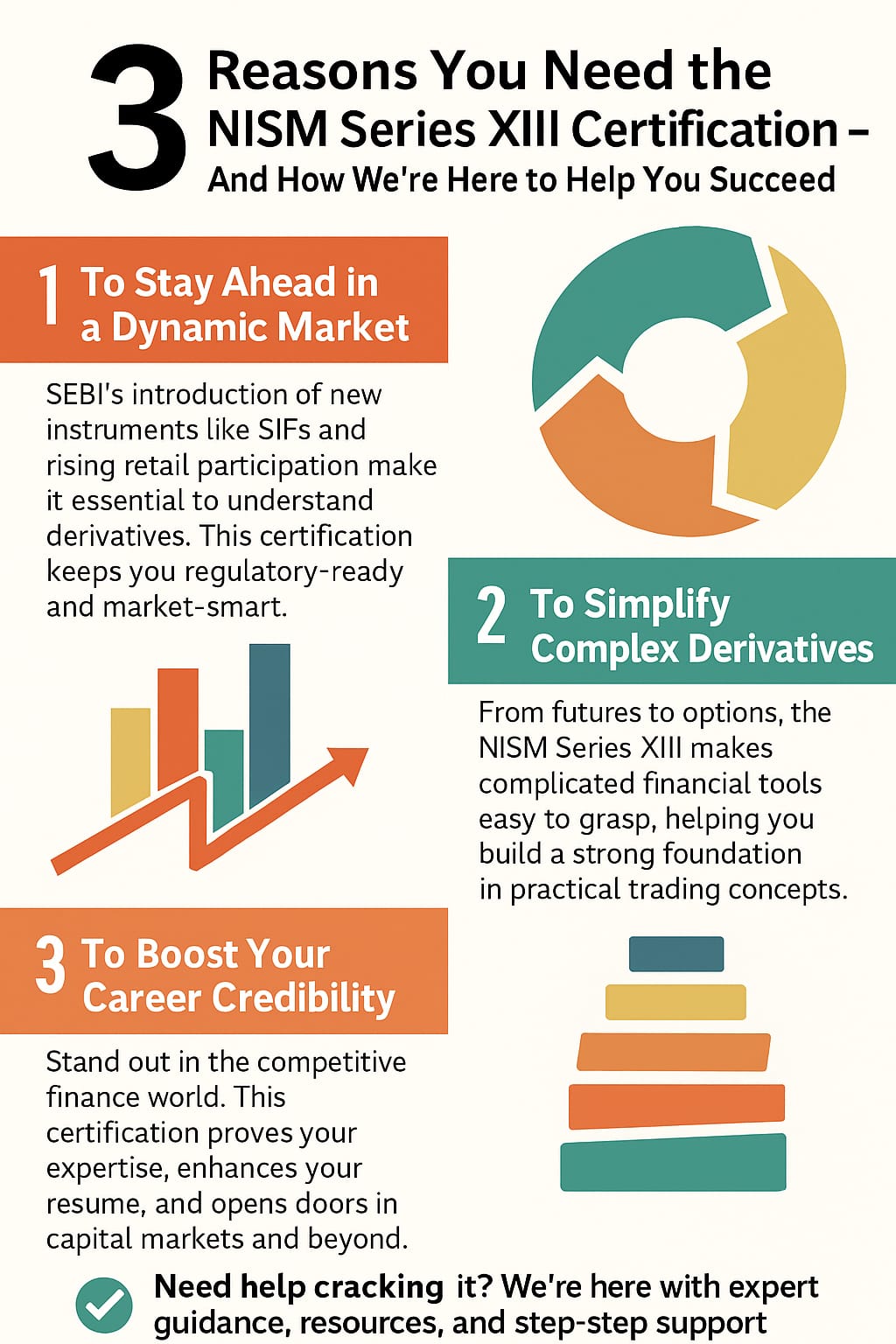
SEBI created Specialised Investment Funds with Circular No. SEBI/HO/IMD/IMDPoD1/P/CIR/2025/26, dated February 27, 2025, which would become effective on April 1, 2025. By focusing on high-value investors with a minimum ticket size of ₹10 lakh, SIFs hope to close the gap between expensive PMS and AIFs and conventional mutual funds.
Here is what is actually happening in the market in 2026:
More than 6,000 distributors have now cleared the exam, so the early bottleneck has eased. But demand is still running ahead of the supply of advisers who truly understand the product, especially as B30 cities now outpace the metros in SIF participation.
No one in a client-facing position can afford to ignore the structural, risk, and regulatory limitations of derivatives, since SIFs enable long-short tactics that employ equity and debt derivatives. An advisor who cannot clarify the inverse relationship between bond yields and prices, how Option Greeks modify pricing, or what a short position entails cannot assist high-value customers at the level they currently expect.
Connect with our program adviser to start your NISM Series XIII preparation today.
The NISM Series XIII syllabus is built around three derivative families, plus the rules that surround them. You can download the official NISM Series XIII PDF from the NISM website for the full unit weights, and the breakdown below shows how to plan your study order.
Most aspirants have some prior exposure to equity markets, which makes this the natural starting module.
Complete this module before continuing. In the sections on currency and interest rates, the ideas presented here are revisited.
This section is among the highest-scoring parts of the exam for candidates who prepare methodically.
This is the module most candidates underprepare for and the one that most often causes failures.
Spend more preparation time on this module than on the other two combined.
For most candidates, 30 to 50 days is enough, even with no prior derivatives background.
Phase | Days | Focus |
Equity Derivatives | Days 1 to 10 | Core concepts and chapter-wise practice |
Currency Derivatives | Days 11 to 20 | Concepts and settlement mechanics |
Interest Rate Derivatives | Days 21 to 32 | Slow, thorough concept study |
Mock Tests and Revision | Days 33 to 40 | Full-length NISM Series XIII mock test runs and weak-area revision |
Aim for 1.5 to 2 hours of focused daily study. Consistent daily sessions beat irregular cramming every time.
A rapid score check. You receive 95 correct marks if you try 115 questions and get 95 right and 20 incorrect. Your deduction is 20 multiplied by 0.25, which comes out to 5 points. You got 90 out of 150 points, or exactly 60%. You pass.
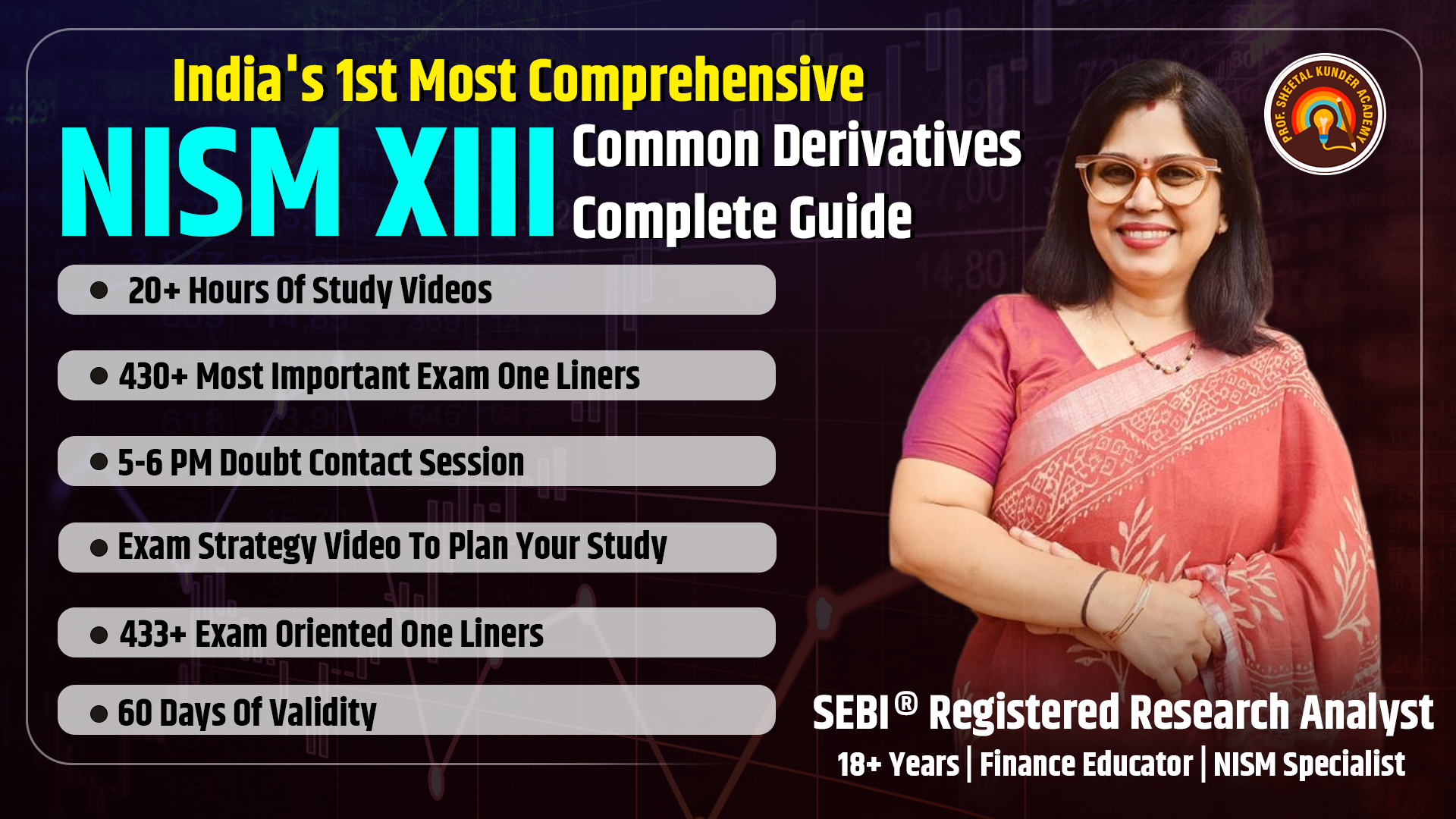
PSKA's NISM-Series-XIII program is built for working finance professionals who need to clear the exam without interrupting their practice. We have trained more than 3,000 MFDs across India.
What the PSKA course includes:
A criterion upheld by hundreds of pupils. Timelines are flexible, with a 15-day expedited preparation plan and fewer extensions, if necessary, to accommodate your schedule. Additionally, you may talk with Prof. Sheetal via video or audio call from 5 to 6 p.m. to resolve any issues.
You have the ambition. We have the method. Start your enrollment immediately and prepare to become a Certified SIF Distributor on your first attempt.

{{AUTHOR}}
SEBI® Research Analyst. Registration No. INH000013800 M.Com, M.Phil, B.Ed, PGDFM, Teaching Diploma (in Accounting & Finance) from Cambridge International Examination, UK. Various NISM Certification Holders. Ex-BSE Institute Faculty. 18 years of extensive experience in Accounting & Finance. Faculty Development Programs and Management Development Programs at the PAN India level to create awareness about the emerging trends in the Indian Capital Market and counsel hundreds of students in career choices in the finance area
SIFs use derivatives as core operating instruments. SEBI introduced this requirement to make certain that every distributor handling SIF products has verified conceptual knowledge of equity, currency, and interest rate derivatives before advising or selling to clients.
Research analysts, traders, investment advisors, AMC relationship managers, and sales representatives of trading members in the currency, equity, and interest rate derivatives sectors are all required to complete this. While the certification has a broad range of applications, SIF distribution is the most recent and pressing driving force behind it.
The official PDF of the full NISM Series XIII syllabus is available for download from the NISM website under the Common Derivatives Certification section. It discusses investor protection, accounting and taxation, the regulatory framework, trading and settlement, and the fundamentals of derivatives, futures, and options on shares and currencies.
Although most professionals routinely interact with equity and currency markets, they have limited real-world experience with bond pricing, duration, and yield curves. With twisted, statement-based questions, the test fills that gap. The capacity of passers to conceptually grasp the inverse relationship between price and return sets them apart from others.
There is a 25% reduction in marks for every incorrect answer. For a question worth one mark, a 0.25 mark penalty is assessed for each incorrect answer. Four incorrect responses offset one right response, making careful, accurate tries considerably more effective than speeding through all 150.
PSKA NISM Series XIII sample tests are designed to mimic the difficulty of the real exam and include thorough justifications for each choice, not merely an answer key. Revision is guided by data rather than conjecture because the performance dashboard records scores on a module-by-module basis.
Yes. Before any formula, PSKA's concept-first strategy develops understanding from first principles, outlining the reasons behind each mechanism's effectiveness. With this technique, pupils with experience in mutual fund distribution, relationship management, banking, and general finance have passed it on their first try.
Registrations are completed using certifications. nism. ac. in, the official NISM certifications portal. The SEBI circular that outlines the regulatory framework for SIFs is available under Legal, then Circulars at sebi. gov. in.
 Launch your Graphy