The transition from a life of active service in the Indian Army to the complex, often volatile world of financial markets is a journey rarely taken, yet deeply logical. As Colonel Anand Srinivasan, founder of Dhatri Finsov, explains in a recent conversation with Prof. Sheetal Kunder, the "mission" doesn't end with retirement; it simply changes field. While the terrain of a high-altitude post in Jammu & Kashmir differs physically from the fluctuating charts of the Bombay Stock Exchange, the psychological and tactical requirements for success remain strikingly similar.
For many veterans, the post-2004 pension landscape and the rising cost of modern consumption make informed financial planning a necessity rather than a choice
. Colonel Anand’s journey serves as a blueprint for how military discipline, structured risk management, and a "mission-first" integrity can be translated into a robust investment philosophy
.
1. The Military DNA: Discipline as the Ultimate Weapon. In the armed forces, discipline is not just a rule—it is a life-saving mechanism. Colonel Anand emphasizes that "the more you sweat in peace, the less you bleed in war"
. This philosophy is the cornerstone of his approach to the markets.
Routine and Career Exams: Military life is defined by a structured routine of training, courses, and career exams. Colonel Anand applied this same rigor to his financial transition, spending years (from 2013 to 2019) building a foundation of knowledge before ever advising a client.
Structured Selection: Just as an operation requires the structured selection of personnel and equipment, an investment plan requires a goal-based, risk-aware selection of assets.
Avoiding the "Abracadabra" Mindset: Many first-time investors view the market as a "magic box" where money multiplies instantly
. A military mindset replaces this fantasy with the reality of long-term focus and systematic discipline
.

2. Tactical Risk Management: The Low-Compromise Approach. In a combat operation, a failure to manage risk doesn't just result in a financial loss; it results in casualties
. Colonel Anand carries this "low-compromise" risk management into his investment philosophy
.
- The Intelligence Phase (Pre-Investment). Before entering a "built-up area" in an operation, soldiers check the terrain and plan their entry and exit. In investing, this translates to a thorough audit of the investor's capability:
- The Safety Net: Does the investor have term insurance or medical insurance?
- The Debt Audit: Does the individual carry personal loans or high-interest bank debt?
- The Documentation Check: Colonel Anand highlights a case where he refused to proceed with an investment because a client’s name differed across documents after marriage. "Whatever time it may take, this is fine," he notes, emphasizing that integrity in documentation is non-negotiable.
- Controllables vs. Outcomes: A soldier can control the plan, the weapons, and the training, but they cannot control the outcome of the battle. Similarly, an investor has no control over market outcomes.
- Focus on the Controllables: The only "guaranteed" thing is risk management. By mitigating known risks, you determine the likelihood of a sustainable outcome.
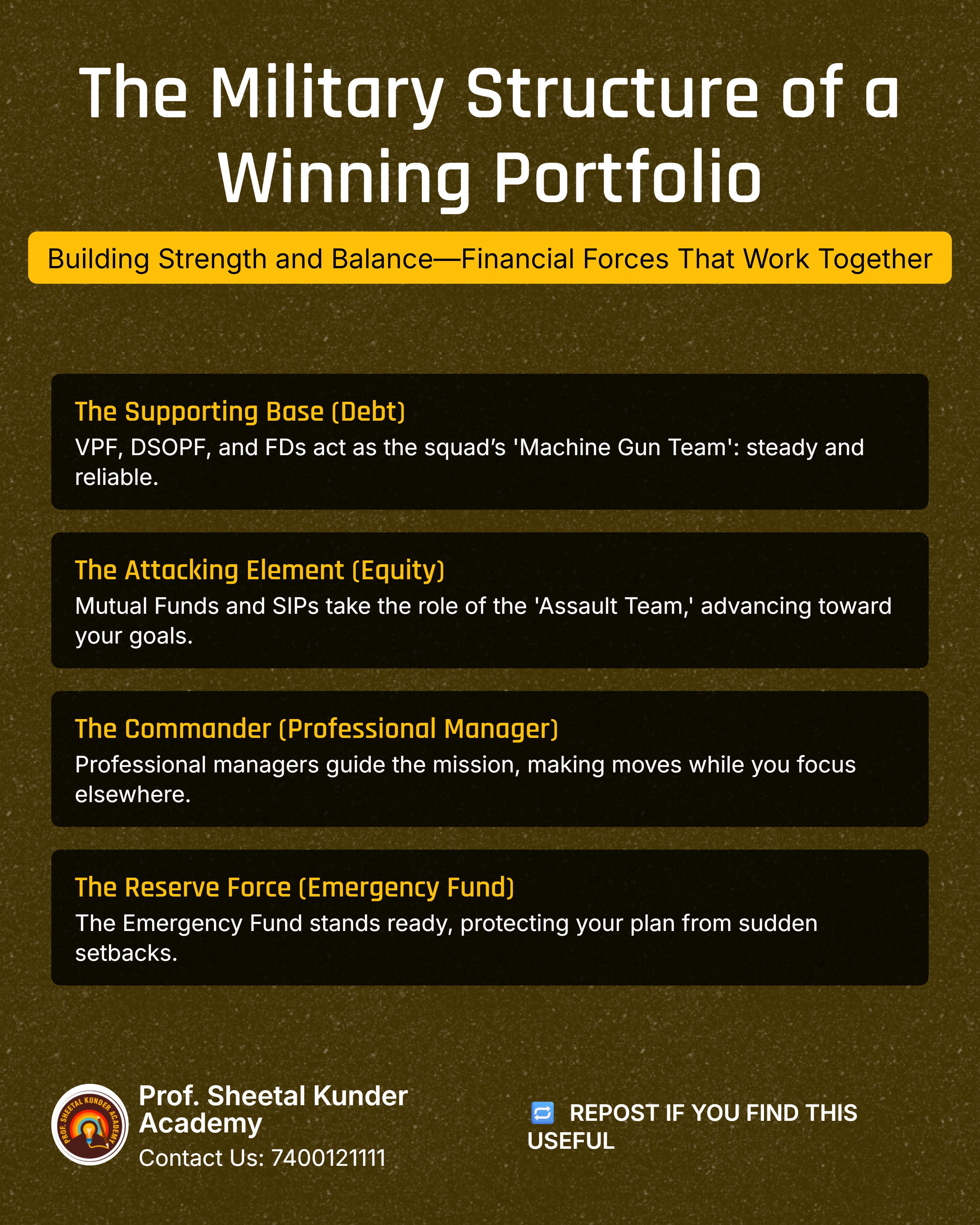
3. The "Supporting Team" Analogy: Asset Allocation. One of the most striking military analogies used by Colonel Anand is the concept of the "Attacking" and "Supporting" teams in asset allocation.
- The Supporting Team (Stability): In an attack, the supporting team provides cover fire with heavy weapons to keep the enemy suppressed. In your portfolio, this is your Fixed Income/Debt component (EPF, VPF, FD). It provides the "leg on the ground" and the stability needed to stay in the game.
- The Attacking Team (Growth): This is your Equity component. It moves forward to capture growth and achieve long-term goals.
- The Stability Mandate: For defence personnel, the Defence Services Officers Provident Fund (DSOPF) acts as a safe, 7.1% compounding instrument that offers stability when the equity markets are down for 2-3 years.
4. Weapon Selection: Choosing the Right Financial Instruments. In a civilian "built-up area," you wouldn't use a heavy rocket launcher because of collateral damage; you would choose a precise, single-target weapon
.
- Mutual Funds as Professional Command: Colonel Anand views mutual funds as "professionally managed" and "well-regulated" vehicles that allow an investor to focus on their core work while experts handle the stock-picking.
- The Specialized Investment Fund (SIF): For those seeking higher risk or alpha, the newly introduced SIF provides a regulated alternative to "reckless" F&O trading. It allows the fund manager "liberty" to use hedging and shorting strategies that were previously unavailable in traditional mutual funds.
- Skin in the Game: True to the military code of leading from the front, Colonel Anand believes in "skin in the game." He invested his own money into an ICICI SIF product to test it before ever recommending it to a client.
5. The Mission: Creating Informed Veterans and InvestorsThe ultimate aim of Dhatri Finsov is to transform individuals into "informed investors". This involves more than just selling a product; it involves a "consolidation of knowledge".
- Fundamental Understanding: Practice is useless without understanding the fundamentals. Colonel Anand spent years reading Value Research articles and taking pre-release courses at IIM Bangalore to understand macros and debt.
- Transparency and Ethics: In a market often clouded by "Ponzi schemes" and "big dreams," the Colonel emphasizes a transparent and ethical approach in line with SEBI and RBI guidelines.
- A Message to the Fraternity: For fellow "Fawji brothers," the advice is clear: start early, don't touch your provident fund for unnecessary purchases (like gold or land without a plan), and follow a roadmap.
The Verdict: Victory through DisciplineColonel Anand Srinivasan’s transition proves that the principles of the Indian Army - integrity, discipline, and tactical awareness - are the perfect armor for the "minds and tracks" of the financial market. Whether you are a veteran or a civilian, the message is the same: Invest in knowledge first; financial investment will follow naturally.

 Launch your Graphy