There are no items in your cart
Add More
Add More
| Item Details | Price | ||
|---|---|---|---|

Tue Aug 19, 2025
Crack the NISM-Series-XIII Exam and Become a Certified SIF Distributor with Prof. Sheetal Kunder Academy
Becoming a Certified SIF Distributor starts with one exam, the NISM-Series-XIII Common Derivatives Certification. The early bottleneck has eased, and more distributors are clearing it each week, yet demand still surpasses supply. SIF assets have crossed Rs. 12,255 crore across 14 AMCs, with more fund houses set to launch shortly and B30 cities now outpacing the metros. This guide walks you through the exam pattern, the syllabus, a realistic study timeline, a mock test strategy, and how PSKA helps you get through on your first attempt.
Table of Contents
Not all candidates who pass the NISM-Series-XIII test on their first attempt have a solid financial foundation. They get ready in a unique way.
They adhere to the module sequence without fail. First: equity derivatives; second: currency derivatives; third: interest rate derivatives. The syllabus is interconnected; therefore, studying out of order results in gaps that manifest as incorrect replies on exam day.
Before taking practice examinations, they develop concepts. A mock exam is a measurement tool, not a learning tool. Taking one before the concepts are understood leads to low scores, fuels exam anxiety, and pushes candidates to avoid their weakest subjects, which is the reverse of what works.
As the most crucial module, they view interest rate derivatives. It feels the least familiar, so most applicants spend the least time on it. Because this module has enough weight to determine the final grade, first-attempt passers do the opposite.
The NISM-Series-XIII is not a trading test. It does not evaluate trading techniques, technical analysis, or market timing. It examines a finance professional's proficiency with derivatives in terms of accurately representing SIF products and managing customer expectations.
Who must clear NISM-Series-XIII:
Parameter | Details |
Full Name | NISM-Series-XIII: Common Derivatives Certification Examination |
Also Known As | NISM XIII, SIF Exam, SIF Examination NISM |
Total Questions | 150 |
Maximum Marks | 150 (1 mark per question) |
Duration | 180 minutes (3 hours) |
Passing Score | 60%, which is 90 out of 150 |
Negative Marking | 25% per wrong answer |
Certificate Validity | 3 years |
Mode | Online, computer-based at NISM test centres |
Exam Fee | Rs. 3,000 (payment gateway charges extra) |
The 25% negative-marking rule is the most important number in this table. Four wrong answers cancel one correct answer. Every preparation choice and exam-day decision has to account for it.

The NISM Series XIII syllabus is built around three derivative families, plus the rules and ethics that encircle them. Knowing the structure helps you plan your study order.
The detailed unit weights can be found by downloading the full official syllabus from the NISM website. PSKA organises its study plan exactly like that, so you devote your time where the questions really are. The course syllabus is frequently requested and organised by marks. Before you establish your study calendar, the quickest way to organise your preparation around your own schedule is to consult a PSKA program adviser.
Why the timing matters right now:
Every month you delay certification is a month of high-value conversations going to advisers who are already certified.
The scale of AMC investment behind SIFs tells you how seriously the industry views this category.
Within months of launch, several fund houses had live SIF products, each having its own brand. Quant came first with qSIF. SBI placed its SIF under the trusted Magnum name. ICICI Prudential built iSIF. 360 ONE introduced DynaSIF. Fund houses do not build distinct brand images for products they see as temporary.
A clear signal is when SBI Mutual Fund, India's largest AMC, launches its SIF under the Magnum brand. Attaching a complicated new category to Magnum, which has decades of investor trust, is a long-term commitment, not a pilot.
The momentum validates it. With 14 AMCs currently active, more anticipated soon, AUM expanding by over 10% month over month, and over 50,000 investor accounts, the path is obvious. Right now, the gap between client demand and trained consultants remains open since demand is spreading into B30 markets and the supply of competent distributors is still catching up. It won't always be this broad.
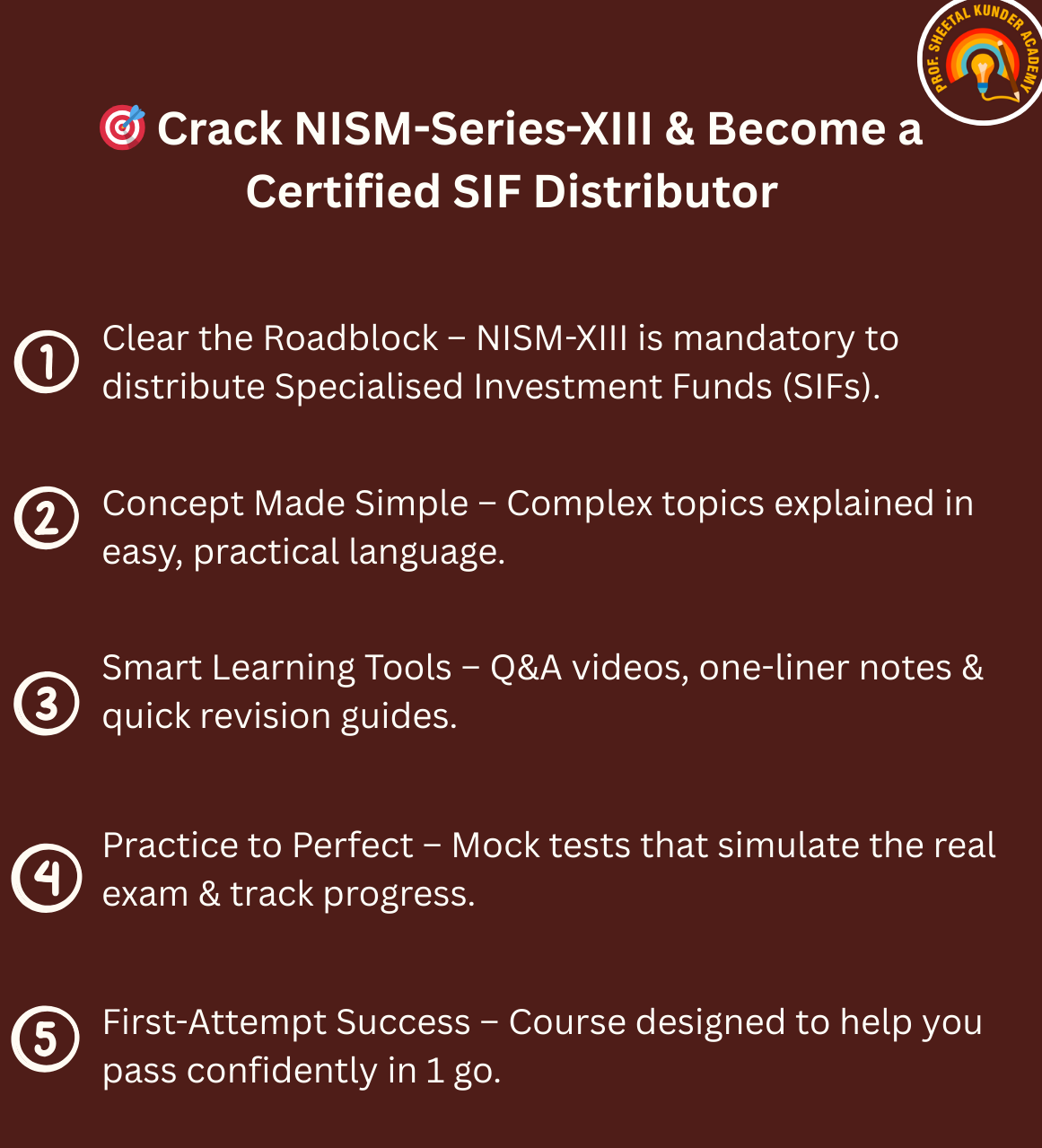
Most NISM-Series-XIII resources are either too thin on explanation or too heavy on mechanical learning. PSKA is built around concept clarity plus first-attempt success.
What the course includes -
The benchmark is simple: students who consistently score 85 to 90% on PSKA mocks clear the real exam with confidence, a pattern proven with hundreds of students.
For most candidates, 30 to 50 days is enough, even with no prior derivatives background.
Phase | Days | Focus |
Equity Derivatives | Days 1 to 10 | Core concepts and chapter-wise practice |
Currency Derivatives | Days 11 to 20 | Concepts and settlement mechanics |
Interest Rate Derivatives | Days 21 to 32 | Slow, thorough concept study |
Mock Tests and Revision | Days 33 to 40 | Full-length mock test runs and weak-area revision |
Timelines stay flexible. Choose a 15-day plan if your schedule demands faster preparation, or request a discount extension. Some PSKA students have cleared the exam in as few as 11 days with structured preparation. Aim for 1.5 to 2 hours of focused daily study. Consistent daily sessions beat irregular cramming every time.
A quick score check. If you attempt 115 questions, get 95 right and 20 wrong, your correct marks are 95, and your deduction is 20 times 0.25, which is 5 marks. Your net score is 90 out of 150, which is exactly 60%. You pass.
You have the ambition, and we have the method, so enrol today and fast-track your journey to becoming a Certified SIF Distributor.

Prof. Sheetal Kunder
SEBI® Research Analyst. Registration No. INH000013800 M.Com, M.Phil, B.Ed, PGDFM, Teaching Diploma (in Accounting & Finance) from Cambridge International Examination, UK. Various NISM Certification Holders. Ex-BSE Institute Faculty. 18 years of extensive experience in Accounting & Finance. Faculty Development Programs and Management Development Programs at the PAN India level to create awareness about the emerging trends in the Indian Capital Market and counsel hundreds of students in career choices in the finance area
The early tally for the first two months was only 284. The number of people who have cleared NISM-Series-XIII has increased steadily since then, but it is still small compared to the 1. 8 lakh mutual fund distributors; as a result, the demand for advisers who truly understand the product still outstrips the supply.
Rs. 10 lakh per PAN across all SIF strategies offered by a single AMC, dropping to as little as Rs. 1 lakh for accredited investors. The average ticket size has risen to about Rs. 24 lakh per folio, which places SIFs firmly in the high-value client segment.
PSKA mock tests are calibrated to match the difficulty of the real exam. A student who consistently scores 85-90% under timed conditions has demonstrated the conceptual insight needed to pass. This benchmark has been proven across hundreds of PSKA students.
With organised preparation, some PSKA students have been able to pass it in as little as 11 days. There is a 15-day regimen for those who want to lose weight quickly. For the majority of prospects, 1.5 to 2 hours every day for 30 to 40 days is the typical timeframe.
No. SIF AUM is growing more than 10% month on month, more AMCs are launching shortly, and B30 cities are now outpacing metros in participation. The number of advisers who truly understand the product is still small relative to demand.
 Launch your Graphy