NISM Certification Blogs for Finance Careers and SEBI Updates
Let’s be honest: most financial professionals approach NISM exams with a bit of "I’ve seen it all" arrogance. "I have 20 years of experience," or "I passed the Mutual Fund exam in 30 minutes," are common refrains. But here is the 2026 reality check:
NISM Series XIII is a different beast.It is technical, lengthy, and involves three separate domains: Equity, Currency, and Interest Rate Derivatives. If you don't treat this like a student, the 150-question paper will likely treat you like a beginner.
1. The Material Challenge: Navigating the 750-Page Ocean
The current NISM XIII curriculum is updated as of December 2025. You are dealing with three distinct workbooks.
- Equity Derivatives: The foundation of most F&O trading.
- Currency Derivatives: Understanding global pairs and hedging.
- Interest Rate Derivatives (IRD): Often the most difficult for non-banking professionals, involving bond pricing and durations.
The Pro Tip: Buy the
Hard Copies. While we live in a digital world, 750 pages on a screen cause "Digital Fatigue," especially for professionals over 45. Physical books allow for better tactile memory and easier referencing during long study sessions.
2. The 10-Day vs. 5-Day Study Logic
If you try to read all 750 pages word-for-word, you will spend at least 10–15 days just reading, with zero retention.
- The PPT/Slide Strategy: Look for condensed study notes or slides (around 500 slides). Because slides are visual and bite-sized, you can cover them in 4–5 days (around 100–125 slides a day).
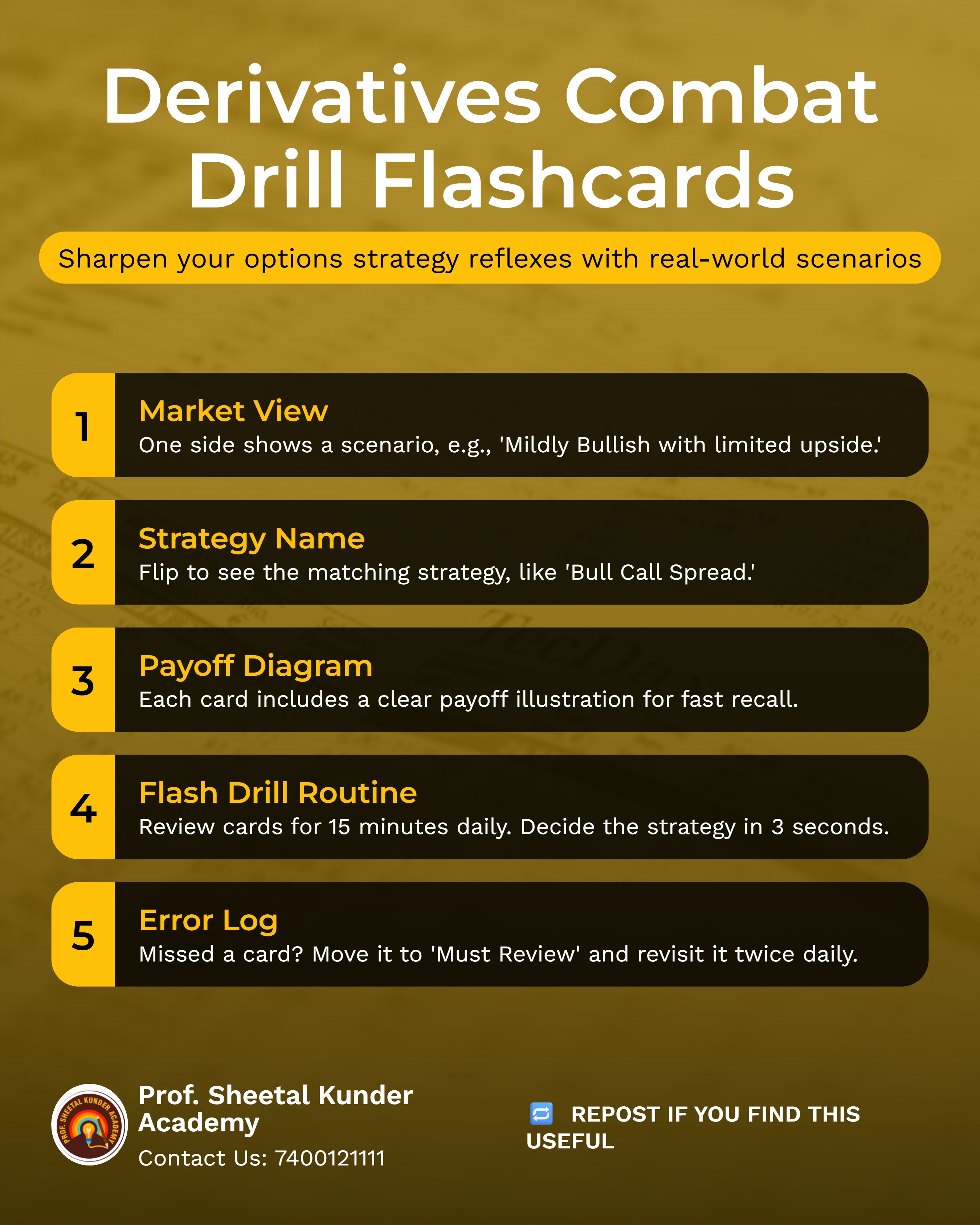
- Video-First Approach: If you have no background in F&O (Futures & Options), do not start with the book. Start with Training Videos. Once you see how a Call Option or a Currency Swap works, the technical jargon in the workbook will suddenly make sense.
3. The "Triple-Colour" Highlighter System
True/False questions and "Choose the Correct Statement" are the "silent killers" of the NISM XIII exam. They require high precision.
- Colour 1 (Green): For easy concepts you already know.
- Colour 2 (Yellow): For moderate difficulty - concepts that need a second look.
- Colour 3 (Pink): For "Exam-Critical" definitions or complex formulas that you must revisit 2 hours before the exam. This system ensures that during your final revision, you aren't wasting time on what you already know; you are zooming straight into the "Pink" zones.
4. Tactical Tools: The Calculator & Excel Secret
Don't be a "Fancy Calculator" victim. You don't need a high-end financial calculator unless you are already a CFA.
- The Casio Advantage: Use a regular calculator (Casio CT-500 or 250) with big keys. Big keys mean fewer "finger errors" during high-stress numerical solving.
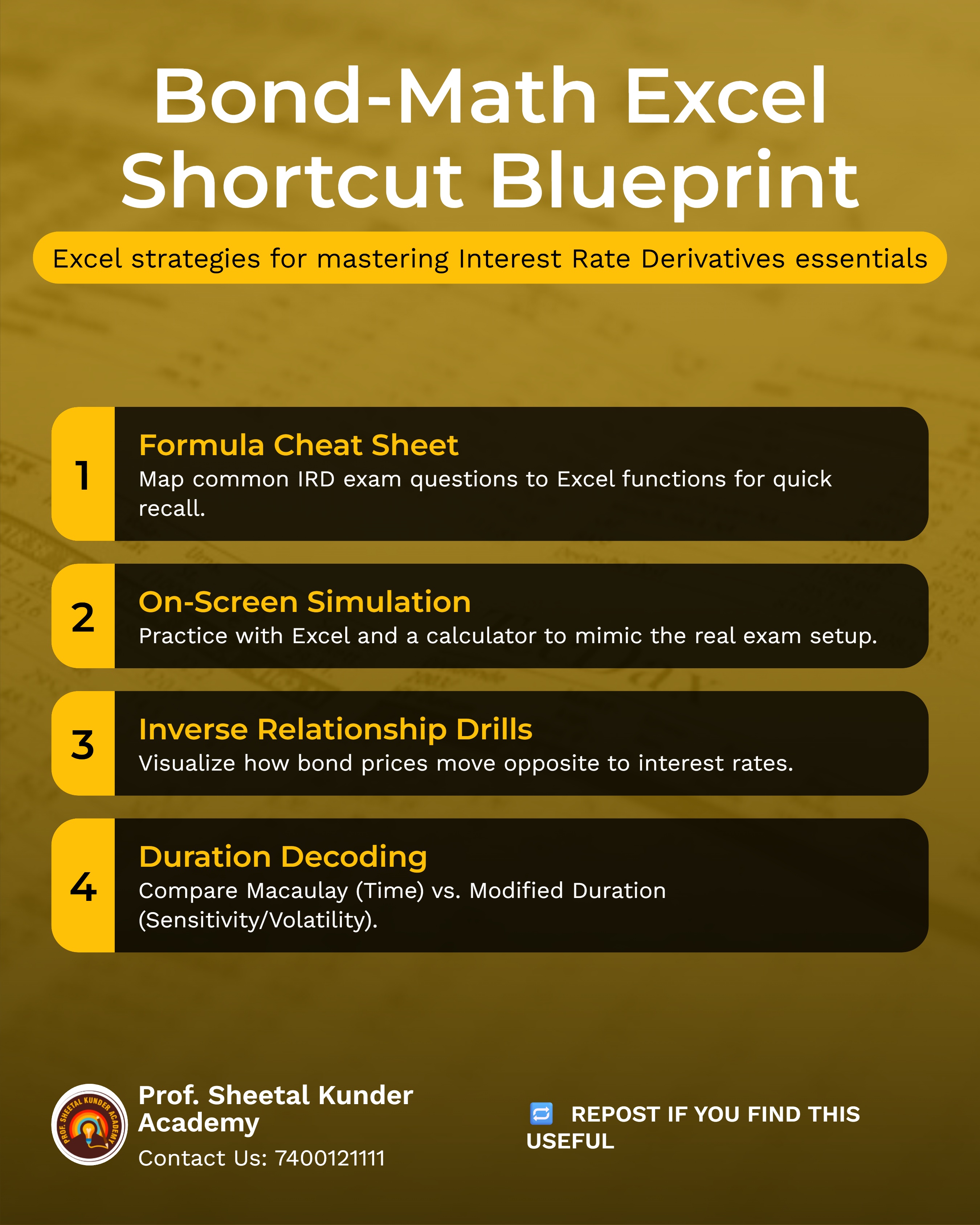
- The Excel Edge: For complex IRD problems - like calculating Macaulay Duration, Modified Duration, or YTM (Yield to Maturity) - NISM provides a scientific calculator and Excel access on your exam screen. Practice using Excel's built-in formulas (=IRR, =PRICE) during your prep so you can solve in seconds what others struggle with manually for minutes.
5. The "90% Benchmark" for Mock TestsMany aspirants take a mock test, score 65%, and think, "Hey, passing is 60%, I'm ready!" You are not. In the real exam, the pressure of negative marking and new question phrasing usually drops your score by 10–15%.
- The Rule: Do not book your slot until you are consistently hitting 90%+ in mock tests.
- Mock Test Videos: Watch videos of mentors solving mock tests. They often explain the "logic" behind the question, which is more valuable than just knowing the answer.
6. Exam Hall Strategy: The 150-Question Sprint
You have 3 hours for 150 questions. That is 72 seconds per question.
- Pass 1 (Theory Sprint): Finish all "one-liner" theory questions first.
- Pass 2 (The Marked Review): Go back to the questions you marked for review (usually short numericals).
- Pass 3 (The Deep Dive): Handle the complex bond pricing or multi-leg option strategy questions last.
The Fatigue Factor: Sitting in front of a screen for 3 hours causes eye strain and mental exhaustion. Take 5-second "micro-breaks" every 30 questions to look away from the screen and reset your focus.
7. The "Anti-Tukka" Policy (Negative Marking)
NISM Series XIII has a 25% negative marking policy. "Tukka-baazi" (guessing) is the fastest way to fail.
- The Math of Guesses: If you guess 15 questions and get them wrong, you lose 18.75 marks (15 for the wrong answers + 3.75 penalty).
- The Strategy: If you don't know a question, leave it. It is better to attempt 130 questions with high accuracy than 150 questions with 20 guesses.
Conclusion: A Challenge for Your Knowledge Version 2.0Think of the NISM Series XIII not as a hurdle, but as an upgrade. In 2026, clients are becoming technically sound. When an Investment Advisor gives them a "Long-Short" or "Arbitrage" fund, they will turn to you for an explanation. Passing this exam makes you a Technically Sound Professional. It gives you the authority to speak about F&O, hedging, and bond durations with total confidence. Take it as a challenge, follow the 90% mock-test rule, and lead the SIF revolution with pride.


 Launch your Graphy