There are no items in your cart
Add More
Add More
| Item Details | Price | ||
|---|---|---|---|

{{DATE}}
Parameter | Details |
Full Name | NISM-Series-XIII: Common Derivatives Certification Examination |
Also Known As | NISM XIII, NISM Series XIII, SIF Exam, SIF Examination NISM |
Total Questions | 150 |
Maximum Marks | 150 (1 mark per question) |
Duration | 180 minutes (3 hours) |
Passing Score | 60% - 90 out of 150 |
Negative Marking | 25% per wrong answer |
Certificate Validity | 3 years |
Mode | Online, computer-based at NISM test centres |
Exam Fee | Rs. 3,000+ (payment gateway charges extra) |
The assumption that a ₹10 lakh investment product lives only in Mumbai, Delhi, and Bengaluru is worth questioning. The data on where Indian investment culture is actually growing tells a different story.
Investors from beyond India's top 30 cities now account for more than 27% of total individual mutual fund assets. New SIP registrations from Tier 2 and Tier 3 cities make up 56% of all incoming SIP volumes nationally. These numbers reflect a structural shift in where Indian households are choosing to deploy capital, and the wealth base behind these numbers is real.
Cities like Surat, Rajkot, Coimbatore, Ludhiana, and Indore have produced genuine HNI investor populations over the past decade through business growth and the compounding of equity returns. A business owner in Surat with investable capital of ₹25 to ₹50 lakh is not a Tier 2 investor in the traditional sense. That person has outgrown fixed deposits, has been in mutual funds for years, and is looking for the next level of product. SIFs are that product.
Edelweiss has been direct about this. Their CEO noted that new branches in Tier 3 cities break even within 18 to 24 months, which is a clear commercial signal that demand exists before the branch arrives.
For MFDs operating in non-metro markets, this matters more than it might seem. The HNI client capable of writing a ₹10 lakh cheque for a sophisticated strategy is no longer exclusive to metros. That investor is already in your city. The question is whether you are certified to serve them when they ask.
Equity Derivatives is where preparation should begin. It is the most familiar module for most aspirants and lays the conceptual foundation on which that the other two modules depend.
What the exam tests here:
Master this module before moving forward. Every concept here reappears in a different form in Currency and Interest Rate Derivatives.
Currency Derivatives is more scoring than most candidates expect. The questions are largely conceptual with limited numerical complexity.
What the exam tests here:
Direct and indirect quotation conventions
Candidates who avoid this section lose marks that are straightforward to earn with two weeks of focused preparation.
Interest Rate Derivatives is the module that determines most final scores. Most candidates underestimate its weight, underprepare for it, and pay the price on exam day.
What the exam tests here:
Spend more time preparing for this module than for the other two combined.
The NISM Series XIII syllabus is not three independent subjects. Each module builds on the previous one. Candidates who study in the wrong sequence - or jump between topics - create knowledge gaps that appear at the worst possible moment on exam day.
Correct sequence:
Complete Equity Derivatives fully - concepts, not just chapter summaries
Move to Currency Derivatives only after Equity is clear.
Cover Interest Rate Derivatives last, slowly and thoroughly.
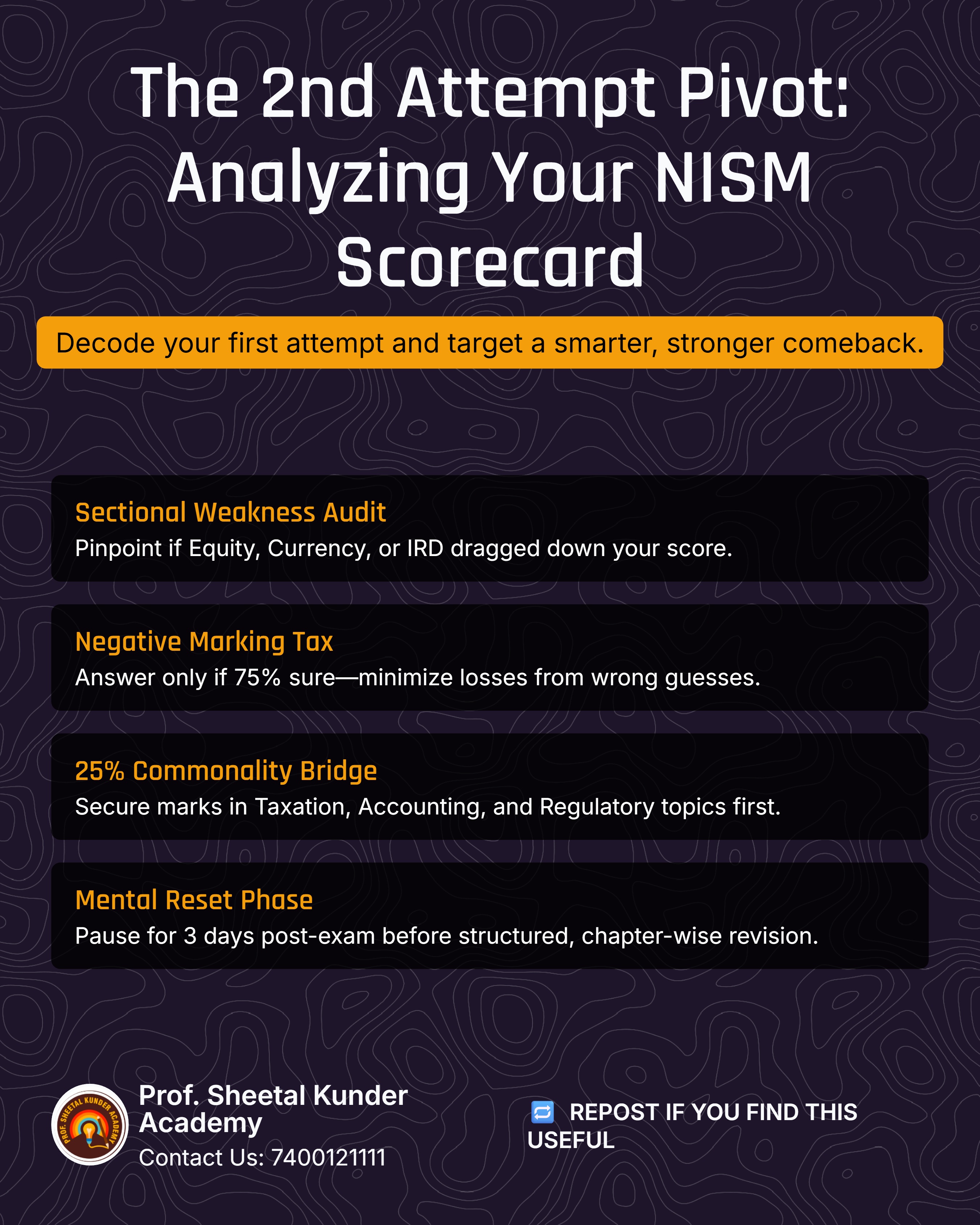
Begin mock tests only after all three modules are complete.
Use mock test errors to direct revision - not to learn new content.
Daily commitment: 1.5 to 2 hours of focused study across 30 to 50 days. Consistency outperforms intensity every time.
Phase | Days | Focus |
Equity Derivatives | Days 1 to 15 | Core concepts + chapter-wise practice |
Currency Derivatives | Days 16 to 28 | Concepts + settlement mechanics |
Interest Rate Derivatives | Days 29 to 42 | Slow, thorough concept study |
Mock Tests + Revision | Days 43 to 50 | Full-length mock tests + weak area revision |
Attempt all familiar questions in the first pass - build your score before touching uncertain ones.
If you attempt 112 questions, answer 93 correctly and 19 incorrectly:
One accurate attempt at 112 questions beats a rushed attempt at 150 every time.
Connect with our programme adviser to choose the right plan for you.

Prof. Sheetal Kunder
SEBI® Research Analyst. Registration No. INH000013800 M.Com, M.Phil, B.Ed, PGDFM, Teaching Diploma (in Accounting & Finance) from Cambridge International Examination, UK. Various NISM Certification Holders. Ex-BSE Institute Faculty. 18 years of extensive experience in Accounting & Finance. Faculty Development Programs and Management Development Programs at the PAN India level to create awareness about the emerging trends in the Indian Capital Market, and counsel hundreds of students in career choices in the finance area
SEBI introduced NISM Series XIII to establish a common minimum knowledge benchmark for professionals operating in Equity, Currency, and Interest Rate Derivatives segments. It ensures that sales and distribution personnel understand derivatives and their risks before advising or selling to clients.
The minimum ticket size for Specialised Investment Funds is Rs. 10 lakh. This positions SIFs in the HNI client segment, which represents high-value business for MFDs who hold NISM Series XIII certification.
Yes. SIF fund managers can take short derivative positions of up to 25% of the portfolio, allowing the fund to generate returns in bearish and sideways market conditions - unlike long-only mutual funds.
With 25% negative marking, attempting uncertain questions reduces your net score. Four wrong answers cancel one correct answer. Selectively attempting with high accuracy is a more reliable strategy than attempting all 150.
The workbook covers the syllabus, but is not structured for exam-oriented preparation. Candidates who study only from the workbook without concept-first sequencing and mock test practice consistently underperform in the application-based questions.
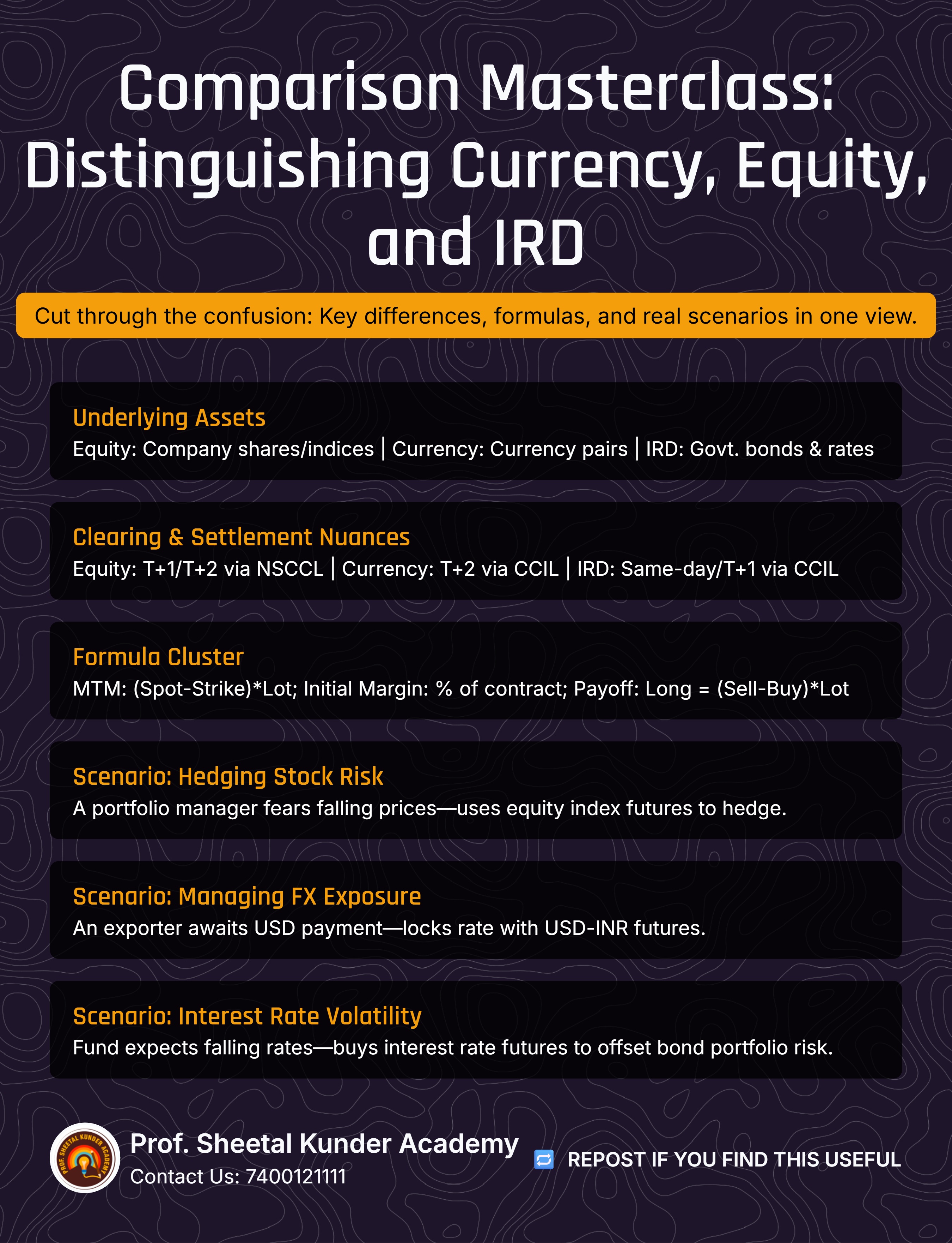
Currency Derivatives tests knowledge of currency pairs, quotation conventions, and hedging use cases. Interest Rate Derivatives tests bond pricing, yield, duration, and how interest rate changes affect derivative positions. Both are conceptual, but Interest Rate Derivatives have greater complexity in their questions.
PSKA mock tests are calibrated to match actual NISM exam difficulty. A candidate who consistently scores 85-90% on these tests has demonstrated sufficient conceptual depth to clear the actual exam. This benchmark has proven reliable across hundreds of PSKA students.
ICICI Prudential, SBI Mutual Fund, Mirae Asset, Nippon India, and HDFC Mutual Fund have launched SIF products. The category crossed thousands of crores in AUM within months of the first launches.
Yes. The exam covers the regulatory environment governing exchange-traded derivatives in India, including SEBI regulations, exchange mechanisms, clearing and settlement, and risk management frameworks.
PSKA students have cleared NISM Series XIII in as few as 11 days with structured preparation. The key factor was following the correct module sequence and achieving conceptual clarity before attempting mock tests.
 Launch your Graphy