There are no items in your cart
Add More
Add More
| Item Details | Price | ||
|---|---|---|---|

Wed Dec 10, 2025
But don't panic! Here’s the simple approach to breaking down IRD and securing those crucial marks for your NISM 13 certification: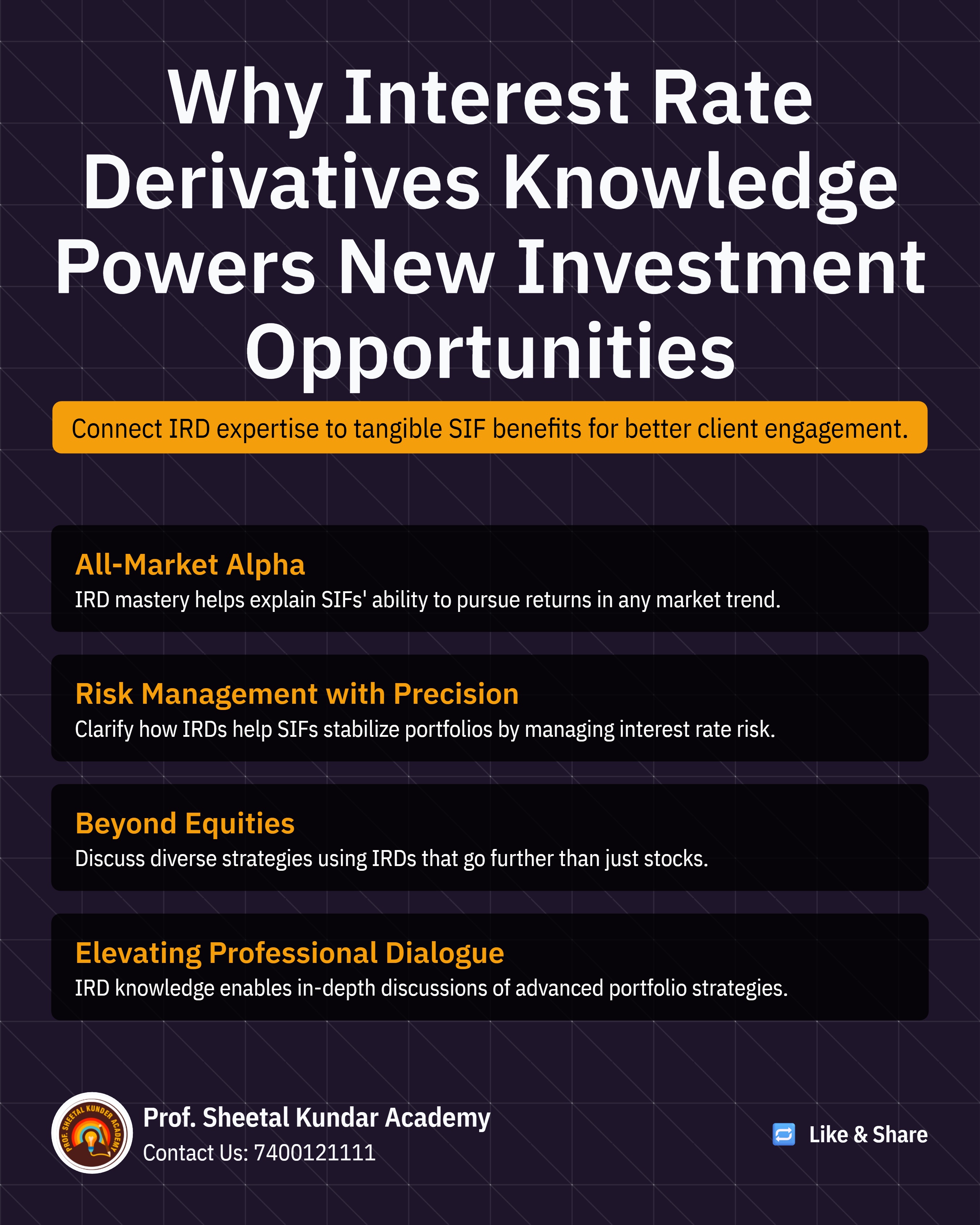
Why is IRD the "blind spot"? Unlike stocks, we don't deal with these products (such as bond futures or interest rate swaps) in our day-to-day life. The lack of practical exposure and the use of complex jargon make it feel like the most challenging part of the entire exam.
When Rohit first enrolled, he admitted that the Interest Rate portion was the scariest part. But the key advice he received and the core truth of the exam is that a derivative is a derivative.
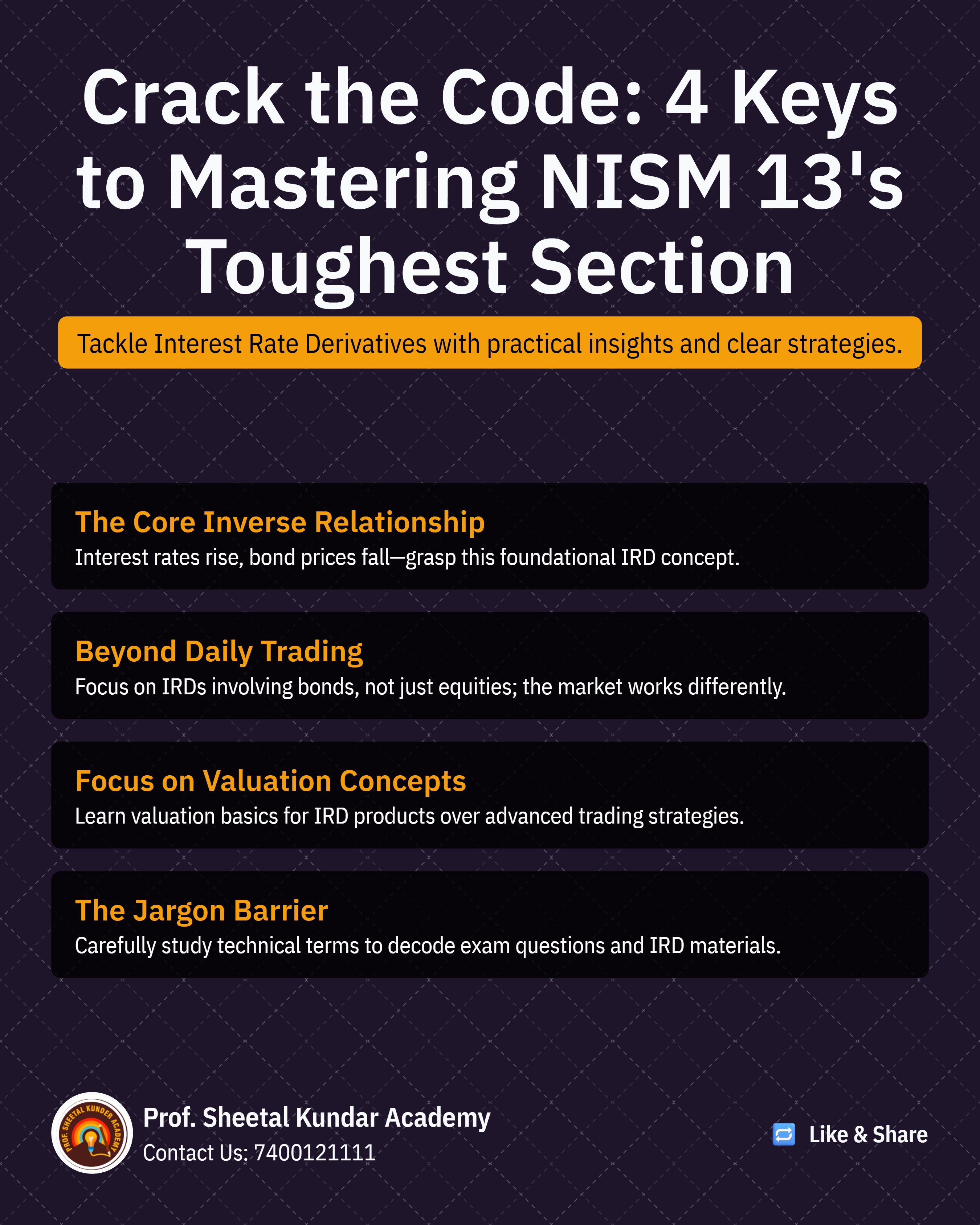
The Golden Rule: The mechanics (futures, options, hedging, speculation) that you learn for Equity are largely the same for Interest Rate products. Once you understand the basic payoff profiles, you are halfway there.
To understand an Interest Rate Derivative, you must first understand the Underlying Asset, which is the bond or fixed-income security.
The Inverse Relationship: This is the most fundamental concept: If interest rates rise, bond prices fall. You must know this relationship thoroughly, as it is the foundation of IRD.
Yield vs. Price: Don't confuse the two! When interest rates rise, a bond's price falls, but the percentage yield you receive on the bond's face value does not necessarily decrease. You need to have a "deeper knowledge" of these basic things.
The exam wants to know why a Fund Manager (or SIF Manager) would use these complex instruments. IRD is primarily used for managing risk.
Handling Volatility: Our markets have been highly volatile. Derivatives excel at operating during periods of high volatility.
Lack of Practical Examples: Since these products (like bond futures or corporate bonds) don't have the trading volumes of stocks, it’s hard to find current, practical examples on the screen. This is why conceptual clarity, as taught in the study material, is so important.
IRD sections are full of complex terminology (like YTM, Duration, etc.).
Word-by-Word Study: As Rohit advised, when the wording gets difficult, slow down and read the text word to word. The products are easy to understand once the concepts are clear.
Use Excel for Speed: Where complex bond pricing or YTM calculation is required, you should be ready to use the Excel sheet provided in the exam environment. This is where the calculation becomes "very fast" and "very easy".
The NISM Series 13 is a three-in-one certification covering three asset classes. Don't let your weakness in one area-IRD-cost you the entire exam. Clear the concept, and you clear the exam!

Prof. Sheetal Kunder
 Launch your Graphy