There are no items in your cart
Add More
Add More
| Item Details | Price | ||
|---|---|---|---|

Sat Aug 1, 2026
Quick Read
Family office growth in India is one of the biggest stories in Indian wealth management right now, with over 300 family offices managing more than 30 billion dollars in assets. These setups need more than fund recommendations; they need succession planning, consolidated reporting, and advisers who can speak to two generations at once. That's a real opening for anyone becoming a NISM investment advisor through the SEBI-mandated X-A and X-B exams. This piece covers the family office boom, what these desks actually need from advisers, and the exam, fee, and registration details for 2026.
The Numbers Behind Family Office India Growth
Three hundred family offices. Thirty billion dollars in assets. Thirty per cent of domestic startup funding. These figures come from the Indian Family Offices Report 2026, built by 1Lattice with The Economic Times. EY had counted roughly 45 family offices a few years earlier, so the jump to nearly 300 shows how fast this segment has moved.
This growth isn't confined to a small corner of wealth management anymore. It's becoming a real hiring channel for people who hold a SEBI Investment Adviser certification, and few articles explain what the work inside one of these offices actually involves.
What a Family Office Actually Wants From an Adviser
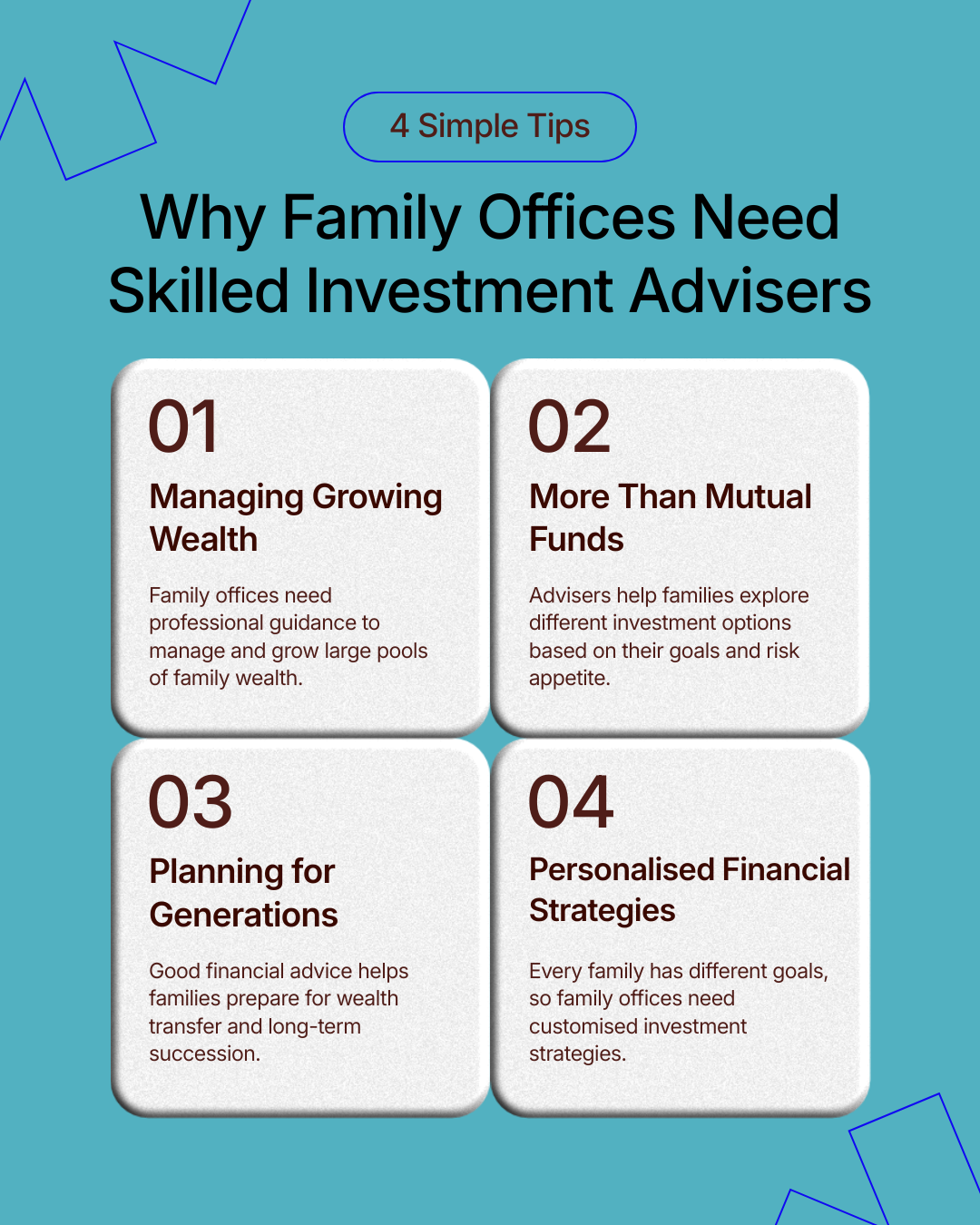
Picking three mutual funds and calling it advice doesn't cut it here. Private equity and venture allocations delivered 25% returns on just 20% of allocated capital per the 2026 report, yet most family offices remain underweight in that asset class. Closing that gap needs someone comfortable with both public and private markets.
Succession is the bigger, quieter problem. An estimated 1.3 to 1.5 trillion dollars in wealth is expected to transfer across generations in India over the next decade, but only about 20% of family offices currently have a formal succession plan. Over half now involve millennial or Gen Z members directly in investment decisions, pushing allocations toward ESG and digital assets, which means an adviser today is translating between two generations, not just reporting numbers.
A quick hypothetical: a newly certified adviser joins a small family office in Pune serving three business families. Week one isn't fund selection; it's building one dashboard pulling together holdings across four banks and a family trust, since nobody had ever seen it all in one place before. That's the real job hiding behind the word "adviser."
Why NISM Investment Advisor Certification Comes First
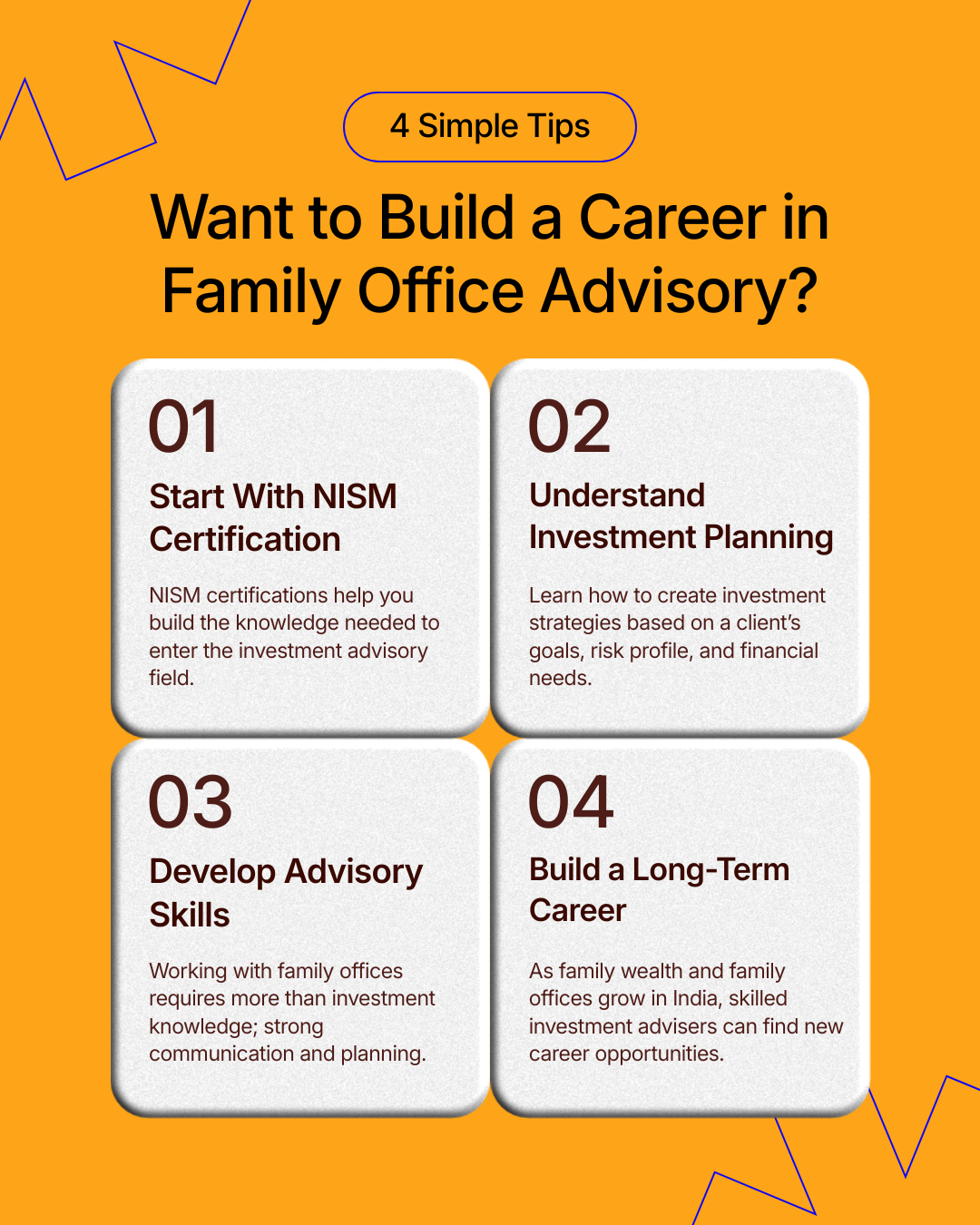
None of this work is legal to bill for without clearing SEBI's certification requirement. Under Regulation 7(2) of the SEBI (Investment Advisers) Regulations, 2013, anyone acting as a NISM investment advisor must pass both NISM-Series-X-A and NISM-Series-X-B. Miss one, and registration doesn't go through.
| Detail | X-A (Level 1) | X-B (Level 2) |
| Duration | 3 hours | 3 hours |
| Questions/marks | 135 questions, 150 marks (90 standalone + 9 caselets) | Weighted toward comprehensive advice, taxation, retirement, and estate planning |
| Passing score | 60% | 60% |
| Negative marking | 25% per wrong answer | 25% per wrong answer |
| Exam fee | ₹3,000 | ₹3,000 |
Mock Tests Matter More for X-B Than People Assume
X-A gets treated as the easier exam and X-B as an afterthought, which is a mistake. X-B's caselets carry 60 of the 150 marks, covering risk profiling and full case studies, exactly the skill that separates memorising definitions from constructing real advice. Test-prep providers now flag caselet practice as the biggest lever for improving an X-B score, since the theory portion is comparatively simple once the formulas are clear.
Registration: Where the Real Delay Happens
Clearing both exams makes someone eligible, not registered. Registration runs through BSE's Investment Adviser Administration and Supervisory Body portal, and it needs qualification proof, personal declarations, and a deposit filing before SEBI grants approval.
That deposit gets misdescribed often. It's refundable capital held with a bank as a lien, not a fee, and it should never be counted alongside actual exam or registration costs when budgeting for this path.
This Career Is Getting Institutional Backing
NISM has been building tie-ups with universities and market infrastructure institutions to embed its certification into formal academic programmes, rather than leaving X-A/X-B as a standalone exam. Regulators pushing a credential into mainstream education usually signal a career path built to last.
Industry events reflect the same shift. The 14th Indian Wealth Management Summit in 2026 brought together family office principals specifically to discuss scaling the advisory model, and Equalifi's Indian Family Office Summit ran sessions on "purpose-driven wealth," a theme barely discussed five years ago.
If the family office opportunity above sounds worth pursuing, the practical next step is clearing X-A and X-B with a structured plan. PSKA's Fellowship Year Investment Adviser Programme (FYIAEP) is built around this outcome, with placement guaranteed to candidates who clear both NISM exams and hit at least 50% of the Month 4 evaluation target, with no cap on candidates placed. On PSKA's own mock tests, candidates scoring 85 to 90% or higher have historically cleared NISM exams at a strong rate, a pattern PSKA extends by analogy to newer exams, not a guaranteed outcome for everyone.
For more on how this certification connects to registration and career scope, read SEBI Investment Advisor (IA) Certification Examination: Benefits & Career Scope.

Prof. Sheetal Kunder
NISM Series X-B tests deeper application through caselets on risk profiling and comprehensive advice. It isn't necessarily harder, but its caselet weighting demands more practice than memorisation.
Several test-prep platforms offer X-B-specific mock tests aligned to the caselet-heavy syllabus. Confirm that any mock test is updated for the current exam year before relying on it.
Registration is filed through BSE's Investment Adviser Administration and Supervisory Body portal, requiring proof of qualifications, personal declarations, and a refundable deposit held as a lien, not a fee.
NISM's FAQ page lists the X-A exam fee at 3,000 rupees, with X-B at the same level across recent fee tables. Always confirm against NISM's live portal since older sources sometimes show outdated numbers.
 Launch your Graphy