There are no items in your cart
Add More
Add More
| Item Details | Price | ||
|---|---|---|---|

Mon Dec 15, 2025
As a fellow mutual fund distributor in India, you know the NISM Series XIII exam is no ordinary certification-it’s a blend of equity, currency, and interest rate derivatives all in one paper. Most of us who stumble on the first attempt aren’t missing financial knowledge; it usually comes down to a handful of fixable prep mistakes. This guide is written with you in mind: I’ll help you spot where things went off track, show you exactly how to adjust your preparation, and share a smart exam-day approach that respects the 25% negative marking. Plus, you’ll get the real-world SIF insights you’ll need to confidently answer any HNI client who tests your expertise after you pass.
If your last attempt landed below 60%, the gap between that score and a pass is smaller and more fixable than it feels right now. The exam did not beat you. Your preparation method did, and it's something you can change.
Start by being honest about what went wrong. The NISM series XIII mock test free scores you saw at home, the topics you rushed, the questions you guessed on under pressure. All of it points to a specific, named error, and every one of those errors has a defined fix in this guide.
The 25% negative-marking rule is the one most people misread. Four wrong answers wipe out one correct answer. That single rule has to shape how you prepare from day one, not just how you behave for three hours on exam day.
Exam Parameter | Details |
Full name | NISM-Series-XIII: Common Derivatives Certification Examination |
Also known as | NISM XIII, NISM Series XIII, SIF Exam, SIF Examination NISM |
Number of questions | 150 |
Maximum marks | 150 (1 mark per question) |
Duration | 180 minutes (3 hours) |
Passing score | 60%, which is 90 out of 150 |
Negative marking | 25% per wrong answer |
Certificate validity | 3 years from the exam date |
Exam fee | Rs. 3,000 (payment gateway charges extra) |
Mode | Online, at NISM test centres |
Regulated by | SEBI / NISM |
You can easily download the official NISM Series XIII study materials from the website after you register. But here’s the truth: just reading the workbook won’t guarantee a pass if you’ve struggled before. It’s your approach-not more reading-that makes the difference.
Whenever SIFs come up, most conversations focus on the basics: minimum investment, new fund launches, or top-performing strategies. But as a distributor, what really matters is how these funds are changing the way Indian companies get reviewed-and this is the context your HNI clients care about. When you can explain this, you instantly set yourself apart.
India has never had a strong institutional culture of short selling. AIFs technically allow it, but the ₹1 crore minimum kept that world tiny. SIFs change the picture by bringing regulated short positions into a structure that qualified investors can actually access at ₹10 lakh. As the category scales, fund managers are building derivative-based short positions in individual stocks, including mid- and small-cap names that have been undercovered for years.
This is not a theory anymore. By April 2026, the SIF category had crossed roughly ₹12,255 crore in AUM across about 25 strategies from 14 fund houses, and the best performer, qSIF's Equity Ex-Top 100 Long-Short Fund, returned about 15.24% in a single month. ICICI Prudential's new iSIF Equity Long-Short Fund screens an investment universe of over 650 companies and can run unhedged short exposure of up to 25% of net assets. Even JioBlackRock has filed for its own Prism Hybrid Long-Short SIF.
The Ex-Top 100 funds matter most for the corporate-scrutiny story. They invest specifically in companies ranked below the top 100 by market cap, pushing institutional capital into segments that have leaned on retail money for liquidity. Weak earnings, poor capital allocation, or governance gaps that once slipped by can now attract institutional short interest from managers operating within a regulated framework. Over time, that sharpens how mid- and small-cap management teams behave and improves how risk is priced across the smaller end of the market.
When you’ve cleared the NISM Series XIII and your client asks about a SIF’s strategy, your genuine understanding - not just your certificate - will win their trust. That’s what makes you a real advisor.
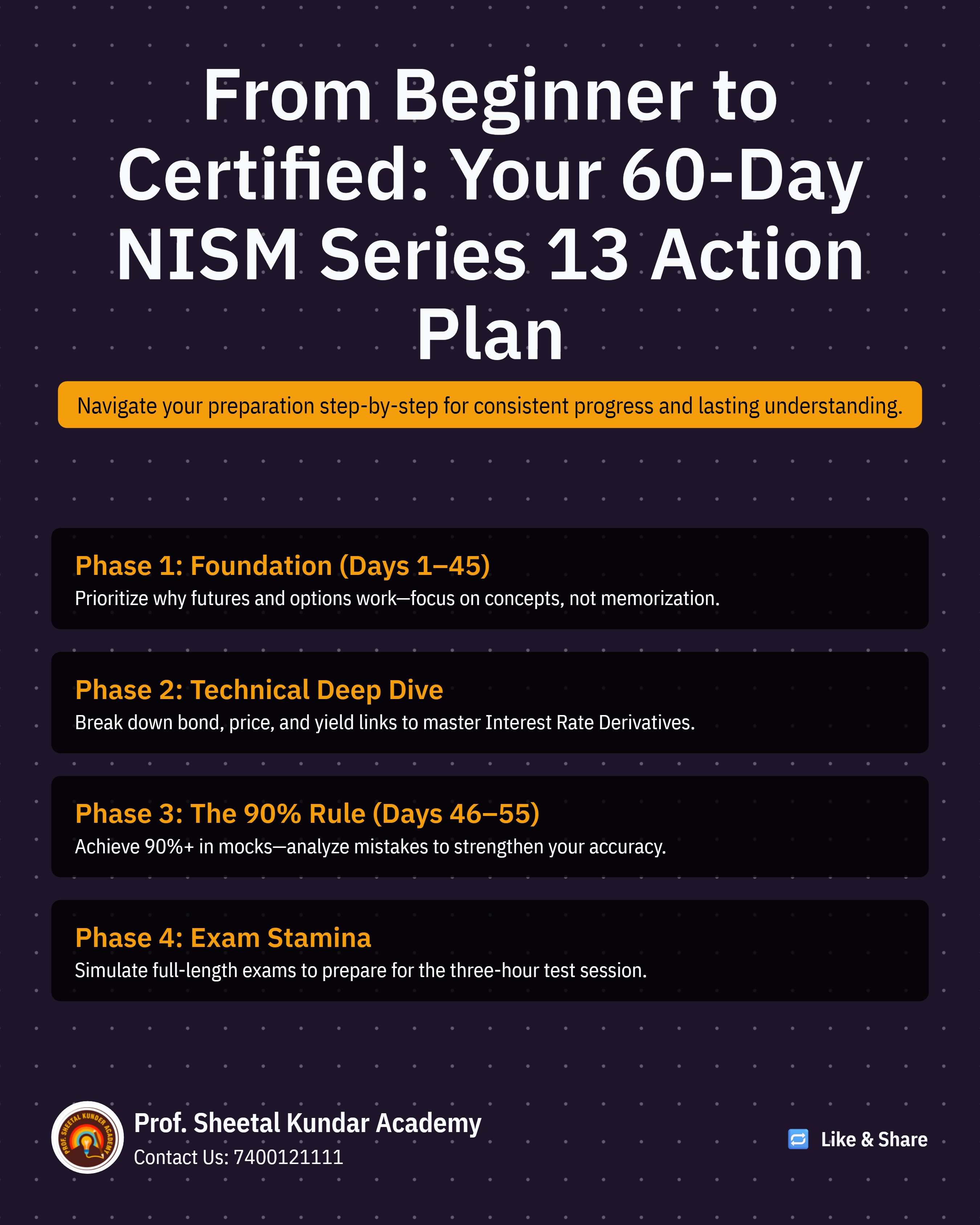
Treat the modules like building blocks: start with equity, then move to currency, and finally interest rate derivatives. Jumping around just makes things messy. Stick to the sequence and it all falls into place.
People who jump around find each topic looks clear on its own, then falls apart the moment a question blends two modules. The sequence is the structure. Drop it, and your knowledge stays disconnected.
The exam loves to twist concepts into new shapes. If you only memorise answers, you’ll get stuck when a question looks different. But if you really understand the concepts, you’ll stay calm - no matter how tricky the question is.
Memorisation hands you a false sense of readiness. You score well in self-study, then meet a reworded version of the same idea on exam day and freeze. Real understanding removes that risk completely.
A mock test does not build readiness. It measures readiness that already exists. Sit one before your concepts are clear, and the inflated score lies to you. On exam day, the questions feel foreign because the material was never understood at the depth the paper demands.
Think of mock tests as your temperature check-they show you how ready you are, not how to get ready.
Interest Rate Derivatives carries enough weight to sink an otherwise ready candidate. It is the module people spend the least time on, mostly because it is the least familiar.
Here’s the truth: Interest rate derivatives aren’t actually harder - they just feel new. Once you’re comfortable with equity, this part will start to make sense too.
Do not pick up where you stopped last time. Restart in this order.
Take your time. Finish one module before starting the next so everything connects and sticks.
For every concept, check that you can answer these three without looking at your notes:
If you can answer all three, you’re set. If not, no stress - just review the basics. That’s how everyone learns.
Only attempt a mock after a module is fully clear. After every test:
Don’t speed through mock tests. The real learning happens when you review your mistakes - that’s your goldmine for improvement.
Do not book the slot until your NISM Series XIII mock test scores are between 85% and 90% under timed conditions. Your last attempt already showed you what an underprepared attempt produces. This benchmark stops a repeat.
PSKA students get 25+ full-length mock tests with worked explanations for every question, calibrated to match the real exam's difficulty.
If you’re ready to turn things around, join us. We’ll help you rebuild your prep on a strong foundation, right from the start.
Most second-attempt failures are strategy failures, not knowledge failures. Here is how the paper splits.
Question difficulty | Share of paper | Approx. questions |
Very easy | 20% | ~30 |
Moderate | 60% | ~90 |
Hard | 20% | ~30 |
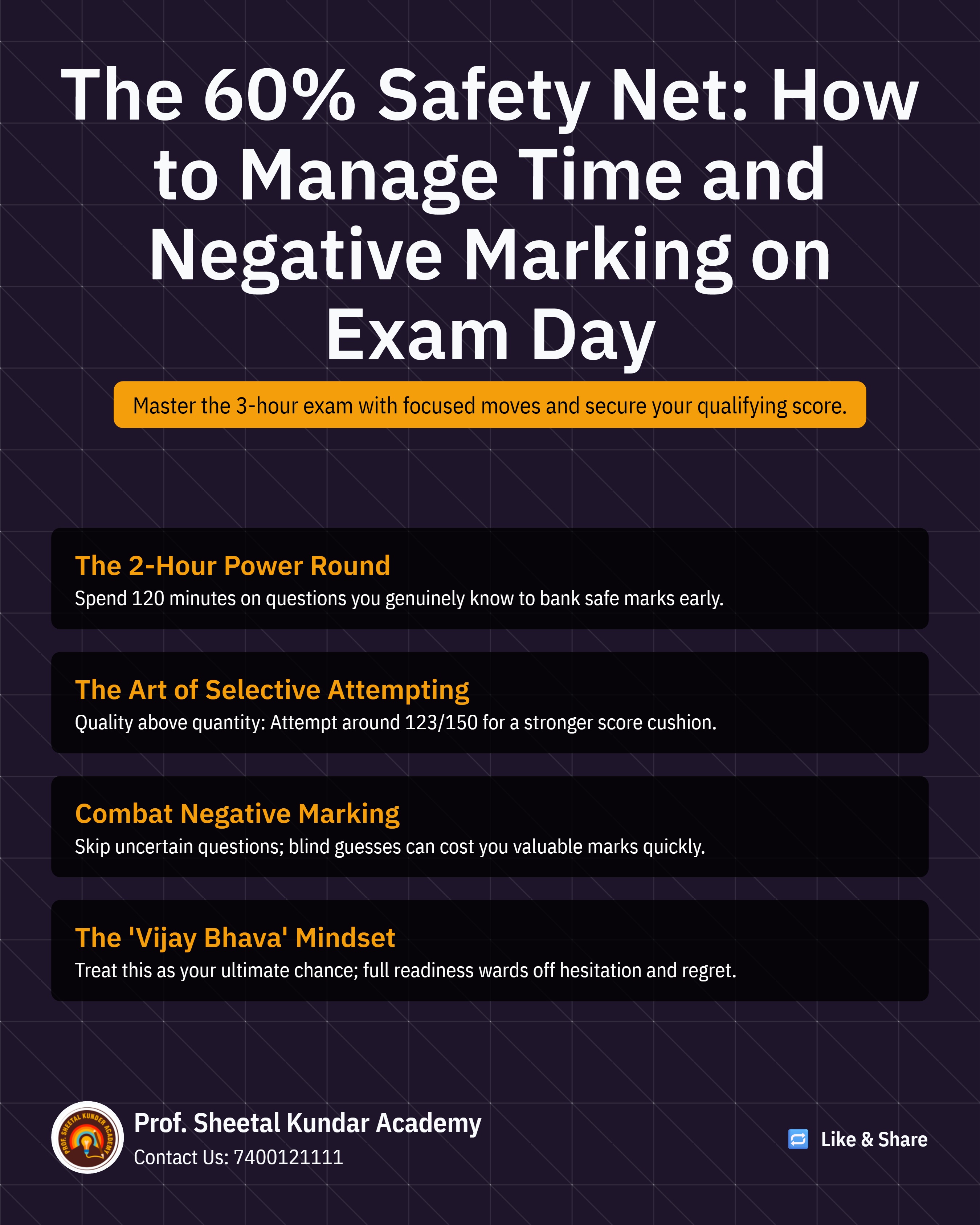
Don’t fall into the trap of tackling the hardest 20% first and wasting valuable time. If negative marking hurt your score last time, try attempting fewer questions but with higher accuracy.
Let’s say you attempt 115 questions, get 98 right, and 17 wrong - you’ll still score well above the pass mark. The lesson? Stay calm and focus on accuracy, not on answering every single question.
Before you rebook the slot, confirm every line:
Why PSKA Works for Second-Attempt CandidatesMost people who join us for a second attempt already know finance. The real problem is that their prep was scattered and nobody pointed out where the gaps were. That’s exactly what our course is designed to fix.

Prof. Sheetal Kunder
They are the same certification. NISM Series XIII Common Derivatives is the mandatory qualification for distributing Specialised Investment Funds (SIF) products in India, as mandated by SEBI.
ICICI Prudential, SBI Mutual Fund, Mirae Asset, Nippon India, and HDFC Mutual Fund have already launched SIF products. The category crossed thousands of crores in AUM within months of launch.
NISM prescribes a waiting period between attempts. That period should be used to rebuild preparation from the beginning with a corrected approach, not to review the same material in the same way.
The derivative logic is the same. The difference is context - Interest Rate Derivatives operates in the bond and debt markets, which most candidates have less prior exposure to. Once the equity foundation is clear, this module becomes structured and learnable.
For every wrong answer, 0.25 marks are deducted. Four wrong answers cancel one correct answer. This is why selectively attempting with high accuracy consistently outperforms attempting all 150 questions.
No. Interest Rate Derivatives carries enough question weight to push a borderline candidate below 60%. Skimming or avoiding this module is the leading cause of second- and third-attempt failures.
Consistently scoring 85-90% on full-time PSKA mock tests is a reliable indicator of readiness before rebooking the exam.
The exam format and difficulty remain as set by NISM. What has changed is the stakes- with SIF distribution now requiring this certification, the professional consequences of not clearing it are significantly higher than before.
30 to 50 days is sufficient when preparation follows the correct sequence. Rushing into a reattempt without correcting the original preparation error produces the same result.
Yes. PSKA's programme adviser can review your previous attempt details and build a preparation plan targeting the specific gaps that caused your result, rather than a generic restart.
 Launch your Graphy