There are no items in your cart
Add More
Add More
| Item Details | Price | ||
|---|---|---|---|

Fri Aug 28, 2026
This guide covers the exact exam pattern, which chapters carry more weight, a six-resource study plan, the Mark for Review strategy for pacing, and the mock-test score (45-46 out of 50) that signals you're ready to book. It also briefly covers NISM V-D, the newer certification for distributors who also want to sell SIFs.
Note: NISM V-A tests memory, not maths, and passing on your first attempt comes down to organizing theory into something you can recall accurately, not to raw difficulty.
NISM-Series-V-A is the Mutual Fund Distributors exam. NISM runs it, the institute SEBI set up to decide knowledge standards for India's securities markets.
Passing NISM Series V-A is a prerequisite for obtaining an AMFI Registration Number (ARN). Eligible candidates must then complete the AMFI registration process before engaging in mutual fund distribution, the AMFI Registration Number you need to legally sell mutual funds in India. Many AMC staff who deal directly with sales and distribution need it too.
The way the exam is built tells you how to prepare for it. As one trainer says, this exam tests your memory, not your maths.
You need to recall things correctly and quickly: fund rules, product features, tax rules, and how to look after investors. All of that, in a two-hour sitting.
This table tells you a few things about how to sit the exam:
Based on the training material used for this guide, these areas deserve additional revision attention.
The NISM V-A workbook has twelve chapters. It covers mutual fund structure, legal and regulatory rules, scheme types, NAV and expenses, taxation, investor services, and return and risk.
Not all chapters carry equal weight. These four get more questions than the rest:
Legal structure comes first because later chapters build on it, so a weak grip here creates problems throughout the exam. Taxation is one area candidates commonly find challenging, and the training material suggests it can account for a significant share of questions.
Taxation isn't actually hard to understand, it just feels that way because the exam draws on the same small pool of question types again and again, and candidates who skip mock tests often freeze when a familiar idea shows up worded a little differently.
Note: Taxation isn't a knowledge gap, it's a practice gap. More mock tests help more than rereading the chapter.
A well-run NISM V-A prep track layers six resources, and knowing what each one is actually for matters more than grinding through all of them equally.
Short notes work as a shortcut only if you back them up with mock tests and your own one-liners. Skip straight to mock tests without any baseline reading, and you'll recognize right answers without knowing why they're right, which falls apart the moment a question is worded differently.
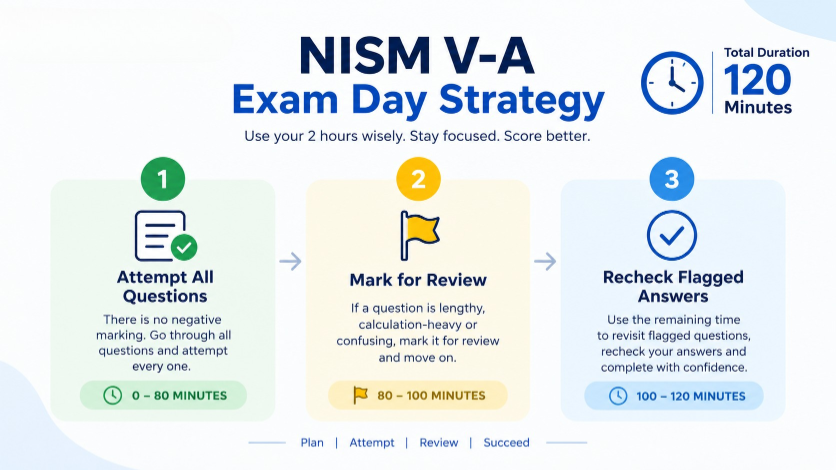
There's no negative marking on this 100-question paper, so most prepared candidates finish in 50 to 60 minutes. That leaves you real time for a proper pacing strategy, not just a race against the clock.
Use the Mark for Review function on the exam screen. It works in three simple steps:
This one habit prevents the biggest time-management mistake: burning eight minutes on one hard question that could have been four easy ones elsewhere.
Attempt the official NISM practice test before your exam date. It gets you used to the real screen layout, and trainers note that some practice-test questions tend to reappear in the actual exam.
NISM's own MFD mock test, scored out of 50 across 50 questions, is the clearest readiness signal trainers use.
A typical progression looks like this: a first attempt lands around 38-40, mostly lost on taxation and legal structure. After two more attempts, focused on the weak chapters plus a fresh set of one-liners, the score climbs into the mid-forties. That climb, not the first score, tells you whether you're ready.
The rule of thumb: once you're consistently scoring 45 or 46 out of 50, you're ready to book the real exam. If a question repeats on retake, that's expected, since the exam draws from a similar question pool.
Before booking, run through this checklist:
If all four are true, additional weeks of study rarely move the needle. Waiting too long can actually cost you sharpness on chapters you covered early. If you're still building that foundation, our NISM V-A course covers all six resources in one structured track.
Three mistakes come up repeatedly among NISM V-A candidates:
One logistics point worth knowing: NISM allows one reschedule per booking, and you must request it at least four days before your exam date. Inside that window, rescheduling is no longer possible.
If you feel underprepared as the date nears, use the reschedule window. It beats sitting an exam you're likely to fail and losing both the fee and the attempt. Confirm the current fee and process on the NISM portal when you book, since it can change.
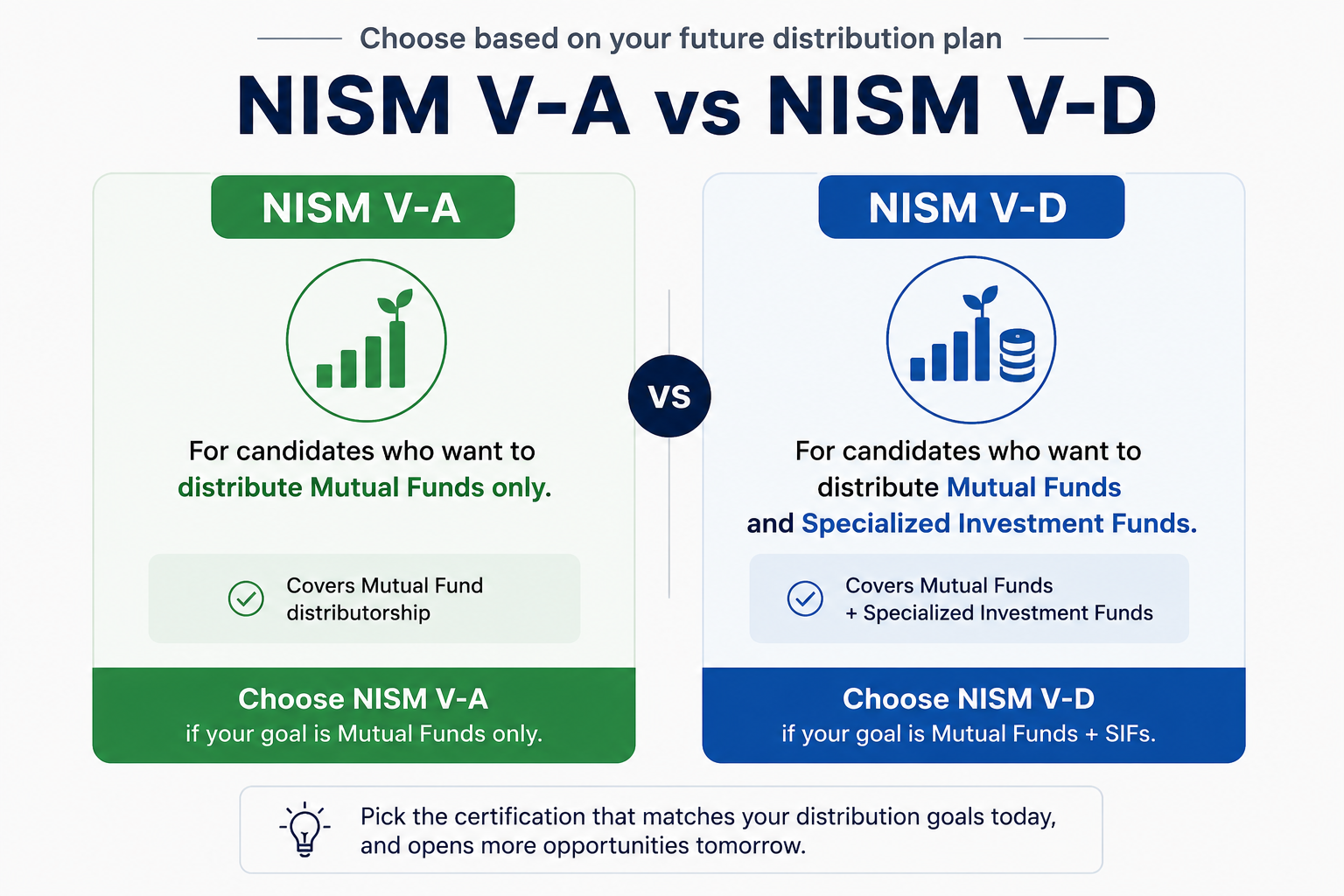
NISM launched a new certification, NISM-Series-V-D: Mutual Fund - Specialized Investment Fund Distributors Certification Examination, effective 22 July 2026.
It lets mutual fund distributors also distribute Specialized Investment Funds, a category SEBI positioned as a middle ground between regular mutual funds and portfolio management services, without requiring the tougher NISM Series XIII derivatives exam that was previously the only route in.
Candidates exploring this option can check a NISM V-D mock test to see how the pattern compares to V-A.
The V-D equivalence and syllabus details are from industry trackers reporting on AMFI's circular, not AMFI's original text directly, so confirm current specifics on NISM's and AMFI's own pages before publishing this as settled fact.
The honest answer to "is NISM V-A hard" is that the exam format is genuinely forgiving and the content volume is genuinely demanding, and both things are true at once. Fifty percent to pass with no negative marking means every attempted question is a free swing.
The real preparation problem is organizing twelve chapters of theory into something you can recall accurately under time pressure, and that's a study-sequencing problem, not a difficulty problem.
If you're an aspiring MFD working through this right now, the concrete next step is simple: don't wait for a feeling of readiness, track it.
Run the NISM mock test this week and measure your score against the 45-46 out of 50 benchmark rather than a vague sense of confidence. Once you're consistently there, book the exam, use Mark for Review deliberately, and trust that the format is working in your favor.
If SIF distribution is on your radar too, it's worth a look at NISM V-D before you finalize your certification plan, but don't let that decision slow down the V-A preparation you're already deep into.

Prof. Sheetal Kunder
SEBI® Research Analyst. Registration No. INH000013800 M.Com, M.Phil, B.Ed, PGDFM, Teaching Diploma (in Accounting & Finance) from Cambridge International Examination, UK. Various NISM Certification Holders. Ex-BSE Institute Faculty. 18 years of extensive experience in Accounting & Finance. Faculty Development Programs and Management Development Programs at the PAN India level to create awareness about the emerging trends in the Indian Capital Market, and counsel hundreds of students in career choices in the finance area.
No. There's no negative marking, so attempt every question even if you're unsure. A wrong answer costs the same as a blank one, nothing, so guessing is always worth it here.
You need 50%, which means 50 marks out of 100. Each question is worth one mark, so it's just a straight count of correct answers.
100 questions, one mark each, 2 hours (120 minutes) total. Most prepared candidates finish in 50 to 60 minutes.
Yes, most centres allow it. The numerical questions (NAV, CAGR, turnover ratio, Sharpe or Treynor ratio) are simple enough for a basic calculator. Confirm the exact device policy when you book.
You get one reschedule per booking. Request it at least four days before your exam date, since rescheduling isn't possible inside that four-day window.
Scoring 45 or 46 out of 50 consistently on NISM's own MFD mock test is the usual benchmark for being exam-ready.
Taxation, usually worth 15-20 questions. It's not conceptually hard, the question pool just repeats, so mock tests help more than re-reading.
A flag on the exam screen to tag a question and move on. Attempt everything on your first pass, flag anything slow, then revisit only the flagged ones with remaining time.
NISM V-D, launched in July 2026, is built on the same core mutual fund distribution syllabus as V-A with an added lighter derivatives module, and reportedly satisfies the V-A requirement on its own. If SIF distribution is a firm goal, it's worth confirming current equivalence rules with NISM and AMFI before deciding which one to sit.
The certificate is valid for three years from your test date and can be renewed through Continuing Professional Education (CPE) rather than resitting the full exam, though you should confirm current renewal requirements on NISM's site closer to your renewal date.
 Launch your Graphy