There are no items in your cart
Add More
Add More
| Item Details | Price | ||
|---|---|---|---|

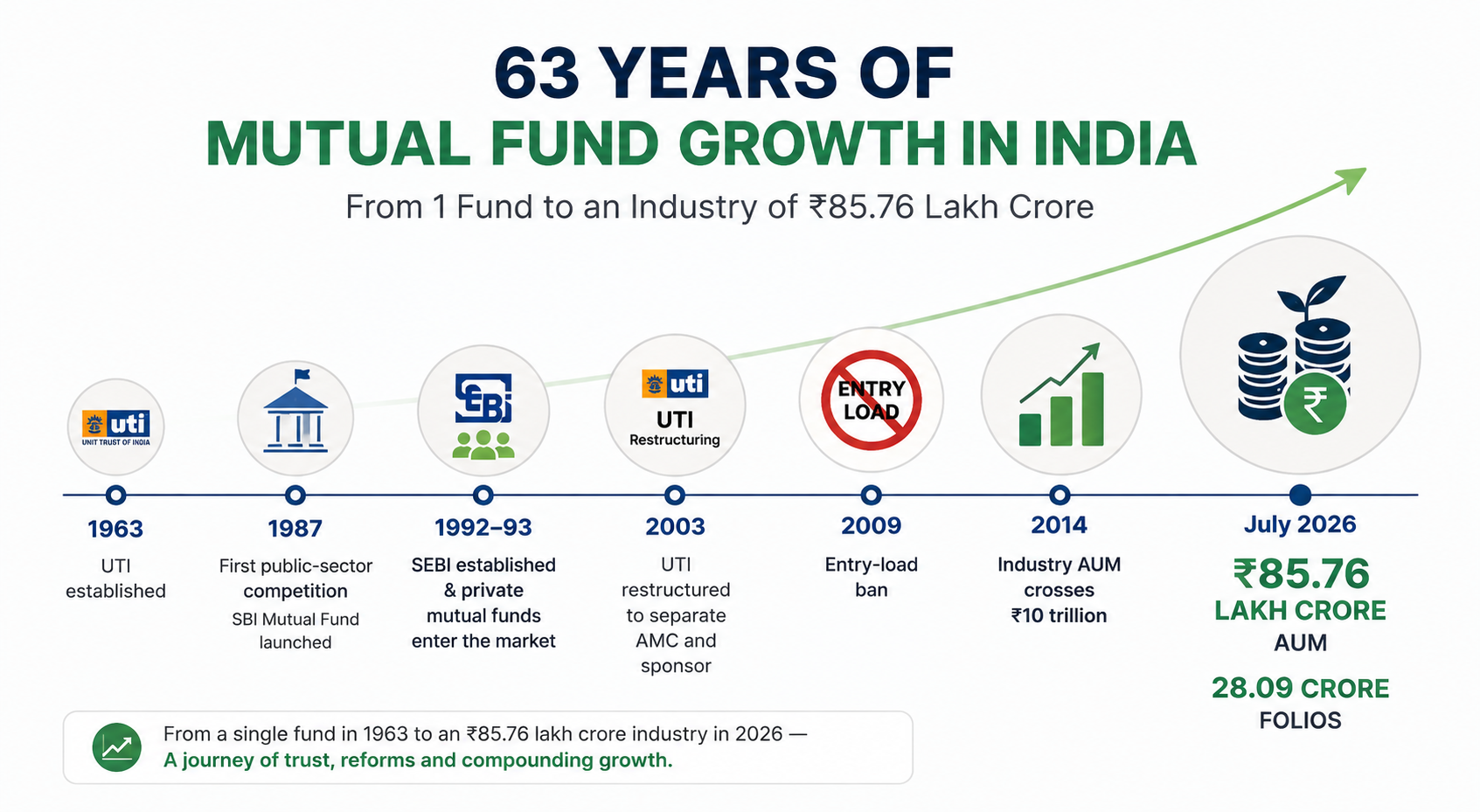
In 1963, India had exactly one mutual fund. Sixty-three years later, in July 2026, that single fund has grown into an industry managing ₹85.76 lakh crore across 28.09 crore investor folios. The road between those two points was anything but straight, running through.
A public-sector monopoly, a regulatory overhaul, a global crisis, a slow recovery, and finally a boom that hasn't let up since.
The industry grew from one UTI scheme in 1964 to ₹85.76 lakh crore in AUM and 28.09 crore folios by July 2026.
Three moments shaped this growth: SEBI's creation in 1992 (opened the market to private players), the 2009 entry-load ban (fixed a real conflict of interest, at a real short-term cost), and the sustained expansion from 2014 onward, which sped up further after the pandemic.
The Unit Trust of India, or UTI, was set up by an Act of Parliament in 1963, becoming India's first mutual fund and, for over two decades, the only one.
For roughly 24 years, from 1963 to 1987, UTI was not just the biggest mutual fund in India. It was the only one.
The one-fund monopoly ended in 1987. Public sector banks and insurers started launching their own mutual funds, one after another:
Even with new competitors, UTI stayed dominant. This was still a fully public-sector industry, no private players existed yet.
This period's biggest change wasn't a new fund launch, it was a new regulator, and that single shift did more to shape the industry's future than any single scheme or institution that had come before it.
Everything that followed, private players entering, capital flowing in, investors gaining real protection, traced back to this one decision.
In under a decade, the industry went from one government-run fund to a regulated market with private players, foreign sponsors and a real rulebook. SEBI's 1996 regulations, more than any single scheme, are what made that possible.
By early 2003, the industry had grown well beyond its UTI-only roots, but UTI itself still cast a long shadow over everyone else in the market.
This decade ended UTI's special status for good. Once the government split it up in 2003, every fund in India, old or new, had to play by the same rules.
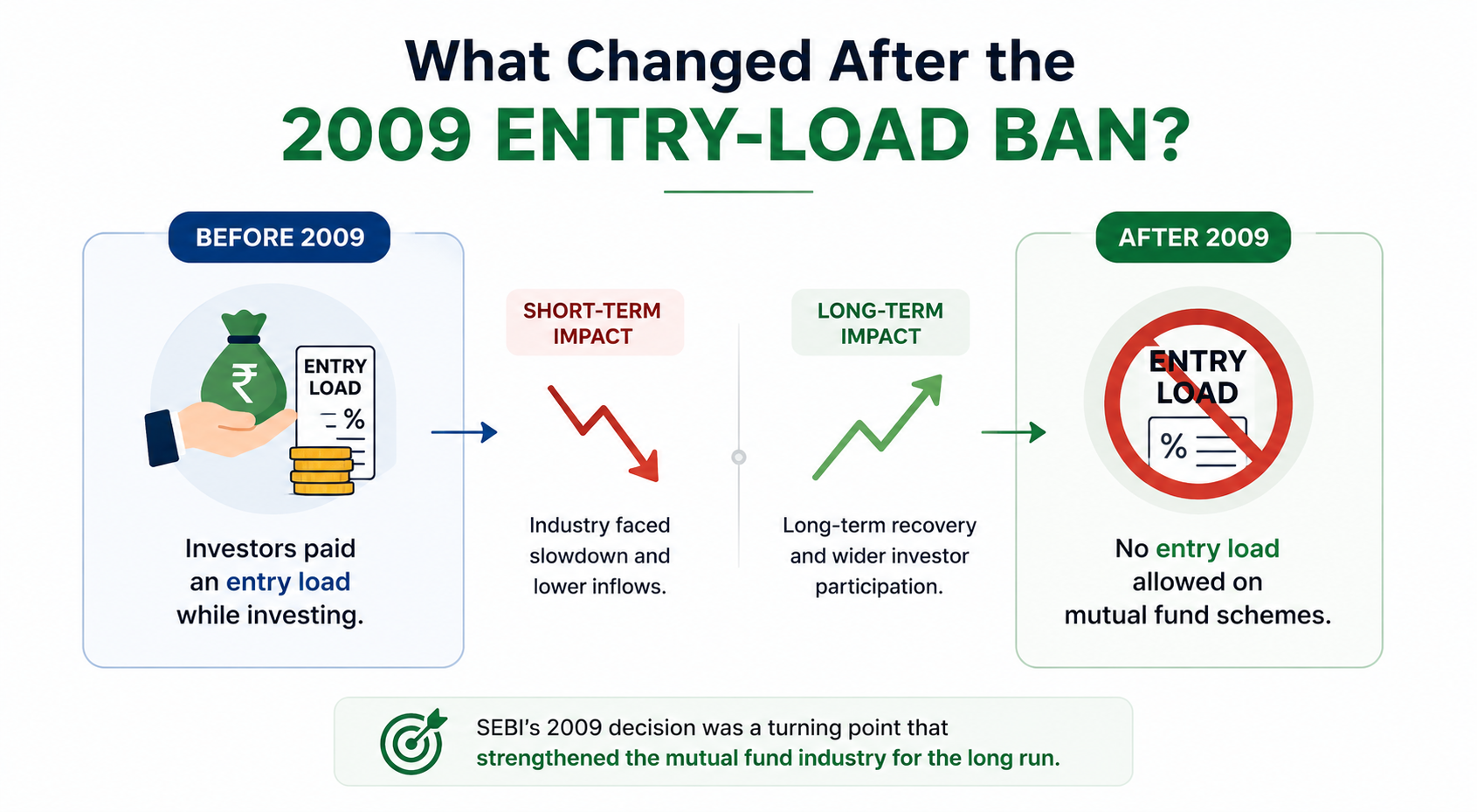
Two things hit the industry at the same time in 2009, and only one of them was bad news in the long run.
The entry load ban fixed a real problem, distributor incentives that didn't always match investor interest. But the timing hurt. With the crisis already squeezing the industry, growth stayed slow from 2010 to 2013.
SEBI followed up in September 2012 with reforms meant to re-energize the industry and push further into Tier II and Tier III cities, markets the industry had mostly ignored until then.
The recovery that started in May 2014 turned out to be the real thing, not a short bounce.
The 2014 recovery didn't just hold, it grew straight through a global pandemic. That says a lot about how much deeper and steadier the investor base had become compared to 2009.
By July 2021, the industry had already crossed ₹35.32 trillion in AUM, with folios past 10.55 crore for the first time.
Then came five years unlike anything that had come before, and the shift didn't start in the markets at all, it started at home, during a period when a lot of Indian households were forced to sit down and think seriously about money for the first time in years.
For millions of people, investing stopped being something they got around to occasionally and turned into something they did every single month without fail, almost as routine as paying a bill.
That change in behaviour, more than any single policy or product launch, is what carried the industry through its fastest stretch of growth ever.
AUM went from ₹35.32 trillion to ₹85.76 trillion in that five-year window, folios climbed from 10.55 crore to 28.09 crore, and through it all, the industry kept adding close to 29.23 lakh new folios every single month, year after year, without any real slowdown along the way.
Digital investing platforms are everywhere now, yet distributors haven't become any less important, for two clear reasons.
Distributors still earn their place by reaching towns digital platforms haven't and by keeping investors calm and invested when markets get rough.
The Indian mutual fund industry grew from a single UTI scheme in 1963 to ₹85.76 lakh crore in AUM and 28.09 crore folios by July 2026.
Three shifts drove that growth, SEBI's creation in 1992 opened the market to private players, the 2009 entry-load ban corrected a real conflict of interest at genuine short-term cost, and sustained expansion since 2014, which accelerated after the pandemic, reflects more Indians treating investing as a routine habit rather than an occasional decision.
For NISM candidates and distribution professionals, the takeaway is that correction and growth aren't opposites.
The entry-load ban slowed AUM growth for years, yet the industry that emerged kept expanding through a pandemic, supported by distributors maintaining reach in smaller towns.
Past growth doesn't guarantee what's next, but the six-decade trend has pointed toward wider participation.

Prof. Sheetal Kunder
SEBI® Research Analyst. Registration No. INH000013800 M.Com, M.Phil, B.Ed, PGDFM, Teaching Diploma (in Accounting & Finance) from Cambridge International Examination, UK. Various NISM Certification Holders. Ex-BSE Institute Faculty. 18 years of extensive experience in Accounting & Finance. Faculty Development Programs and Management Development Programs at the PAN India level to create awareness about the emerging trends in the Indian Capital Market, and counsel hundreds of students in career choices in the finance area.
UTI was established by an Act of Parliament in 1963, India's first mutual fund institution. It launched its first scheme, Unit Scheme 1964, the following year.
Kothari Pioneer, registered in July 1993, was India's first private-sector mutual fund. It followed SEBI's first mutual fund regulations, issued that same year.
SEBI was established in 1992 to protect investors and regulate the securities market. It issued the first mutual fund regulations in 1993, then replaced them with the SEBI (Mutual Funds) Regulations, 1996, which still governs the industry today.
A comprehensive regulatory framework that replaced SEBI's original 1993 rules, covering fund structure, disclosure, and investor protection. It remains the backbone of mutual fund regulation in India, over two decades later.
The UTI Act, 1963 was repealed in February 2003. UTI split into two entities: SUUTI and UTI Mutual Fund. UTI Mutual Fund now operates as a regular SEBI-regulated fund like any other player.
To fix a structural conflict of interest in how distributors were paid. The timing coincided with the global financial crisis, which added short-term pain, but it's widely seen as a necessary long-term correction.
As of 31 July 2026, industry AUM stood at ₹85.76 lakh crore, per AMFI data. This number changes monthly, check AMFI's site for the latest figure.
28.09 crore as of 31 July 2026, up from 10.55 crore in July 2021, roughly 29.23 lakh new folios added every month over that stretch.
Yes. Much of the industry's growth since 2014 depended on investors staying invested through downturns rather than redeeming in panic, and distributors, especially in smaller towns where digital-only platforms have limited reach, played a real role in that discipline.
 Launch your Graphy