There are no items in your cart
Add More
Add More
| Item Details | Price | ||
|---|---|---|---|

Fri May 15, 2026
NISM Series XXV-A study material starts with the official NISM workbook, available as a free PDF download. This guide covers where to get it, chapter weightage, free resources, study schedules, and common mistakes that make candidates fail.
The free download is the starting point for every candidate. If you would rather follow a plan that already sequences the workbook, notes, and mock tests, you can follow a session-mapped NISM XXV-A course instead of building one yourself. This guide covers what actually works and what you can skip.
Table of Contents
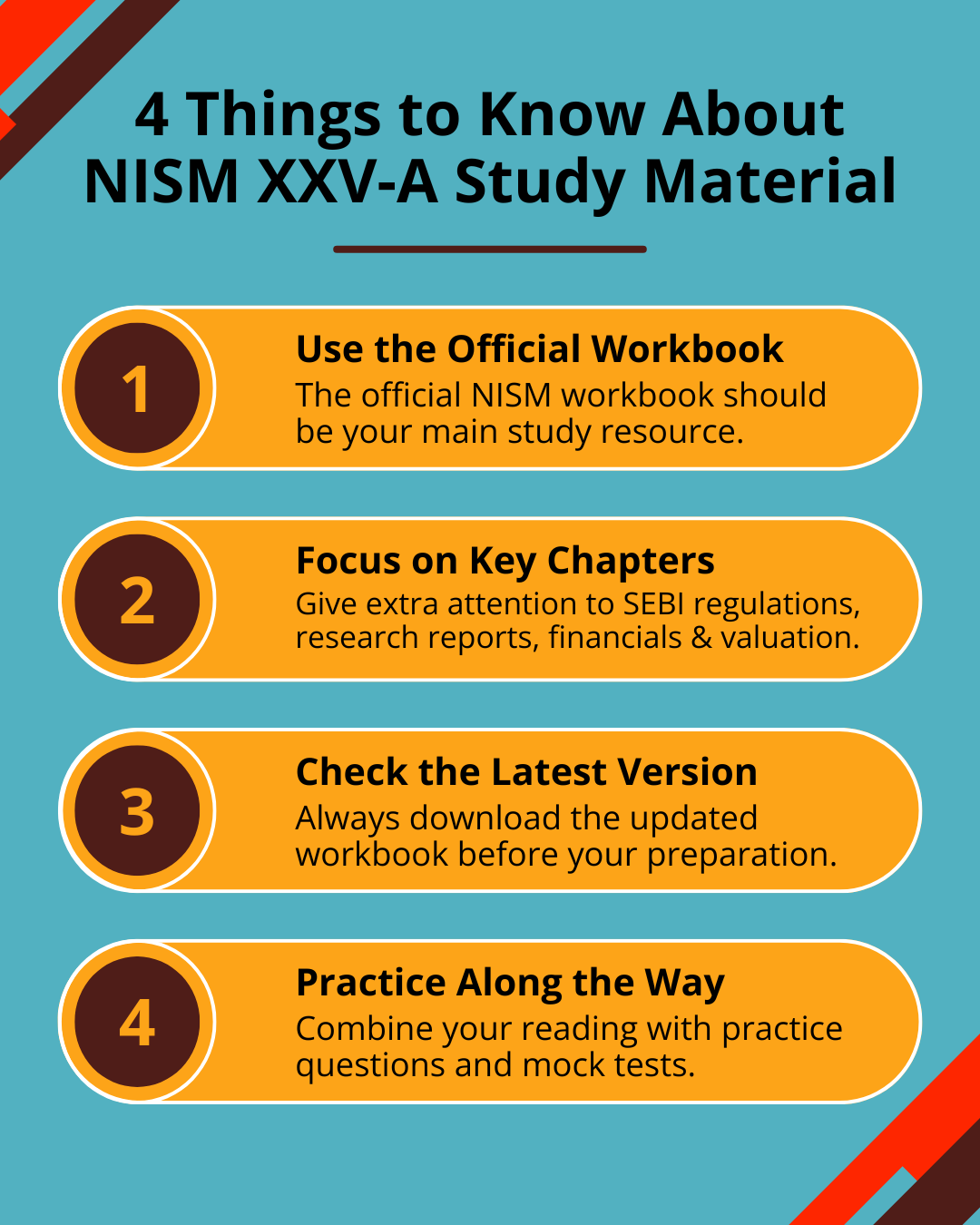
The NISM Series XXV-A official workbook is the only resource guaranteed to be exam-relevant. Every question in the paper is drawn from this document, and everything else is supplementary.
NISM provides the workbook as a free PDF download on its official website. You do not need to pay for it, create an account on any third-party site, or buy it from a reseller.
Follow these steps to download it:
Step | What You Need To Do |
1 | Go to nism.ac.in and open the Certification Examinations section |
2 | Select “NISM-Series-XXV-A: Persons Associated with Research Services” from the exam list |
3 | Scroll down to find the Study Material or Workbook area on that exam page |
4 | Click the free PDF download link and save the workbook to your device |
5 | Check the version date printed on the cover or listed on the portal before starting your preparation |
A print version is also available for purchase through the NISM portal if you prefer a physical book. The printed workbook has the same content as the PDF, so the choice is simply about the reading format.
Before you start studying, check the version date printed on the cover page or listed on the portal. NISM revises workbooks when the regulatory framework changes. If the version on the portal is newer than the copy you already have, download that updated version and use it as your base. Preparing from an outdated workbook is one of the most avoidable reasons candidates fail on their first attempt.
The workbook covers all six chapters of the NISM-Series-XXV-A curriculum. At a high level, these are:
Financial statement basics and key ratios
Each chapter is broken into multiple sub-sections, and not all of them carry the same weight in the exam. Some sub-topics are concept-heavy but low-weightage, while others look straightforward but appear frequently in questions.
A practical way to approach the workbook structure is:
Reading the workbook cover to cover is not the most efficient way to prepare. The chapters are not equally weighted, and spending equal time on a chapter worth 5% of the paper and one worth 30% is a misallocation that shows up in your mock scores.
Chapters to study first and spend the most time on:
Research Report Standards chapter
Chapters to study next:
Financials and Valuation chapters
The final chapter to study last:
As you build notes chapter by chapter, keep a one-page overview for each chapter that becomes your quick revision sheet closer to the exam. This prevents you from getting lost in bulky notes when you need a fast refresh.
Beyond the official workbook, a few additional documents genuinely help with NISM XXV-A preparation. All are free and publicly available.
SEBI circulars on Research Analyst compliance
NISM Securities Markets module
Useful if you have not taken NISM Series V-A or VIII
Reinforces the market basics tested in the securities markets chapter
What to avoid:
Use them only as a cross-check, never as your primary source. If a third-party note contradicts the official workbook or SEBI regulations, trust the official version.
Video resources work well for the securities markets and valuation chapters because these are conceptual areas where seeing something explained is often faster than reading. They are less useful for the regulatory chapters, which require close reading of legal language rather than passive listening.
How to use video resources effectively:
If you notice a video deviating from the wording in the current workbook or regulations, treat the workbook as your reference standard and adjust your notes accordingly.
The right preparation route depends on your background, timeline, and comfort with regulatory content.
Self-study works well if:
Coaching adds value if:
If you decide to join a coaching programme, choose one that:
Is designed specifically for NISM XXV-A, not rebranded NISM 10A or generic advisory content
Uses the current official workbook version as its base
Includes chapter-wise practice sets and full mocks, not just lectures
Coaching should give you structure and clarity. It should not replace the workbook entirely, since the exam is still based on the official text.
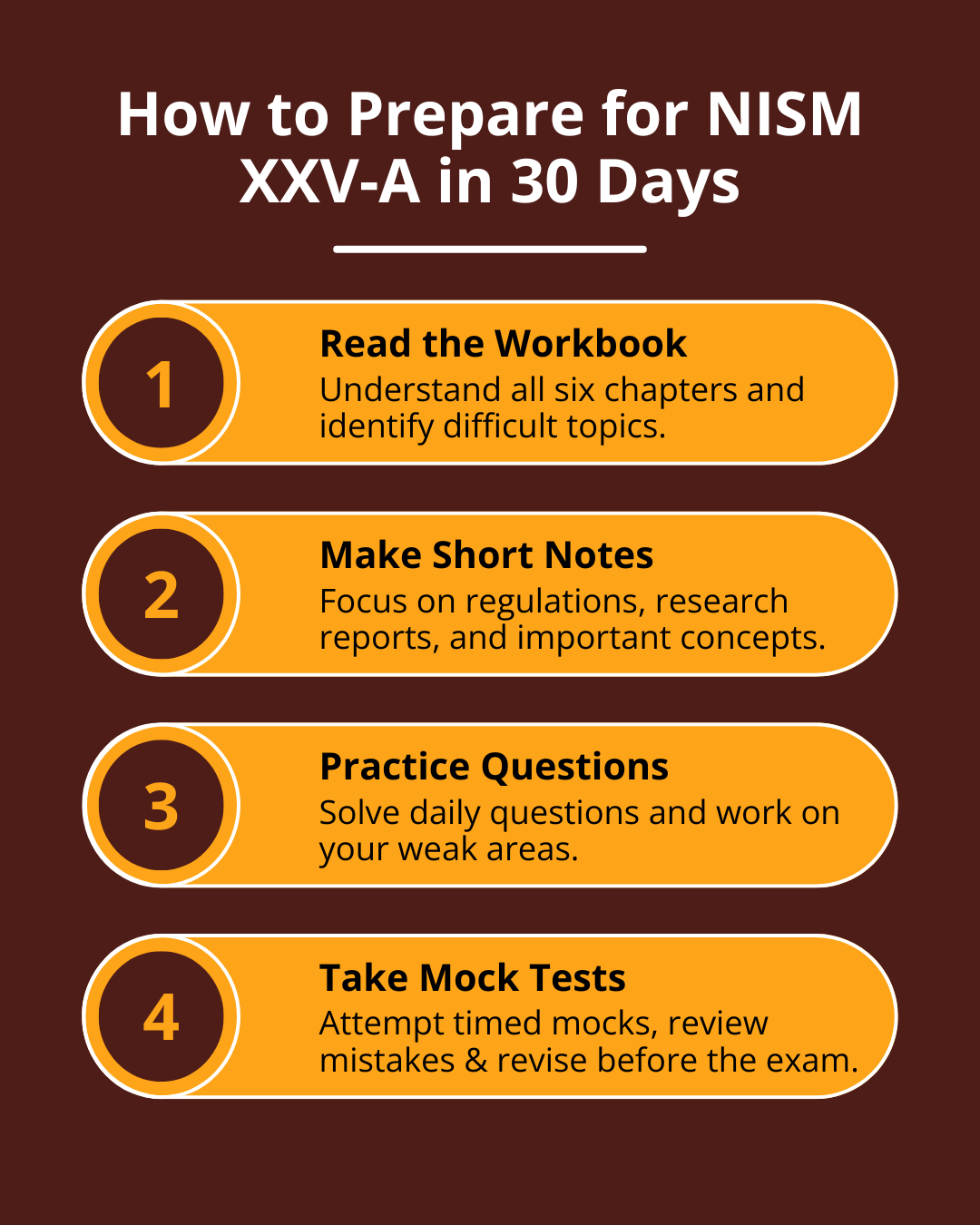
This schedule assumes one to two hours of study per day and targets a first-attempt pass with a score of 65 to 70%.
Week 1: Workbook familiarisation
Week 2: Deep dive into core chapters
Week 3: Supporting chapters and practice
Week 4: Mock tests and revision
This plan keeps heavy reading in the first two weeks and shifts to application and testing in the second half, when most candidates begin to see real improvement.
This plan is for candidates with existing finance knowledge or a tight deadline. A minimum of two hours per day is required.
Days 1 to 4: High-impact reading
Days 5 to 8: Condensed notes and short tests
Days 9 to 12: Full mocks and error logging
Take full 50-question timed mocks every alternate day
Days 13 to 15: Focused revision and final check
This shorter plan leans heavily on practice questions to convert familiarity into recall quickly.
If you have only one week before your exam and no prior preparation, the goal shifts from a comfortable margin to a realistic first attempt.
Day 1: Workbook scan
Day 2: Core notes
Day 3: Targeted practice
Day 4: Supporting chapters
Review securities markets flashcards
Write out ratio formulas and one simple valuation example
Day 5: Full mock
Day 6: Fixes and second mock
Day 7: Light revision and rest
This crash plan is not ideal, but it is far better than going in cold with only a workbook read.
These are the mistakes that separate candidates who pass the first time from those who sit twice:
Avoiding these mistakes alone lifts your odds of a first-attempt pass significantly.
The official NISM workbook remains the only book you strictly need, since the exam is drawn directly from it. If you want additional reference material:
The SEBI (Research Analysts) Regulations, 2014 document is a free companion text for compliance chapters
SEBI circulars on research analyst conduct provide real-world examples and clarifications
A basic securities markets handbook can help if you are completely new to markets, but it should stay secondary to the workbook
You do not need to build a library. A focused set of official documents beats several generic books.
The official NISM XXV-A study material is the only resource you truly need to clear this exam, and everything else on this page is there to help you use it more efficiently. Download the current workbook version, prioritize the regulatory and research report chapters, and build your mock test practice into the middle of your preparation rather than the final few days. Candidates who follow that order consistently score higher than those who simply read the workbook once and hope it sticks. With a structured plan, focused notes, and timely mock tests, NISM XXV-A becomes a manageable certification rather than a source of last-minute stress.

Prof. Sheetal Kunder
SEBI® Research Analyst. Registration No. INH000013800 M.Com, M.Phil, B.Ed, PGDFM, Teaching Diploma (in Accounting & Finance) from Cambridge International Examination, UK. Various NISM Certification Holders. Ex-BSE Institute Faculty. 18 years of extensive experience in Accounting & Finance. Faculty Development Programs and Management Development Programs at the PAN India level to create awareness about the emerging trends in the Indian Capital Market, and counsel hundreds of students in career choices in the finance area
Q1. Where can I download the NISM XXV-A study material PDF for free?
The official NISM XXV-A study material is available free on the NISM certification portal at nism.ac.in. Go to Certification Examinations, select NISM-Series-XXV-A, and download the workbook PDF directly. No payment or third-party registration is required.
Q2. Is the NISM 25A workbook the same as NISM XXV-A study material?
Yes. NISM 25A and NISM XXV-A refer to the same certification, Persons Associated with Research Services. The official workbook is identical regardless of which short form you use.
Q3. How many chapters does the NISM XXV-A study material cover?
The workbook covers six chapters spanning securities markets, SEBI Research Analyst Regulations, research report standards, financials, valuation, and professional conduct. The regulatory and research report chapters carry the highest weightage.
Q4. Are free PDF notes on Telegram reliable for NISM XXV-A preparation?
Not always. Many third-party PDFs circulating on Telegram and WhatsApp are based on outdated workbook versions or contain factual errors. Always cross-check any third-party material against the current official workbook before relying on it.
Q5. Should I prepare with videos or the workbook for NISM XXV-A?
Use videos to build initial understanding of conceptual chapters like securities markets and valuation, then move to the workbook for depth. Videos work poorly for the regulatory chapters, which need close reading rather than passive viewing.
Q6. How long does it take to prepare using the NISM XXV-A study material?
Most candidates need two to six weeks depending on their background. A finance background with prior NISM exposure can manage a 15-day plan, while candidates from a non-finance background typically need the full 30-day schedule.
Q7. Do I need to buy any books for NISM XXV-A apart from the workbook?
No. The official workbook is the only material the exam is drawn from. The SEBI Research Analyst Regulations document is a free companion resource, not a paid book you need to buy.
Q8. What is the biggest mistake candidates make with NISM XXV-A study material?
Preparing from an outdated workbook version or unverified third-party notes is the most common and avoidable mistake. Always check the version date on the official workbook before starting your preparation.
 Launch your Graphy