This guide breaks down every chapter of the NISM Series 25A syllabus for 2026, topic by topic, with mark weightage, what actually gets tested, and a study time allocation plan so you know exactly where to focus your hours.
NISM 25A Syllabus: Quick OverviewThe NISM 25A syllabus covers six domains, built around the SEBI Research Analyst Regulations 2014 and the official NISM Series XXV-A curriculum. All 50 exam questions are drawn from these six domains. This is not the Investment Adviser syllabus. There is no financial planning, tax planning, or wealth management content here. If you have been preparing with Investment Adviser materials by mistake, stop and restart with the correct NISM-XXV-A workbook.
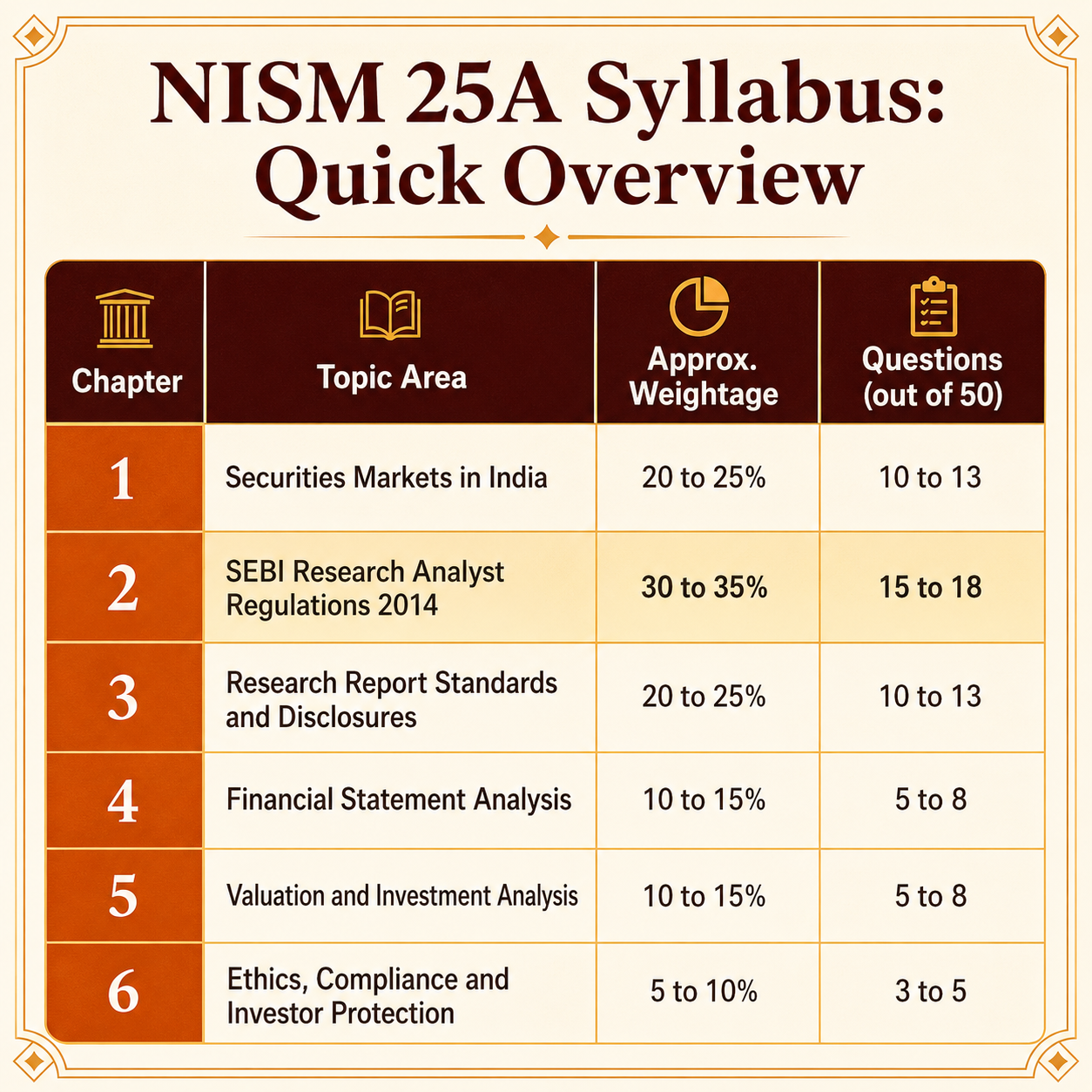
Chapters 2 and 3 together account for 50-60% of the paper. If preparation time is limited, prioritise these two above everything else. A candidate who masters Chapters 2 and 3 and covers Chapter 1 thoroughly has a strong shot at passing even with lighter coverage of the remaining three.
Chapter 1: Securities Markets in India
Weightage: 20 to 25% | Estimated questions: 10 to 13
This chapter builds the foundational market knowledge that all the regulatory chapters assume you already have. Candidates from non-finance backgrounds find this the most unfamiliar chapter and should budget more preparation time here than the weightage alone suggests. The concepts in this chapter are referenced implicitly throughout Chapters 2, 3, and 5, so a weak foundation here creates compounding gaps later.
Market Structure and Key Participants
Regulators and their mandates: SEBI oversees capital markets; RBI governs banking and monetary policy; IRDAI regulates insurance; PFRDA oversees pension funds. Questions frequently test the boundary between SEBI's jurisdiction and that of other regulators.
Market participants: brokers, sub-brokers, depositories, custodians, clearing corporations, and their respective roles in the settlement process
Stock exchanges: NSE and BSE, their roles, listing requirements, and regulatory obligations under SEBI
Market Infrastructure Institutions (MIIs): what they are, why they are systemically important, and how SEBI oversees them
Types of Securities and Market Operations
Equity shares: ordinary shares, preference shares, rights issues, bonus issues
Debt instruments: government securities (G-Secs, T-Bills), corporate bonds, debentures, commercial paper, certificates of deposit
Hybrid instruments: convertible bonds and preference shares that carry equity features
Derivatives: futures and options — basic concepts only, not quantitative valuation
IPO process: book building method, price band, allotment mechanics, grey market
Secondary market trading: order types, price discovery, settlement cycles under T+1
Depositories: NSDL and CDSL, dematerialisation process, beneficial ownership records
Mutual Funds and Other Collective Vehicles
Types of mutual fund schemes: equity, debt, hybrid, index funds, fund of funds, ETFs
NAV calculation: how it is derived, what causes it to change, and how it differs from the market price for ETFs
Regulatory framework:
SEBI's role in mutual fund oversight, AMFI's role in distributor registration, and LODR basics
SEBI's regulatory jurisdiction is tested in multiple-choice formats, in which one or two of the options involve another regulator. T+1 settlement and depository mechanics appear in three to four questions per paper. Know the distinctions between NSDL and CDSL, and between a depository and a depository participant, before moving on.
Chapter 2: SEBI Research Analyst Regulations 2014
Weightage: 30 to 35% | Estimated questions: 15 to 18
This is the most important chapter in the NISM 25A syllabus, and it is where the most preparation effort yields the highest return. PARS who know this chapter thoroughly have effectively secured a passing score before they open Chapters 4 and 5. The exam was introduced specifically to ensure that people in research services roles at RA firms understand these regulations. Expect this chapter to be tested with depth, not just surface definitions.
Read the actual SEBI (Research Analysts) Regulations, 2014 from sebi.gov.in alongside the workbook for this chapter. Questions use exact regulatory phrasing. Relying only on the workbook summary means missing nuances that change the correct answer.
Who Is a Research Analyst and Who Is PARS
Definition of a Research Analyst under SEBI RA Regulations: the specific criteria that qualify someone as an RA
Individual RA registration versus RA entity registration: different categories, different requirements
Definition of PARS (Persons Associated with Research Services): who qualifies, what roles are covered
The RA versus PARS distinction: This is one of the most consistently tested areas in the entire exam
Registration, Obligations, and Renewals
- Eligibility requirements for RA registration: academic qualifications, experience years, and net worth thresholds
- Registration application process: required documents, SEBI portal submission, and approval timeline
- Post-registration obligations: maintaining a compliance programme, record-keeping for a minimum period, periodic reporting to SEBI
- Conditions for suspension and cancellation of registration
- Certificate renewal: timelines, fee requirements, and what triggers a fresh registration versus a renewal
Code of Conduct and Prohibited Activities
General obligations applicable to all Research Analysts: independence, objectivity, diligence, and fair dealing with all clients
- Specific obligations for PARS: disclosure requirements, record-keeping standards, restrictions on handling client information
- Prohibited activities for Research Analysts: what constitutes a code of conduct violation at the RA level
- Prohibited activities specific to PARS: a separate and narrower set of restrictions
- Scenario questions will describe an action by either an RA or a PARS and ask whether it constitutes a violation. The answer depends on which role is involved.
Disclosure Requirements
- Conflict of interest disclosures: personal securities holdings, firm-level holdings in covered companies, third-party compensation arrangements
- Issuer relationship disclosures: mandatory when the company being covered is also a paying client of the RA firm
- Mandatory statements in research reports: the specific disclosures that must appear in every published report, their required placement, and minimum content
- Communication disclosures: what must be disclosed when research is communicated verbally to clients, not just in writing
Conflict-of-interest and disclosure requirements generate four to six questions per sitting. Prohibited activity questions are almost always scenario-based and often hinge on one detail in the situation description. The RA versus PARS distinction alone can be worth three to four marks if you know it precisely.
Chapter 3: Research Report Standards and Disclosures
Weightage: 20 to 25% | Estimated questions: 10 to 13
Chapter 3 is the applied counterpart to Chapter 2. Where Chapter 2 governs the people producing research, Chapter 3 governs the output itself. Questions here test whether you understand what a compliant research report must contain, how it can be distributed, what trading restrictions apply around it, and what happens when coverage changes.
Components of a Compliant Research Report
Analyst certification: the specific language an analyst must include and what it certifies
Conflict of interest statement: format, content, and placement requirements
- Ratings definitions: what each rating means must be defined and applied consistently across all reports by the same firm
- Historical price targets: Prior recommendations on the same security over a defined lookback period must be disclosed
- Time horizon: every price target must carry an explicit time horizon so clients understand the investment period assumed
Front-Running and Personal Trading Restrictions
Front-running definition: trading in a security ahead of publishing a research report or recommendation on that security, for personal gain
- SEBI's prohibition: both Research Analysts and PARS are prohibited from front-running under the RA Regulations
- Personal trading cooling-off periods: the period before and after report publication during which PARS cannot trade in the covered security
- Firm-level trading restrictions: limitations on the RA firm itself taking positions in securities it is actively covering through research
Distribution, Communication, and Fair Disclosure
- Selective disclosure rules: when research can be shared with select clients before broader distribution, and under what conditions this is or is not permitted
- Fair disclosure principle: ensuring all clients have equal access to research output at the same time
- Verbal and digital communication rules: restrictions on how research calls, ratings, and targets can be shared beyond the formal written report
- Social media restrictions: specific rules on what PARS and Research Analysts can post or share publicly about covered securities
Research Coverage Decisions
- Initiating coverage: obligations when beginning formal research coverage of a new security
- Dropping coverage: disclosure obligations when an RA firm stops covering a security
- Upgrade and downgrade rules: what must be communicated, to whom, and within what timeframe when a rating changes
Front-running scenarios appear in almost every paper and often involve a violation that is subtle rather than obvious. Mandatory research report components are tested in a direct, factual way. Distribution and fair disclosure questions generate three to four marks per sitting.
Chapter 4: Financial Statement Analysis
Weightage: 10 to 15% | Estimated questions: 5 to 8
This chapter tests financial literacy at the level that a PARS needs to understand and communicate research output. No complex modelling required. Questions are split between factual recall, formula application, and short scenario-based analysis. Candidates from non-finance backgrounds typically drop the most marks here and should not underestimate this chapter just because the weightage is lower.
Reading the Three Financial Statements
- P&L statement: revenue, cost of goods sold, gross profit, EBITDA, depreciation, EBIT, finance costs, PBT, tax, PAT
- Balance sheet: fixed assets, current assets, current liabilities, long-term debt, reserves and surplus, share capital
- Cash flow statement: operating cash flow, investing cash flow, financing cash flow, and free cash flow derivation
- Why profit and cash flow diverge: accrual accounting, capital expenditure, working capital changes
Key Financial Ratios
- Profitability: Net Profit Margin, EBITDA Margin, Return on Equity (ROE), Return on Capital Employed (ROCE)
- Valuation: Price to Earnings (P/E), Price to Book (P/B), Enterprise Value to EBITDA (EV/EBITDA)
Liquidity: Current Ratio, Quick Ratio
- Leverage: Debt to Equity ratio, Interest Coverage Ratio
- Earnings Quality and Red Flags
- Accrual earnings versus cash earnings: why cash-backed profits are higher quality
- One-time items: how to identify and exclude them when assessing normalised profitability
- Revenue recognition: what aggressive recognition looks like versus conservative approaches
- Financial statement red flags: persistent profit-cash flow divergence, receivables growing faster than revenue, repeated large write-offs, changes in auditors or qualified audit reports
Ratio calculations appear in two to three questions per paper. Know the formulas without hesitation. Balance sheet versus P&L classification errors are very common for non-finance candidates. Red-flag questions are scenario-based and reward careful reading over calculation.
Chapter 5: Valuation and Investment Analysis
Weightage: 10 to 15% | Estimated questions: 5 to 8
This chapter covers how Research Analysts arrive at price targets and buy or sell recommendations. Questions are conceptual throughout. You are not expected to build or calculate a full DCF model, but you must understand what drives the output, where models are sensitive, and which valuation method applies to which type of company.
DCF Valuation Concepts
Core concept: the intrinsic value of a company equals the present value of all future free cash flows discounted back at the appropriate rate
- Key inputs: free cash flow projections, weighted average cost of capital (WACC) as the discount rate, and terminal value representing the value beyond the forecast period
- Model sensitivity: small changes in WACC or terminal growth rate produce disproportionately large swings in the final valuation output
- Limitations of DCF: the model is only as reliable as its assumptions; it is highly sensitive to inputs that are themselves uncertain
Relative Valuation and Sector Approaches
- P/E multiple: price paid per rupee of earnings; most useful for companies with stable, positive earnings
- EV/EBITDA: preferred for capital-intensive or leveraged companies where earnings are affected by depreciation and interest
- P/B multiple: most relevant for financial companies like banks and NBFCs, where book value is the most meaningful anchor
- How relative valuation works in practice: comparing a company to sector peers and to its own historical average multiples
- Sector-specific valuation: banks use NIM and asset quality metrics; consumer companies use revenue growth and margin trends; infrastructure companies use asset-based approaches
- Buy, Hold, Sell ratings: what each means, how they must be defined in every report, and what disclosures accompany a rating change
- Fundamental versus technical analysis: why Research Analysts use fundamental analysis and what SEBI requires regarding the stated basis of any investment recommendation.
Chapter 6: Ethics, Compliance, and Investor Protection
Weightage: 5 to 10% | Estimated questions: 3 to 5
The lowest-weightage chapter, but also the most scenario-heavy. Every question in this chapter describes a real-world situation and asks whether the action is permissible, prohibited, or required under SEBI regulations. Do not rush through these questions. The right answer almost always depends on one specific detail in the scenario.
Insider Trading and UPSI
UPSI definition: Unpublished Price Sensitive Information is any information related to a company that is not publicly available and that, if published, would materially affect the price of its securities. Examples include upcoming earnings, mergers, regulatory orders, and key management changes.
Who is an insider: persons connected to the company by employment or through a business relationship, and persons deemed to be insiders because they have received UPSI
- Trading restrictions: insiders and PARS in possession of UPSI cannot trade in those securities until the information becomes public
- Consequences: civil penalties, disgorgement of profits, and criminal prosecution under SEBI regulations
Investor Protection and Compliance Structures
- Fair dealing obligation: PARS must communicate research accurately and completely and must not create misleading impressions about the quality or basis of a recommendation
- Prohibition on misrepresentation: overstating conviction, understating risks, or presenting a recommendation as more certain than the underlying analysis supports
- Client grievance handling: The SEBI SCORES portal is the primary mechanism for investor complaint redressal
- Whistleblowing framework: SEBI's internal whistleblower protections at RA firms
- Internal compliance structures: the compliance officer's role, audit trails, and record-keeping obligations at the firm level
Insider trading questions focus on identifying whether a specific situation involves UPSI and whether a trading restriction applies. Ethics scenario questions test practical judgment, not definition recall. Read every answer option in full before selecting.
NISM 25A Chapter Weightage Table
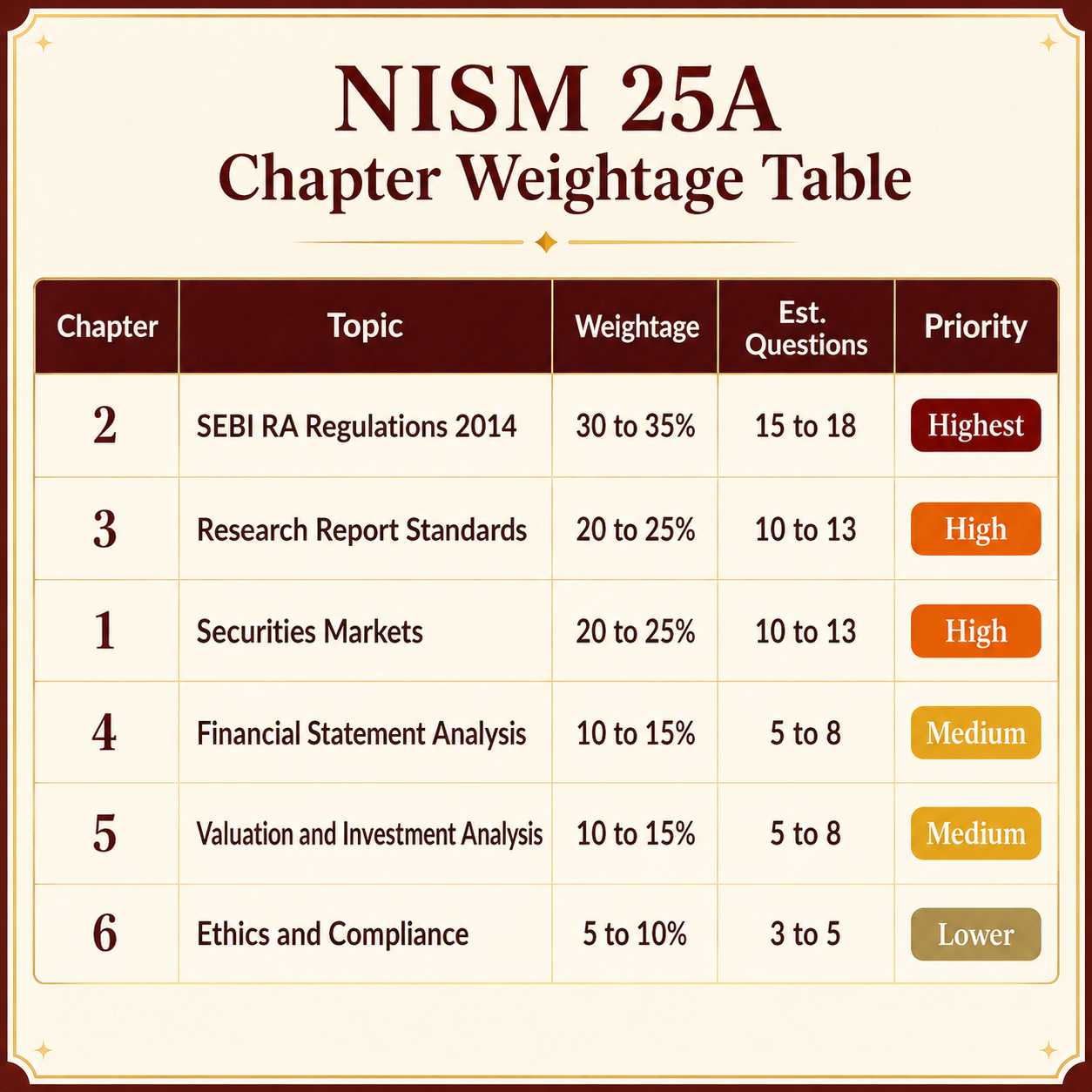
The top three chapters account for 70 to 85% of the paper. Scoring 70% across Chapters 1, 2, and 3 and 50% across the remaining three is enough to pass with a comfortable margin.
How to Study Each Chapter: Time Allocation Guide
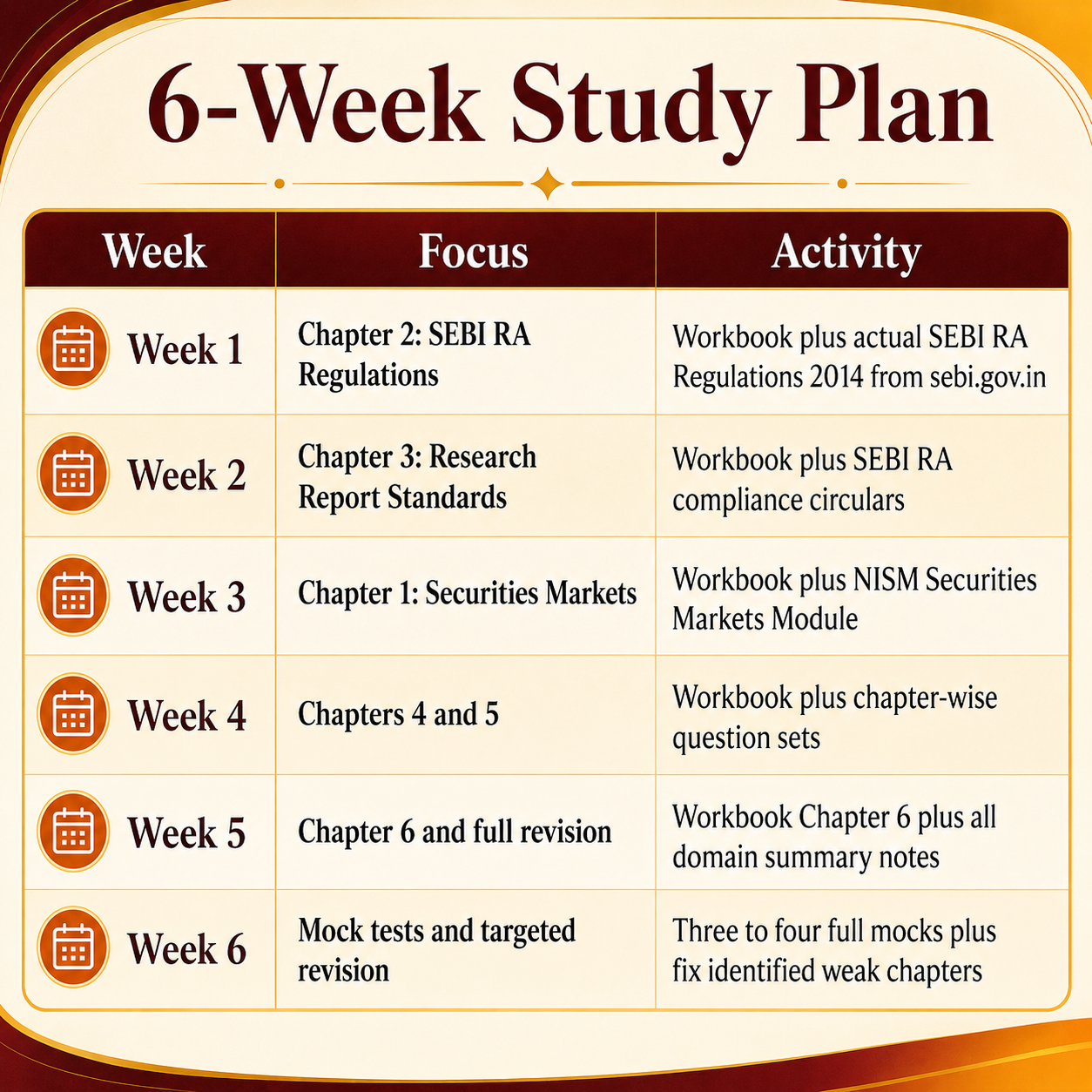
The most common preparation mistake is spending equal time on every chapter. This is a 60-minute, 50-question exam with no negative marking. How you allocate study time matters more than raw hours invested.
6-Week Study Plan
Chapter-Specific Tips
Chapter 2: Do not rely only on the workbook summary. The actual SEBI RA Regulations 2014 are available free on sebi.gov.in. Read the relevant sections directly - the regulatory language appears verbatim in exam questions.
Chapter 3: Build a one-page checklist of everything a compliant research report must contain. Format-based recall works better than re-reading paragraphs for this chapter.
Chapter 1: Use flashcards for definitions, regulatory jurisdiction distinctions, and settlement mechanics. This chapter has the highest density of pure recall questions.
Chapters 4 and 5: Practice every ratio formula until it is automatic. Two to three wrong answers on formula-based questions from these chapters is the difference between passing and failing for borderline candidates.
Chapter 6: Read every scenario option fully and slowly. The correct answer almost always turns on one specific word or phrase in the description.
For a curated list of books, PDFs, and online resources for each chapter ranked by exam relevance, the
NISM 25A study material guide covers everything worth your time and filters out what is not.
Once you finish a chapter, test yourself on it before moving to the next. The
NISM 25A mock test gives you a chapter-wise performance report that shows exactly where you stand after each section, not just overall.
Free NISM 25A Syllabus PDF Download
NISM makes the official Series 25A workbook available as a free PDF on its website. Every exam question comes from this document. It is the single most important resource for preparation.
Download the official workbook at:
nism.ac.inHow to Find It on the Portal
- Go to nism.ac.in
- Click "Certification Examinations"
- Select "NISM-Series-XXV-A" from the exam list
- Scroll to the workbook section and download the PDF
The print version is also available for purchase through the portal. PDF and print are identical in content. Always check the version date on the cover page. NISM updates workbooks periodically, and preparing from an outdated version is one of the most avoidable mistakes a candidate can make.


 Launch your Graphy