There are no items in your cart
Add More
Add More
| Item Details | Price | ||
|---|---|---|---|

Fri Oct 9, 2026
Is explaining a report to a client the same as giving your own investment opinion? Can diversification reduce every type of market risk? And what should you do if a research report mentions an expected return but leaves out the time period?
Preparing for NISM Series 25-A requires more than memorising answers. You need to understand the logic behind them.
This blog breaks down the 10 practice questions discussed in the video. For each question, we explain the correct answer, why it is appropriate, and how to distinguish it from similar-looking options.
Based on student feedback, the video highlights two possible preparation gaps:
At work, you may know how to handle a situation practically. In an exam, however, you must identify the most appropriate answer among closely worded options.
For example, 'communicating better with a client' and 'influencing a client’s decision' may sound similar. But their purposes are different. Recognising that distinction is an important part of preparation.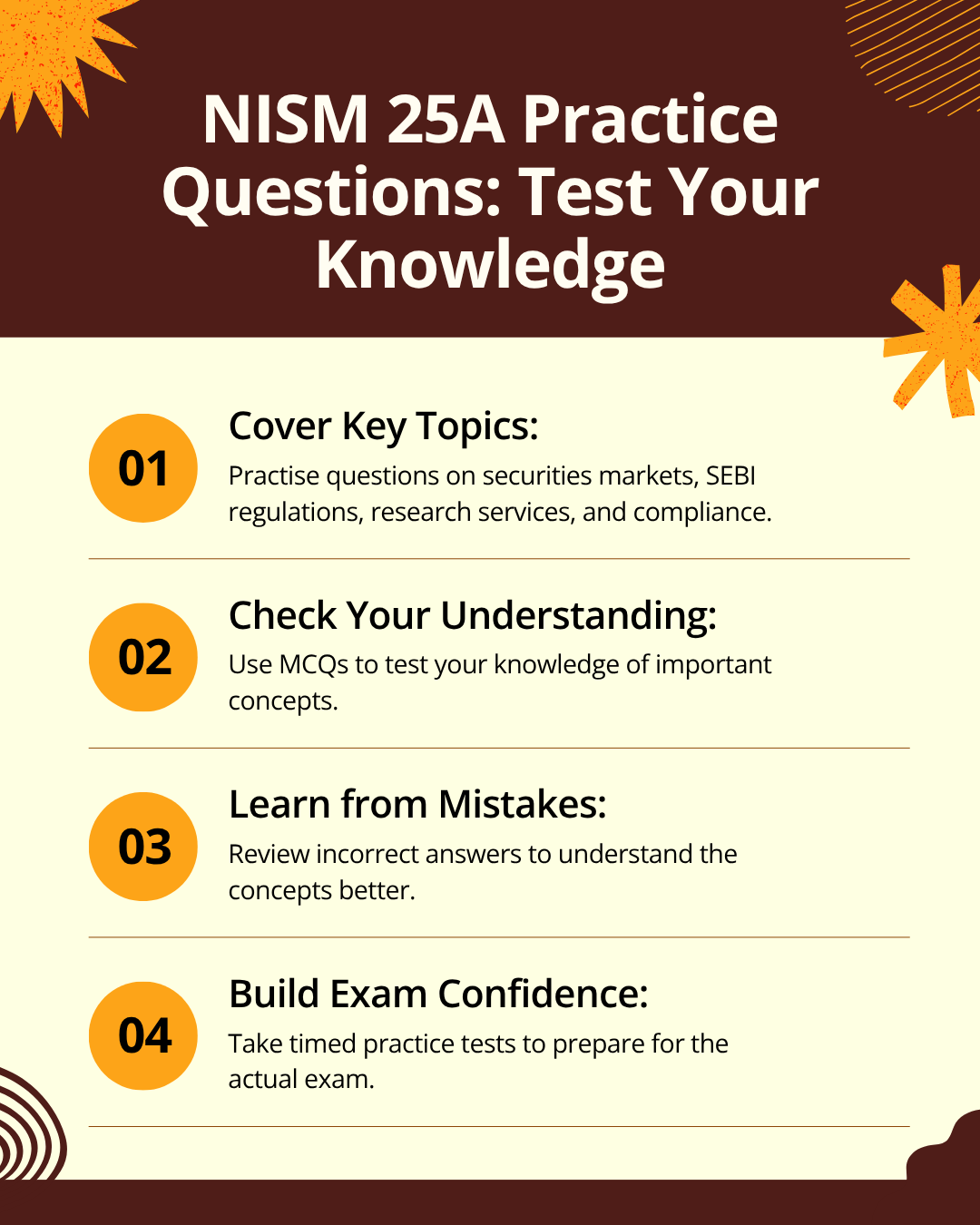
A conflict of interest arises when:
The central issue in a conflict of interest is not market movement or client disagreement. It arises when personal interests may influence the objectivity or independence of research.
For example, if an analyst has a personal financial interest connected to the company they are analysing, it may raise concerns about the neutrality of their research.
Look for a potential conflict between personal benefit and independent research. Do not confuse market volatility or a difference of opinion with a conflict of interest.
Understanding behavioural biases helps persons associated with research services to:
Emotions such as fear, greed, and overconfidence can affect a client’s investment-related behaviour.
The video gives an example of an investor who wants to sell their investment immediately after a 20% market decline. Understanding the client’s emotional reaction can help make communication more relevant and balanced.
The objective is not to promise a guaranteed recovery or pressure the client. It is to understand their concerns and clearly explain the context of the research report.
The video also highlights redirecting the client to their financial adviser when necessary.
Behavioural awareness supports better communication - not guaranteed returns or certain market predictions.
Which is a reliable data source for a company’s financials?
Financial blogs may provide useful commentary, but they are not a replacement for a company’s official disclosures. Similarly, the authenticity of messaging forwards and speculation-based websites can be difficult to establish.
The video identifies official exchange filings as an appropriate source for company financial information. These may include disclosures such as financial results and annual reports.
When a question concerns a company’s revenue, profit, assets, liabilities, or debt, distinguish official disclosures from unofficial commentary.
Unsystematic risk relates to:
The video explains unsystematic risk as company-specific or sector-specific risk.
Examples include:
These differ from broader factors such as interest rate changes or a global recession.
Identify whether the problem is limited to a particular company or sector, or whether it affects the wider market.
Click Here to Enroll to into NISM XXV-A Program
Persons associated with research services must ensure that reports contain:
The video identifies analyst certification as the correct answer to this question.
Colourful charts may make a report easier to understand, but visual presentation and required report elements are not the same thing.
Similarly, shaping a research report around a client’s preferred conclusion is not the objective of independent research.
Pay attention to phrases such as 'must contain.' The question concerns expected report content, not attractive presentation.
Which practices are appropriate?
The video identifies using official email for professional communication and maintaining records for the specified period as appropriate practices.
Completely ignoring algorithmic inputs is not presented as the correct approach. Instead, the explanation focuses on understanding and reviewing their output.
For technology-related questions, understand the purpose of approved communication, information handling, and record maintenance. Evaluate absolute statements such as 'ignore all inputs' carefully.
Which pairing correctly matches an ethical standard with its corresponding compliance expectation?
This question can be tricky because both statements in an option may sound reasonable individually, even when their direct connection is weak.
Using official email and sharing reports through approved channels both relate to authorised communication. That is why the video identifies this pairing as correct.
Do not simply check whether both statements are correct. Also check whether they address the same underlying standard.
A research report mentions an expected return without specifying the relevant time period. What should the person associated with research services do?
An expected return may lack essential context when the time horizon is missing. The client needs to understand the period to which the report’s expectation applies.
The video identifies bringing the missing information to the analyst’s attention as the correct action.
Assuming a period of 15 days, one month, or six months yourself is not the appropriate approach. The updated information should come from the analyst.
Do not independently invent missing research details. The question focuses on clarification and appropriate escalation.

Persons associated with research services must not indulge in:
The video identifies sharing unpublished price-sensitive information, or UPSI, as the prohibited activity.
The other options relate to explaining research material and communicating its context.
'Must not' is the most important phrase in this question. Explaining published research and sharing unpublished price-sensitive information are different activities.

Systematic risk refers to:
The video explains systematic risk as risk affecting the broader market.
The key distinction is between market-wide risk and company-specific risk. Holding stocks in different companies is not the same as completely eliminating broader market risk.
Revise the two concepts together:
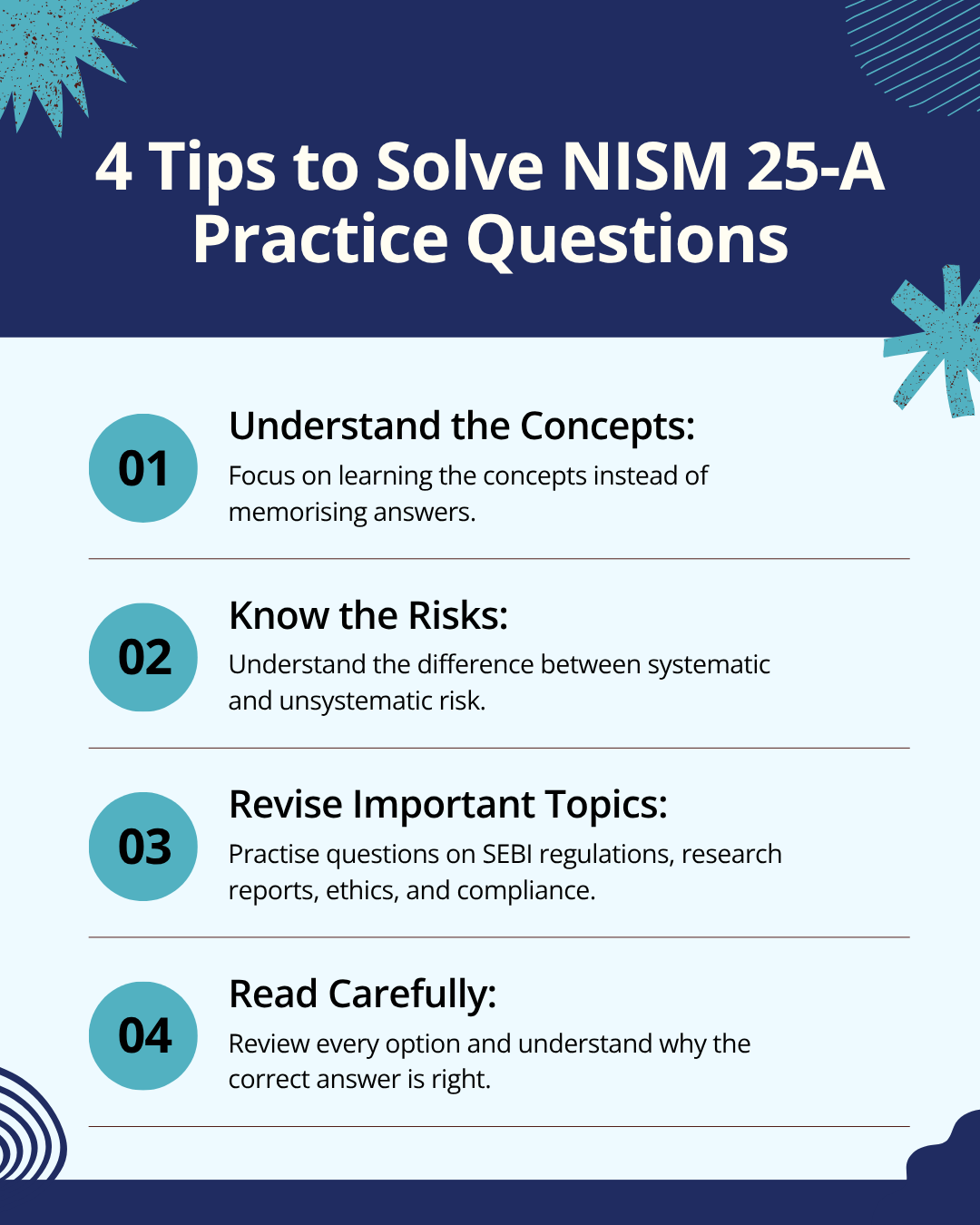
You can organise the video’s explanations into a short revision sheet:
For each practice question, also note why the other options are incorrect. This helps you move beyond recognising answers and understand the distinctions between similarly worded questions.
The video makes a clear distinction regarding ChatGPT-generated questions: they cannot be guaranteed to appear in the actual exam.
Using AI as a learning aid is different from treating its generated questions as confirmed exam content.
The speaker emphasises understanding concepts and preparing notes from official learning material. Likewise, treat the questions discussed here as practice examples - not a promise that the same questions will appear in the exam.
The common thread across this question set is clear: communicate research accurately, flag missing information, respect confidentiality, and understand the boundaries of your role.

Prof. Sheetal Kunder
SEBI® Research Analyst. Registration No. INH000013800 M.Com, M.Phil, B.Ed, PGDFM, Teaching Diploma (in Accounting & Finance) from Cambridge International Examination, UK. Various NISM Certification Holders. Ex-BSE Institute Faculty. 18 years of extensive experience in Accounting & Finance. Faculty Development Programs and Management Development Programs at the PAN India level to create awareness about the emerging trends in the Indian Capital Market, and counsel hundreds of students in career choices in the finance area
Work experience helps you handle practical situations, but exam questions require you to distinguish between closely worded options. A lack of structured notes or difficulty understanding technical terminology can make this challenging. Focus on why each answer is correct rather than simply memorising it.
Understanding behavioural biases helps them recognise how fear, greed, and overconfidence may affect client behaviour. This awareness supports clearer, more balanced communication. It does not guarantee investment returns or enable certain market predictions.
Systematic risk affects the broader market, while unsystematic risk is specific to a company or sector. As explained in the blog, diversification can reduce unsystematic risk but cannot completely eliminate market-wide risk.
Flag the missing time period to the analyst so it can be clearly specified. Do not assume a time horizon or add your own interpretation. The clarification should come from the analyst before the updated report is shared.
No. As highlighted in the video, AI-generated questions cannot be guaranteed to appear in the actual exam. Use them as learning aids, while focusing your preparation on official learning material, structured notes, and understanding the reasoning behind each answer.
 Launch your Graphy