There are no items in your cart
Add More
Add More
| Item Details | Price | ||
|---|---|---|---|

Sun Feb 1, 2026
Let’s talk about SIFs - India’s latest investment trend that’s catching everyone’s attention. SEBI designed SIFs to give you, as a distributor, more to offer your clients than a regular mutual fund, but without the steep entry barrier of alternatives. The ₹10 lakh minimum per PAN keeps things serious, but not out of reach. SIFs have already gathered over 50,000 accounts and ₹12,255 crore in assets across 14 fund houses. Remember, you need to clear NISM Series XIII to get started - this guide is here to make it all easy to understand and help you see how SIFs can grow your advisory business.
A Specialised Investment Fund is a new category of pooled investment that SEBI introduced through an amendment to the Mutual Fund Regulations. It went live for the industry on April 1, 2025.
Picture SIFs as the sweet spot between traditional mutual funds and expensive, exclusive alternatives. While mutual funds stick to long-only investing and big-ticket alternatives start at ₹50 lakh or more, SIFs let your clients access smart strategies free of locking away a fortune.
With SIFs, fund houses can finally use long-short strategies, hold cash when needed, and take bold, well-calculated bets - things regular mutual funds simply can’t do. The ₹10 lakh minimum per PAN is SEBI’s way of making sure only experienced investors jump in, but still keeping it much more accessible than AIFs.
So, if a client asks you about SIFs, just say: it’s a SEBI-regulated fund that gives experienced investors hedge-fund-style tools, but with all the comfort and transparency of mutual funds.
Putting an SIF next to goods you are already familiar with is the quickest way to comprehend one. How the four primary routes stack up in 2026 is shown here.
Feature | Mutual Fund | SIF | PMS | AIF |
Minimum ticket | ₹100 to ₹500 | ₹10 lakh per PAN | ₹50 lakh | ₹1 crore |
Strategy style | Long only | Long and short | Customised long | Wide, including private |
Regulator | SEBI (MF Regs) | SEBI (MF Regs amendment) | SEBI (PMS Regs) | SEBI (AIF Regs) |
Ownership | Units in a pool | Units in a pool | Direct securities in your name | Units in a pool |
Transparency | High, daily NAV | High, regular NAV | Moderate | Lower |
Who it suits | Every retail saver | Experienced investors | HNIs | Sophisticated and institutional |
Here’s what really matters: SIFs keep all the familiar benefits of mutual funds, like pooled investments and daily NAVs, but add the power to short and hedge. So, your clients get some hedge fund advantages - without confusing structures or needing to invest crores.
If you’re advising clients on alternatives, SIFs should be the first thing you talk about, not the last.
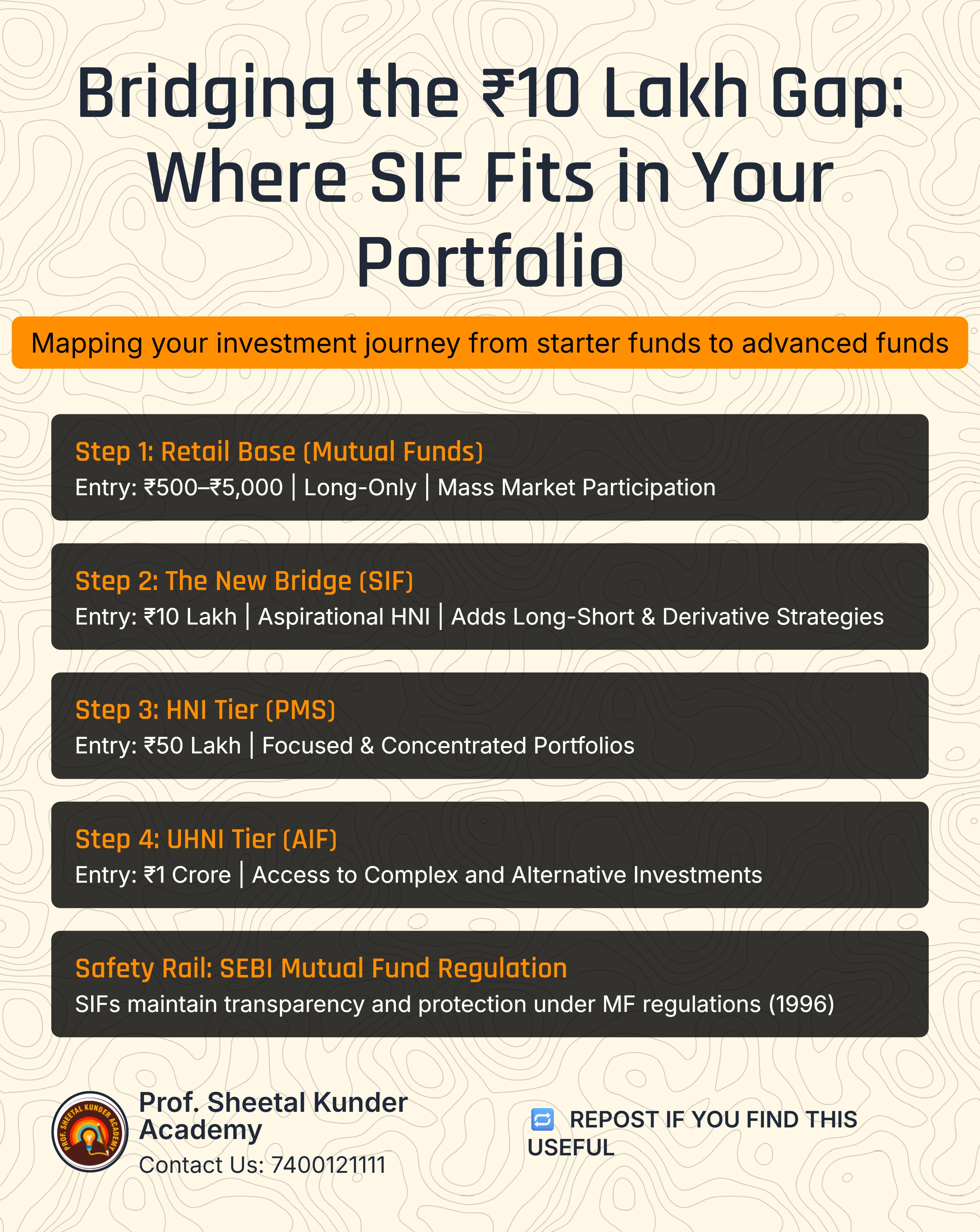
The SEBI SIF regulation did not appear overnight. SEBI amended the Mutual Fund Regulations with effect from December 16, 2024, followed it with a detailed circular on February 27, 2025, and made the framework operational from April 1, 2025.
A few rules shape everything a SIF can do.
That’s what makes SIFs different from offshore hedge funds: everything is transparent and tightly regulated by SEBI, so you and your clients know exactly what’s going on, with all the investor safeguards of mutual funds.
The product is no longer theoretical. The numbers tell the story.
Metric | Figure (2026) |
Total SIF AUM | ₹12,255 crore (April 2026) |
Active strategies | Around 25 |
Fund houses offering SIFs | 14 AMCs |
SIF investor accounts | 50,000+ (June 2026) |
Top performer (April 2026) | qSIF Equity Ex-Top 100 Long-Short, 15.24% |
By April 2026, SIFs had already gathered ₹12,255 crore across about 25 different strategies and 14 fund houses. Hitting 50,000 investor accounts by June 2026 was faster than anyone in the industry thought possible.
Hybrid strategies are pulling in the most money. Equity long-short and hybrid long-short funds are driving the rush, while a pure debt-oriented long-short launch drew almost zero interest. The market is voting clearly for equity-led, hedged plays.
New launches keep coming. JioBlackRock has filed its Prism Hybrid Long-Short SIF, a sign that even the newest entrants see the category as a priority. If you want to track the best specialised investment funds in India, the field is widening every month.
If you’re ready to grow your advisory business with SIFs, now’s the perfect time. Contact our team for guidance on getting started as a distributor.
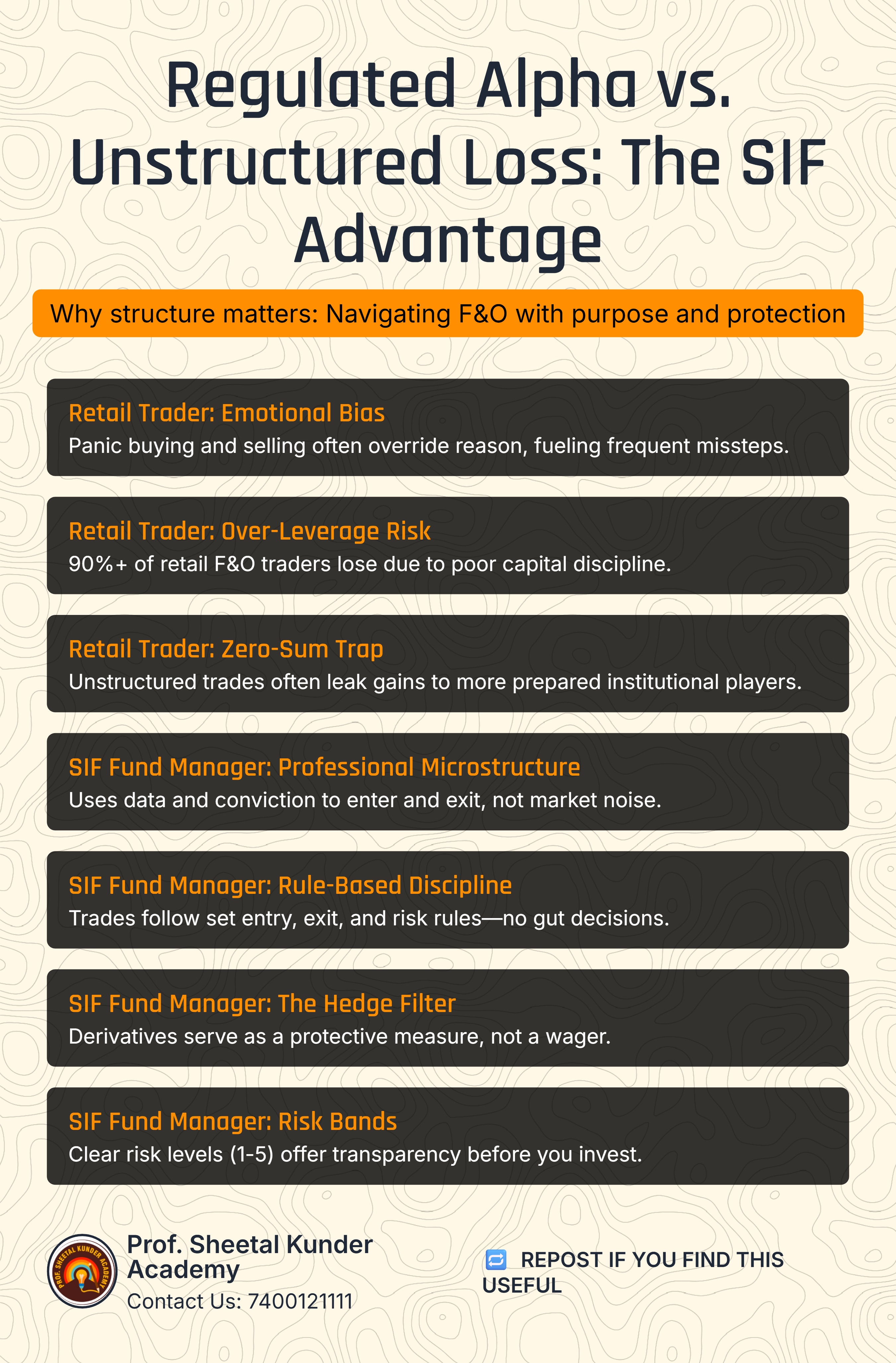
The word that defines a SIF is short. A regular mutual fund can only buy and hold, which means it makes money only when prices rise. A SIF can also bet against a stock it expects to fall. That single freedom changes everything.
Imagine a fund manager who favours a powerful private bank over a weak public one. The strong bank can be purchased for the long book, and the weak one may be shorted by the manager of a SIF at the same time. The long loses while the short gains if the sector falls, and the two provide mutual support. Hedging is based on this fundamental notion.
This is further driven by certain SIF approaches toward a delta-neutral stance. Delta quantifies the shift in a position as the underlying asset changes. A long position has a delta of plus one, while a short position has a delta of minus one. The fund ceases betting on the market's direction and instead bets on which stocks will outperform others when a manager balances longs and shorts so that the deltas approximately cancel out. That is how a fund that trades long and short might generate profits in a flat or declining market.
The qSIF Equity Ex-Top 100 Long-Short also topped the table in April 2026, with a gain of 15. 24%. It capitalised on the difference between winners and losers by going long on high-quality mid- and small caps and shorting less-performing companies rather than depending on the market as a whole rising.
The lesson for you as a consultant is evident. Promising increased returns is not the purpose of selling a SIF. It involves demonstrating to your customer how the long-short engine handles risk in a way that is unique from anything they have previously possessed.
A SIF is powerful, but it is not for everyone. Pairing the product with the right investor is the heart of good advice.
A SIF suits an investor who already holds a core mutual fund portfolio and wants to add a layer that behaves differently. It suits someone who understands that short positions and hedging carry their own risks and can commit ₹10 lakh without straining their financial plan. These are usually seasoned investors, business owners, and professionals who have outgrown plain equity funds but do not want the crore-sized lock-in of an AIF.
A SIF is not for a first-time investor still building an emergency fund. It is not for someone who needs the money back next quarter, since these strategies are intended to play out over years. And it is not for an investor who cannot stomach the idea that a short position can move against the fund.
The honest framing wins trust. When you tell a client a SIF may not suit them yet, you earn the conversation that brings them back when they are ready. That is how a distributor builds a practice that lasts.
The growth story is not simply a Mumbai-and-Delhi story. It is increasingly a B30 story, meaning the cities and towns beyond the top 30 metros.
Smaller cities now account for 26% of equity mutual fund AUM and contributed 56% of new SIPs in FY25. That investor base is maturing fast. Savers who started with a ₹500 SIP a few years ago are now ready for a ₹10 lakh SIF allocation.
This is where the opportunity for distributors becomes real. Demand is rising in Tier 2 and Tier 3 markets, but the supply of advisers who actually understand long-short strategies and SIF rules is thin. If you build that expertise now, you meet a wave that is still in its early days.
Every aspiring distributor must listen to this section carefully. Without the appropriate certification, you cannot sell, advise on, or distribute a SIF.
The NISM Series XIII: Common Derivatives Certification Examination is the gateway. Due to the fact that SIFs operate on long-short mechanics and derivatives, NISM and SEBI regard this test as the threshold for anyone working with these instruments. The door to SIF distributor certification remains closed without it.
This is excellent news, not terrible. Less rivalry and greater value for those who cross the entry barrier result from this. Advisors who clear NISM Series XIII this year will have client relationships in a field that is still developing.
Here is the full specification in one clean table.
Parameter | Detail |
Exam name | NISM-Series-XIII: Common Derivatives Certification Examination |
Total questions | 150 |
Total marks | 150 (1 mark per question) |
Duration | 180 minutes (3 hours) |
Passing score | 60%, which is 90 out of 150 |
Negative marking | 25% per wrong answer |
Certificate validity | 3 years |
Examination fee | ₹3,000 (gateway charges extra) |
Mode | Online at NISM test centres |
Requirement | PAN needed for the certificate |
Regulator | SEBI and NISM |
Plan your attempt with the marks in mind. You need 90 marks to pass, and every wrong answer costs you a quarter mark. Answer the questions you know first, then come back to the ones that need a guess. That order protects your score against the negative marking.
Clearing NISM Series XIII on your first try is very possible with proper preparation. This is where we come in.
At Prof Sheetal Kunder Academy, we have trained more than 3,000 MFDs across India, and our approach is built around your result, not just your enrolment.
Learning from Prof. Sheetal Kunder means learning from a SEBI-registered research analyst with 18 years in accounting and finance, multiple NISM certifications, and a teaching record that speaks for itself.
You have the ambition. We have the method. Start your enrollment immediately and prepare to clear NISM Series XIII on your first attempt.

Prof. Sheetal Kunder
No. Regulation is the main distinction between hedge funds and SIFs in India. Offshore hedge funds are more challenging to access and less clear than SIFs, which operate inside SEBI's open mutual fund system and make regular NAV disclosures.
The minimum is ₹10 lakh per PAN across all SIF techniques of a single fund house, not per scheme.
Investor accounts increased to 50,000 by June 2026, while SIF assets from 14 fund houses and about 25 strategies surpassed ₹12,255 crore by April 2026.
It features 150 questions spread out across 180 minutes, has 150 marks, requires 60% (90 marks) to pass, and has a 25% negative marking. The certificate is valid for three years, and the cost is ₹3,000.
PSKA has instructed more than 3,000 MFDs, administers mock examinations in which students achieve scores of 85–90%, provides customizable 15-day and 60-day validity periods with reduced extensions, and conducts daily 5–6 PM doubt sessions facilitated by Sheetal ma'am herself.
 Launch your Graphy