There are no items in your cart
Add More
Add More
| Item Details | Price | ||
|---|---|---|---|

Mon Dec 15, 2025
Why Specialised Investment Funds (SIFs) Demand NISM XIII Certification for Every Distributor
SIF full form is Specialized Investment Fund, India's hottest 2026 product, sitting between mutual funds and PMS at a ₹10 lakh entry. A SIF can short up to 25% of assets through derivatives, so it targets returns in rising, falling, and sideways markets. To distribute SIF you must clear NISM Series XIII, the exam for SIF distribution covering equity, currency, and interest rate derivatives. With AMCs pushing SIF and SEBI reshaping derivatives, certified MFDs win the new HNI business. This guide covers the product, investor demand, and exam strategy.Table of Contents
The SIF full form is Specialized Investment Fund, and in 2026 it is the biggest conversation in Indian asset management. SEBI notified the framework in December 2024 and it went live on April 1, 2025, and within a year SIF assets crossed ₹12,255 crore. With mutual funds near saturation, this is the new product line affluent investors are already asking about, and the only way to distribute it is by clearing the NISM Series XIII Common Derivatives exam. If you are not SIF-ready yet, today is the day to start.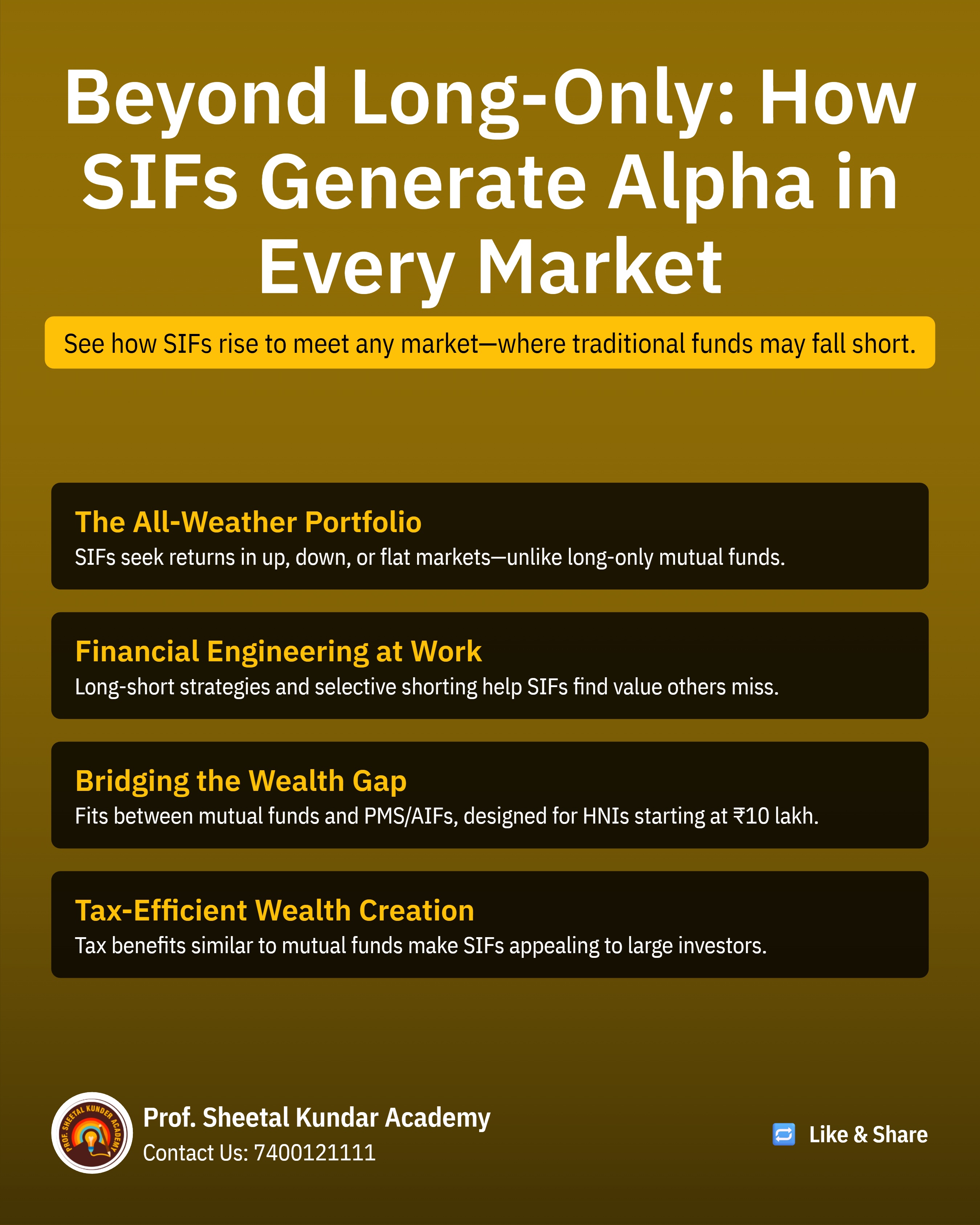
SIF is the first genuinely new mass product India has produced in years, and the business window is open now.
A Specialized Investment Fund is a SEBI-regulated product in the gap between mutual funds and PMS or AIF. It pairs mutual-fund transparency with PMS-style flexibility, under Chapter VI-C of the SEBI (Mutual Funds) Regulations, 1996.
Category | Example Strategies | What It Does |
Equity-oriented | Equity Long-Short, Sector Rotation | Longs strong stocks, shorts weak ones via derivatives |
Debt-oriented | Debt Long-Short, Sectoral Debt | Flexible bond positioning across the yield curve |
Hybrid | Active Asset Allocator, Hybrid Long-Short | Shifts dynamically across equity, debt, and other assets |
Derivatives, across equity, currency, and interest rate segments, are the engine of all three.
This single table answers SIF vs mutual fund which is better, SIF vs PMS, and SIF vs AIF.
Feature | Mutual Funds | SIFs | PMS / AIFs |
Regulation | SEBI (MF) Regulations, 1996 | Chapter VI-C of SEBI (MF) Regulations, 1996 | PMS Regulations 2020 / AIF Regulations 2012 |
Investor base | Retail and HNI | HNI | HNI and Ultra-HNI |
Minimum investment | ₹100+ | ₹10 lakh | ₹50 lakh (PMS) / ₹1 crore (AIF) |
Expense | Max 2.25% / 2% | Max 2.25% / 2% | Management + performance fee |
Derivatives use | Hedging and rebalancing only | Unhedged + hedging + rebalancing | PMS: hedging; AIF: allowed |
Debt single-issuer limit | Up to 10% | Up to 20% | AIF Cat III: 10%; PMS: no limit |
This is where theory meets reality. ICICI Prudential has launched two SIF strategies under its iSIF brand.
Strategy | Type | What It Does | Key Detail |
iSIF Equity Ex-Top 100 Long-Short Fund | Equity | Longs mid and small-caps, shorts overvalued ones | Inception Feb 4, 2026, AUM around ₹1,090 crore |
iSIF Hybrid Long-Short Fund | Hybrid | Combines long-short equity, debt, and derivatives | 65 to 75% equity, 25 to 35% debt |
Awareness is climbing fast, but understanding lags. Adoption hinges on education, and the long-short mechanics must be explained before anyone commits ₹10 lakh.
An MFD who answers with authority keeps the client. One who fumbles the short side loses a ₹10 lakh-plus relationship to a certified rival.
NISM XIII matters now because SEBI is reshaping the entire derivatives landscape.
SEBI Initiative (2025 to 2026) | What Changed | Why It Matters to You |
Derivative segment consolidation (proposed, May 2026) | Merged into three segments, Equity, Currency, Interest Rate | These are the exact three NISM XIII modules |
Expiry day restructuring (Sept 2025) | Tuesday expiry on NSE, Thursday on BSE | A cleaner F&O market SIFs operate within |
Calendar spread margin change (May 2026) | Single-stock derivatives aligned with index rules | Tighter F&O risk management |
SIF framework with 5-level Risk Bands | New asset class, monthly risk review | The product you need certification to sell |
SIF launches are accelerating across the industry.
SEBI opens SIF→AMCs launch SIF products→AMCs need distribution reach
↓
MFDs are the growth engine across every region
↓
MFDs can only sell SIF after clearing NISM Series XIII
↓
So AMCs actively push their networks to get certified
AMCs now own their network's readiness, because MFDs drive the rollout. Connect with our program adviser to position yourself before your competitors do.
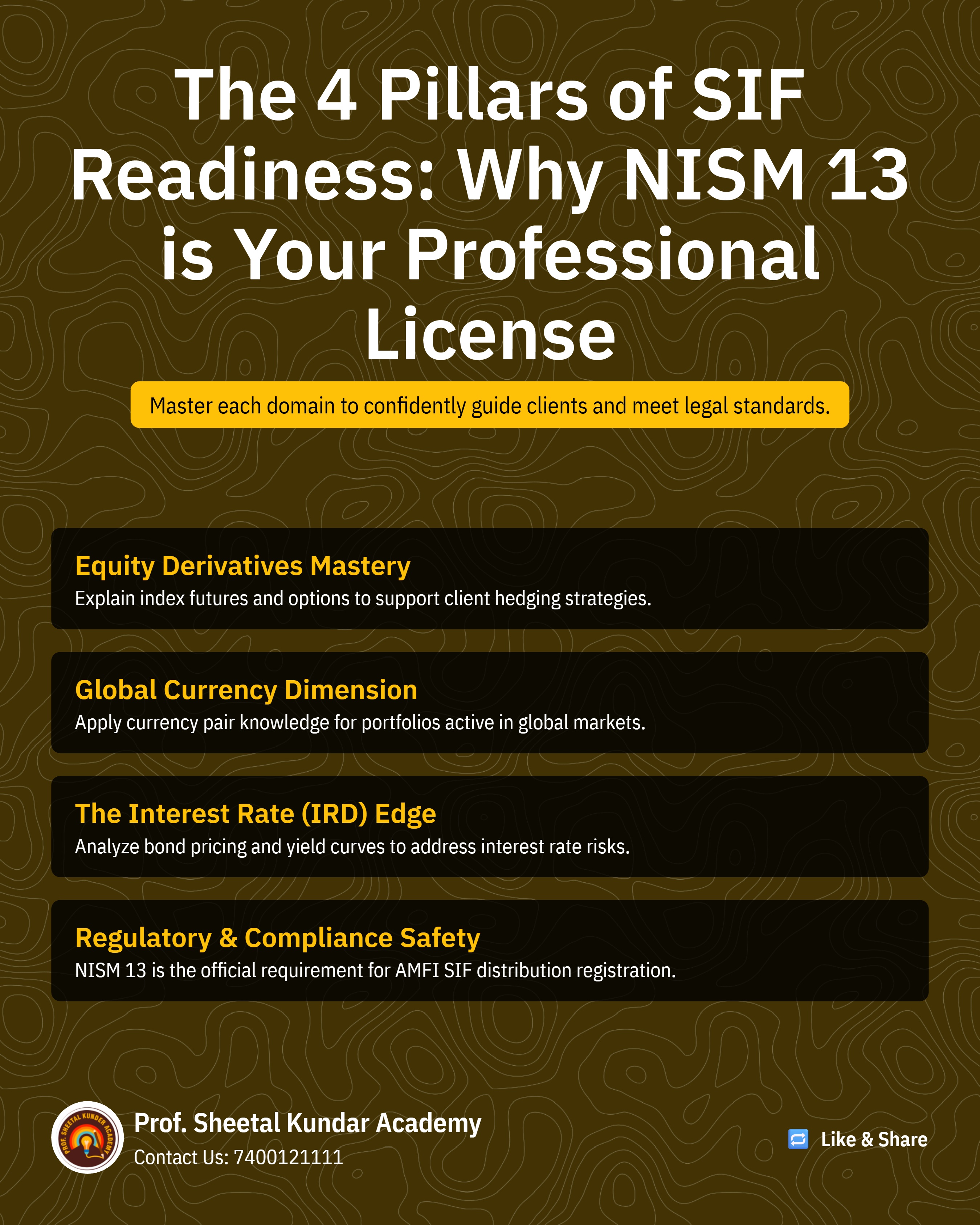
To distribute SIF, SEBI requires you to clear the NISM Series XIII Common Derivatives Certification Examination. A mutual fund distributor becomes SIF-eligible only after passing it.
Parameter | Detail |
Total questions | 150 |
Maximum marks | 150 (1 mark each) |
Duration | 180 minutes (3 hours) |
Passing score | 60% (90 of 150) |
Negative marking | 25% per wrong answer |
Certificate validity | 3 years |
Mode | Online, computer-based at NISM test centers |
Exam fee | ₹3,000 plus payment gateway charges |
You cannot half-learn three domains, which is exactly why mentorship matters. Most MFDs are fine with equity but get caught out by currency and the interest rate numericals.
Knowing the paper's shape is the most useful edge a candidate can have.
Difficulty Band | Share of Paper | How to Treat It |
Very easy | 20% | Lock these in first, guaranteed marks |
Moderately difficult | 60% | Attempt second, this decides pass or fail |
Highly difficult | 20% | Attempt last, do not let these drain the clock |
The difference is never raw effort. It is structure and real exposure.
The goal is not a distinction certificate. It is delivering profitable results to clients over the years, because you are eventually handling real money. Enroll now and become SIF-ready.

Prof. Sheetal Kunder
SIFs use derivatives as their core operating instruments. SEBI mandated NISM Series XIII to ensure every distributor handling SIF products has verified conceptual knowledge of equity, currency, and interest rate derivatives before advising or selling to clients.
SIFs are regulated under the mutual fund framework with a minimum ticket size of Rs. 10 lakh. PMS typically requires Rs. 50 lakh minimum, and AIFs require Rs. 1 crore minimum. SIFs offer more sophisticated derivative-based strategies than regular mutual funds but with lower entry barriers than PMS or AIFs.
Yes. SIF fund managers can take unhedged short derivative positions of up to 25% of the portfolio. This allows the fund to generate alpha in bearish and sideways market conditions, unlike long-only mutual funds, which depend on a rising market.
ICICI Prudential, SBI Mutual Fund, Mirae Asset, Nippon India, and HDFC Mutual Fund have launched SIF products. The category collected thousands of crores in AUM within the first few months after launch.
Rs. 3,000 plus payment gateway charges, as listed on the official NISM website.
An MFD with NISM Series XIII certification can explain why a SIF fund is positioned a certain way, how it generates returns in different market conditions, and why it is more suitable than individual options trading for an HNI client. This depth of knowledge directly builds client trust and retention.
No. The exam tests conceptual understanding, not trading execution. With structured module-wise preparation, MFDs from mutual fund distribution backgrounds clear it on the first attempt.
30 to 50 days with 1.5 to 2 hours of daily focused study is sufficient. PSKA students have cleared it in as few as 11 days with structured preparation.
Every month without certification is a month where certified competitors can distribute SIF products to your HNI clients. Once those client relationships are established elsewhere, they are difficult to recover.
Yes. PSKA offers 15-day and 60-day flexible plans with extension options at a discount, 25+ calibrated mock tests, and one-on-one doubt-clearing with Prof. Sheetal over video or audio call - structured around a working professional's schedule.
 Launch your Graphy