There are no items in your cart
Add More
Add More
| Item Details | Price | ||
|---|---|---|---|

Sun Jun 2, 2024
This free NISM Research Analyst mock test has 14 MCQs and one case study with 4 questions, built for the revised NISM XV (NISM 15) pattern that applies from 20 January 2026. Every question has a worked answer. Together, they cover the chapters that carry the most marks: Financial Analysis, Valuation, Technical Analysis, and Risk and Return. NISM doesn't publish past question papers, so these are original practice questions, not PYQs. Use them to find your weak areas, then switch to full-length timed mocks in your last two weeks.

Before you rely on any mock test, check three things: does it have 5 case studies, does it run for 2 hours, and does it deduct 0.25 marks for each wrong answer?
Many free tests online still follow the old pattern with only 2 case studies. Scoring well on them can give you false confidence.
The case studies now carry 20 marks, so if you’re weak there, you’d need 60 of the remaining 80 MCQs right just to pass, with no room for mistakes.
A mock that matches the real pattern shows you that gap while you still have time to fix it. For the full chapter list and how many marks each chapter carries, see our NISM XV syllabus and chapter-wise weightage guide.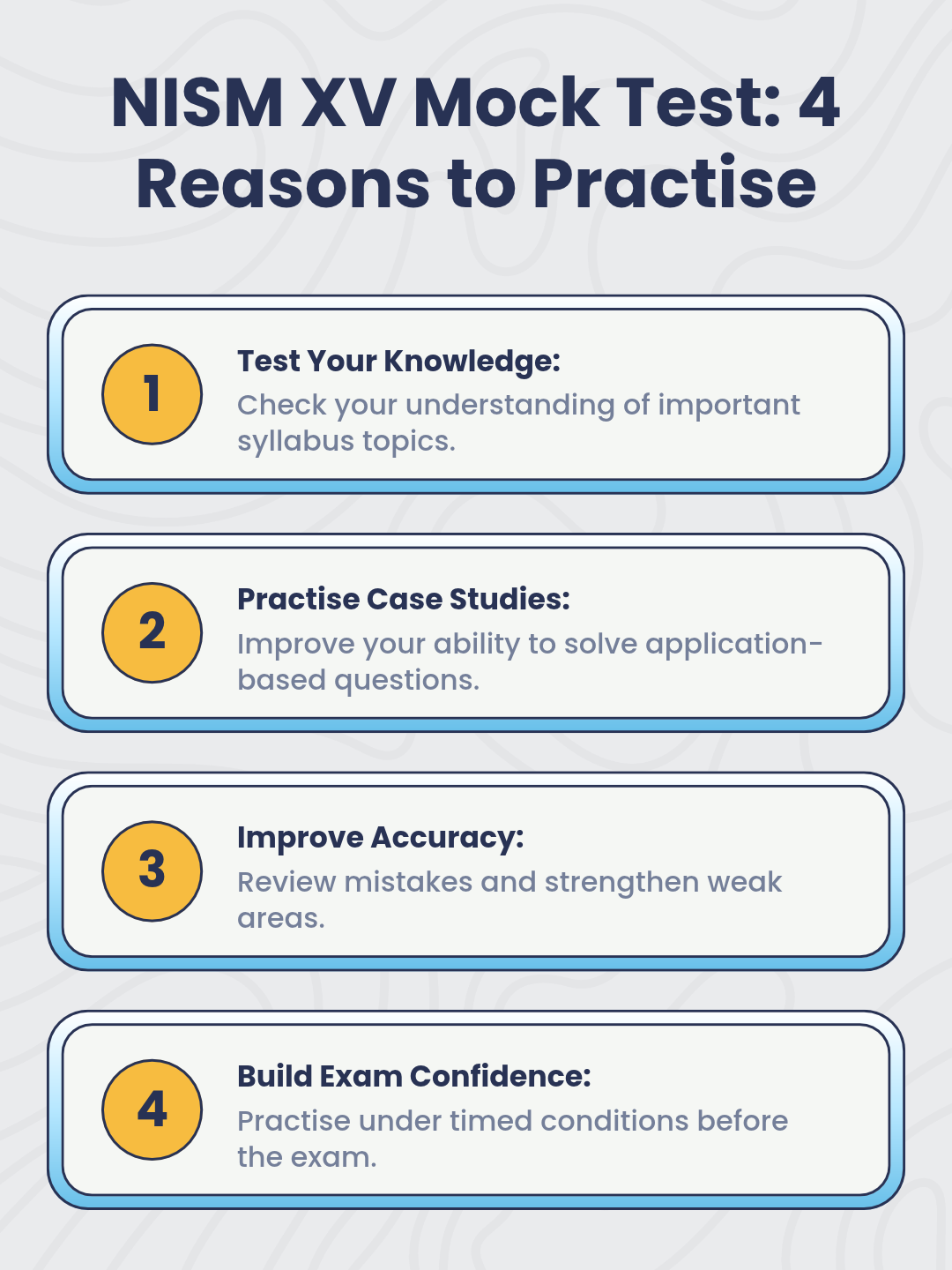
No. NISM keeps its question bank confidential and does not disclose exam questions or answers, so there are no official previous year papers for Series XV.
Anything online labelled “NISM 15 PYQ” or “question paper PDF” is either recalled from memory by past candidates or put together as a practice set.
These sets can still help, but use them with care:
NISM itself recommends the chapter-end sample questions and worked examples in the official workbook. Use those alongside the original questions below.
Each one is tagged with its chapter, so you know exactly which topic you’re practising and where to go back if you get it wrong.
Treat these the way you’d treat the real exam. Cover the answer, work each question out with a calculator, and note your choice before you check.
Give yourself about a minute per question, because that’s roughly the pace you’ll need on exam day. When you get one wrong, read the worked solution carefully. The mistake usually comes from the method, not the arithmetic.
A company has a current ratio of 2.5:1, current liabilities of ₹800 crore and inventory of ₹400 crore. What is its quick ratio?
Answer: (b) 2.0:1
Formula: Quick ratio = (Current assets − Inventory) ÷ Current liabilities
Current assets = 2.5 × 800 = ₹2,000 crore
Quick assets = 2,000 − 400 = ₹1,600 crore
Quick ratio = 1,600 ÷ 800 = 2.0
A company's net profit is ₹10 lakh, it has 40,000 shares, and it retains 40% of its profit. What is the dividend per share?
Answer: (b) ₹15
Formula: DPS = EPS × Payout ratio
EPS = 10,00,000 ÷ 40,000 = ₹25
Payout ratio = 100% − 40% = 60%
DPS = 25 × 0.6 = ₹15
A company holds inventory for 25 days on average. Assuming 365 days in a year, what is its inventory turnover?
Answer: (c) 14.6 times
Formula: Inventory turnover = 365 ÷ Inventory days
365 ÷ 25 = 14.6 times
Opening stock is ₹2,00,000, purchases are ₹15,00,000 and cost of goods sold is ₹10,00,000. What is the closing stock?
Answer: (c) ₹7,00,000
Formula: Closing stock = Opening stock + Purchases − COGS
2,00,000 + 15,00,000 − 10,00,000 = ₹7,00,000
Cash received from selling a company's office premises is shown under:
Answer: (b) Investing activities
Buying and selling long-term assets such as property, plant and equipment is classified as an investing activity.
A firm's debt-to-equity ratio is 1.5:1. The pre-tax cost of debt is 10%, the cost of equity is 12% and the tax rate is 30%. What is its WACC?
Answer: (b) 9.0%
Formula: WACC = (Wd × Kd × (1 − t)) + (We × Ke)
Debt weight = 1.5 ÷ 2.5 = 60%, so equity weight = 40%
After-tax cost of debt = 10% × (1 − 0.30) = 7%
WACC = (0.6 × 7%) + (0.4 × 12%) = 4.2% + 4.8% = 9.0%
A company's EPS is ₹25 and comparable peers trade at a P/E of 18. What is its fair price based on the peer P/E?
Answer: (c) ₹450
Formula: Price = EPS × P/E
25 × 18 = ₹450
Next year's expected dividend is ₹10, the required return is 12% and dividends grow at a constant 7%. What is the share's value?
Answer: (c) ₹200
Formula: Value = D1 ÷ (k − g)
10 ÷ (0.12 − 0.07) = 10 ÷ 0.05 = ₹200
A fund's NAV rises from ₹16 to ₹27 in 2 years. What is the CAGR?
Answer: (b) 29.9%
Formula: CAGR = (Ending value ÷ Beginning value)^(1/n) − 1
(27 ÷ 16)^(1/2) − 1 = √1.6875 − 1 = 1.299 − 1 = 29.9%
Trap: Option (c), 34.4%, is the simple annual return (68.75% ÷ 2). It ignores compounding.
The risk-free rate is 6%, the market return is 12% and the stock's beta is 1.5. What is the required return?
Answer: (c) 15%
Formula: Required return = Rf + β × (Rm − Rf)
6% + 1.5 × (12% − 6%) = 6% + 9% = 15%
A share trades at ₹400 before a 1:1 bonus issue. What is its theoretical price after the bonus?
Answer: (b) ₹200
A 1:1 bonus gives one extra share for every share held, which doubles the share count. The company's value doesn't change, so the price halves: 400 ÷ 2 = ₹200.
A stock closes at ₹100, ₹102, ₹104, ₹103 and ₹106 over five days. What is its 5-day simple moving average?
Answer: (b) ₹103
Formula: SMA = Sum of closing prices ÷ Number of days
(100 + 102 + 104 + 103 + 106) ÷ 5 = 515 ÷ 5 = ₹103
An RSI reading above 70 is conventionally read as:
Answer: (b) Overbought
RSI moves between 0 and 100. By convention, readings above 70 suggest a stock may be overbought, and readings below 30 suggest it may be oversold.
A golden cross occurs when:
Answer: (a)
A golden cross is read as a bullish signal. A common example is the 50-day moving average crossing above the 200-day moving average. Option (b) describes the opposite, a death cross.
Check which chapters your wrong answers came from.
If most were from one chapter, revise that chapter first. If they were spread across chapters, you’re probably rushing, so slow down and recheck each step.
Then try the case study below, which tests several of these topics in one question set.
The revised exam has 5 case studies, each with 4 questions, together worth 20 marks. Every case gives you one company’s data, and the questions build on each other.
Read the full case once before you start, note the key figures, and solve the questions in order.
Here's the full case in the same format as the MCQs, with the company data in a table so it's easy to refer back to while solving.
Answer: (c) 20%
Formula: EBITDA margin = EBITDA ÷ Revenue
100 ÷ 500 = 20%
Answer: (b) 8x
Formula: Interest coverage = EBIT ÷ Interest
EBIT = EBITDA − Depreciation = 100 − 20 = ₹80 crore
80 ÷ 10 = 8x
Trap: Using EBITDA instead of EBIT gives 10x, which is option (d).
Answer: (a) ₹4.90
Formula: EPS = Net profit ÷ Shares outstanding
PBT = EBIT − Interest = 80 − 10 = ₹70 crore
PAT = 70 × (1 − 0.30) = ₹49 crore
EPS = 49 ÷ 10 = ₹4.90
Answer: (d) 34.3x
Formula: P/E = Share price ÷ EPS
168 ÷ 4.90 = 34.3x
Each answer feeds into the next: EBIT gives you PBT, PBT gives you EPS, and EPS gives you the P/E.
One early mistake carries through the whole case, so double-check your first calculation before moving on.
Give yourself +1 for each correct answer and deduct 1.25 for each wrong one. Questions you left blank score zero. This is how NISM marks the real exam, so practise scoring the same way.
Treat your score as a starting point, not a verdict. Use it to decide what to study next, then come back to this set after revising to see how much you’ve improved.
If your score showed gaps across several chapters, guided study can help you close them faster. Our NISM Series XV Research Analyst Program takes you through the full syllabus chapter by chapter, with case-study practice along the way.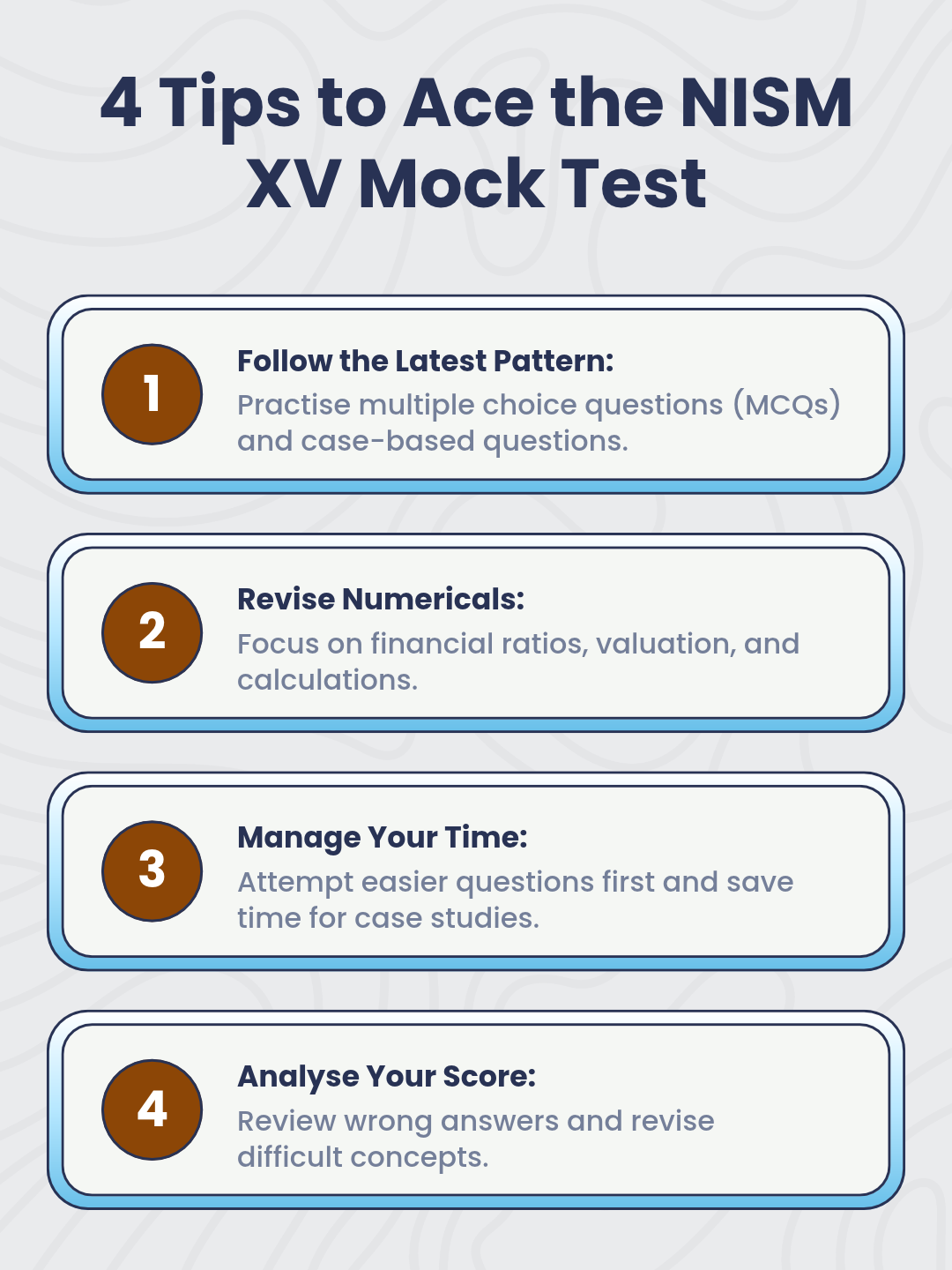
In NISM XV, most marks are lost on easy questions solved in a hurry, not on hard ones. These five mistakes come up again and again.
The wrong options in the exam are usually set up to catch exactly these slips. So when an answer comes too easily, check it once more before you move on.
NISM XV rewards students who practise for the exam as it is today: 80 MCQs, 5 case studies worth 20 marks, and a 0.25-mark penalty for every wrong answer.
Since NISM doesn’t release past papers, your best preparation is the official workbook combined with practice questions written for the current syllabus, like the ones on this page.
Use the 18 questions here to find out where you stand. Your score shows which chapters need attention, the case study shows how one calculation leads to the next, and the common mistakes show where easy marks usually slip away.
Fix those areas first, then build speed and stamina with full-length timed mocks in your last two weeks.
There’s no fixed exam date, so book your slot only when your mock scores are steadily above 90% makrs in our mock test . That way you walk in prepared, not just hopeful.

Prof. Sheetal Kunder
SEBI® Research Analyst. Registration No. INH000013800 M.Com, M.Phil, B.Ed, PGDFM, Teaching Diploma (in Accounting & Finance) from Cambridge International Examination, UK. Various NISM Certification Holders. Ex-BSE Institute Faculty. 18 years of extensive experience in Accounting & Finance. Faculty Development Programs and Management Development Programs at the PAN India level to create awareness about the emerging trends in the Indian Capital Market, and counsel hundreds of students in career choices in the finance area.
Yes. All 18 questions on this page are free, with worked answers. Full-length timed mocks are available in the [NISM XV Mock Test course].
No. NISM doesn't publish past papers, so practice questions mapped to the current syllabus are the most reliable way to prepare.
There are 80 MCQs of 1 mark each and 5 case studies with 4 questions each, for a total of 100 marks.
60 out of 100, calculated after negative marking.
A good mock should, because the real exam deducts 0.25 marks for each wrong answer on a 1-mark question.
Take enough full-length mocks to score consistently above the pass mark, including the case-study section, before you book your slot.
Technical Analysis (15 marks), Financial Analysis (12), Valuation Principles (12) and Legal and Regulatory Environment (10). Together they carry 49 marks.
Many are, especially those drawn from financial analysis, valuation and technical analysis.
 Launch your Graphy