There are no items in your cart
Add More
Add More
| Item Details | Price | ||
|---|---|---|---|

Fri Jul 31, 2026
Quick Read
If you are serious about becoming a SEBI Registered Investment Adviser, 2025-26 is the period that quietly changed the game. SEBI has updated who can advise, how much regulatory capital you must park, and how clearly your role is separated from pure sales. The heart of the journey still runs through NISM’s investment advisor certification path (Series X-A and X-B), but these exams now sit inside a tighter, more professional framework. Instead of a simple clear the papers, file the form approach, you deal with client-linked deposits that scale with your practice, a formal part-time adviser route, and a separate track for sales-only PAIA roles. For a 24-year-old finance graduate or a 35-year-old working professional, the big question is no longer Is the exam tough but Do I want the responsibility, control and long-term upside that comes with a regulated advisory licence, versus staying in distribution or generic wealth sales. This article unpacks SEBI’s 2025-26 changes in plain language, shows exactly what they mean for your NISM X-A/X-B and RIA journey, and helps you decide whether this is the right lane for your next 5-10 years.
Why These Changes Matter For Aspiring RIAs
SEBI’s recent updates affect almost every key decision an aspiring RIA makes: exam choice, entry route, capital planning and client strategy.
The path is not harder, but it is more clearly structured around fiduciary advice rather than product sales.Earlier, most content treated the RIA journey as a checklist.
Now, you need to think of it as a professional track: upfront qualification, regulatory capital, ongoing compliance and renewal.Understanding the 2025-26 rules helps you avoid two mistakes: entering without a clear picture of obligations, or dismissing RIA as just one more NISM exam when it is much more than that.
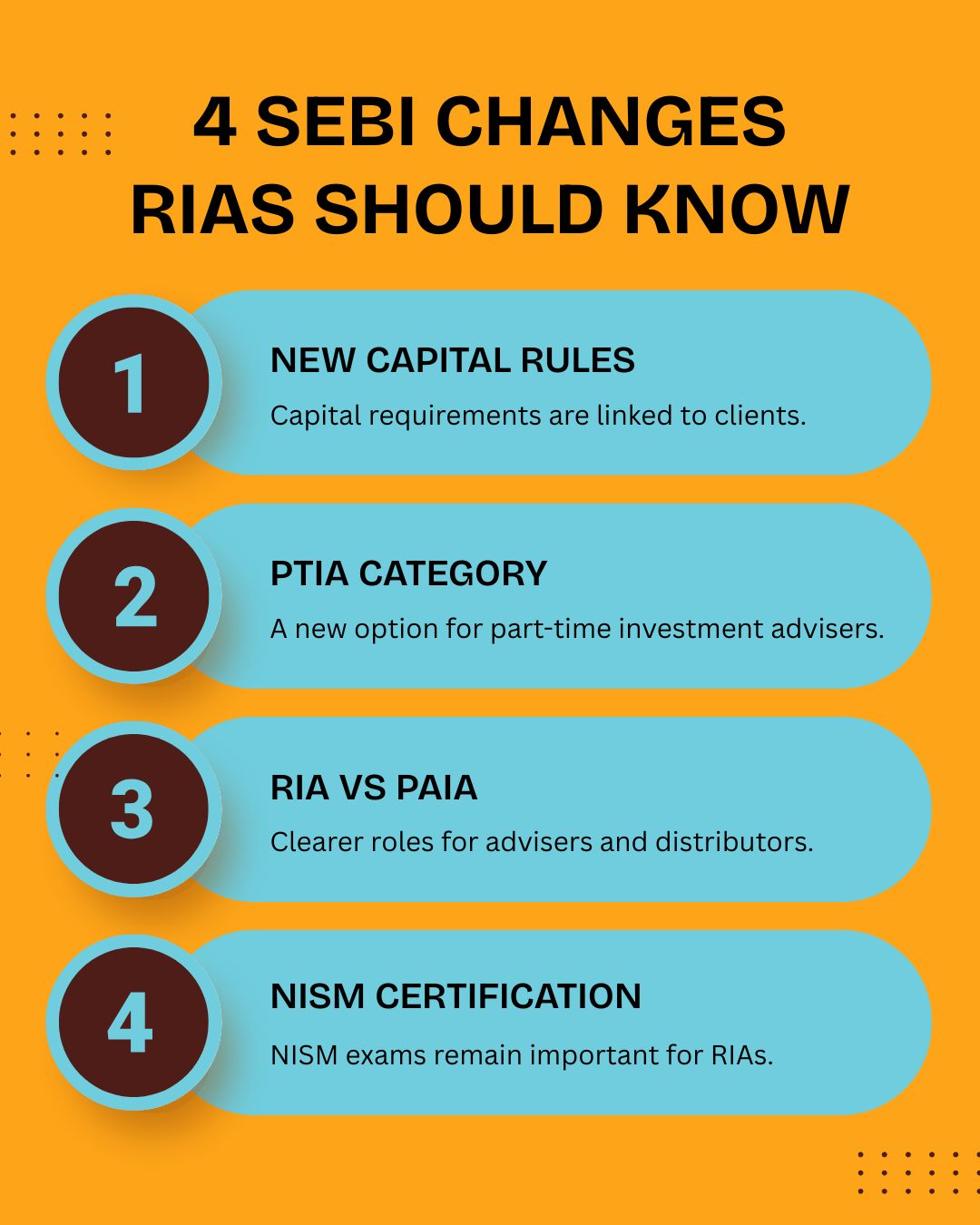
NISM Investment Advisor Certification (X-A & X-B)
What Investment Advisor Certification Means Today
For SEBI RIA eligibility, investment advisor certification effectively means clearing two NISM exams:
NISM Series X-A - Investment Adviser (Level 1)
NISM Series X-B - Investment Adviser (Level 2)
Together, they cover:
Indian financial markets and product landscape
Mutual funds, equities, debt and other products
Risk, return and portfolio basics
Financial planning, tax, retirement and estate topics
Regulatory environment and adviser ethics
X-A builds your foundation.
X-B test how well you can apply that foundation in more complex, case-based scenarios.If you want a deeper dive into benefits and career scope once these certifications are cleared, you can read:
SEBI Investment Advisor (IA) Certification Examination - Benefits & Career ScopeWhy SEBI Still Relies On X-A/X-B
SEBI treats these exams as a way to check whether an adviser can:
Understand client profiles and suitability
Match products and plans to goals
Work within regulatory boundaries and document advice properly
For you, this means passing X-A, and X-B is not just a CV line.
It is the legal base of your licence to advise, and the starting point for building client trust.Change 1: Client-Linked Deposit Instead Of Static Net Worth
One of the most important shifts is the move from minimum net worth to a client-linked deposit kept under lien.
What This Deposit Actually Is
It is refundable capital, not a fee.
It is held with a lien in favour of the supervisory body.
It is tied to the number of clients you serve, not a fixed threshold.
Think of it as regulatory capital that grows with your practice:
At lower client counts, your deposit requirement is smaller.
As you cross higher bands, the required deposit rises.
For a solo RIA or small firm, this is easier to plan around than a one-size-fits-all net worth rule.
You can model how much capital you will lock at each stage of growth.What It Means For Your Plan
If your goal is a high-volume advisory firm, you must be comfortable with more capital on the table over time.
If you prefer a smaller, high-touch client base, the deposit obligation remains modest.The main mental shift is to stop treating this as money lost and treat it as locked capital that protects clients and signals seriousness.
Change 2: The Part-Time Investment Adviser (PTIA) Category
SEBI now recognises Part-Time Investment Advisers as a separate category.
This opens a structured bridge for people who are already working in other fields.Who PTIA Suits
This route is ideal if you:
Have a primary job outside the securities business.
Want to advise a limited number of clients in a regulated way.
Are willing to meet education and NISM requirements, but are not ready to shift into full-time advisory.
PTIAs:
Have a client cap and disclosure obligations.
Must still follow conduct and documentation norms.Are explicitly recognised as part-time practitioners.
Why It Matters For Working Professionals
If you are a 30- to 40-year-old professional, PTIA lets you:
Test advisory as a side practice.
Build real-world experience without immediately quitting your job.
Decide later whether full RIA status and larger client volume are right for you.
This reduces risk.
You move from all-or-nothing career decisions to a phased approach based on actual client work.Change 3: Clearer Split Between Advisory And Sales (PAIA Vs RIA)SEBI’s newer framework also clarifies how sales and advisory roles differ.
Persons Associated with Investment Advice (PAIA) have their own certification track, separate from RIAs.
Why The Split Matters
Earlier, many roles mixed advice, sales and distribution.
Now the boundary is clearer:Full advisers who design and sign advice must meet RIA conditions and hold the relevant NISM certifications.
Sales-only or non-core advisory staff can use different certification routes designed for their responsibilities.
For you, this forces a conscious choice:
Do you want a sales-led career tied to targets and products?
Or an advice-led career with fiduciary duty and direct client accountability?
The answer decides whether you invest in the full investment advisor certification path and RIA licence, or stay in lighter sales frameworks.
What The RIA Job Looks Like After Certification
Most content stops at clear exams, register, start advising.
Real-world practice under SEBI’s updated regime is broader.More Than Fund Recommendations
Modern RIAs spend significant time on:
Full financial planning and goal-setting
Designing and maintaining portfolios across MF, PMS, AIF and direct holdings
Explaining risk and outcomes in plain language
Working on succession, retirement and tax planning for families
Fund selection is part of the job, but it is not the whole job.
You add value by building structure and clarity around the entire financial life of clients.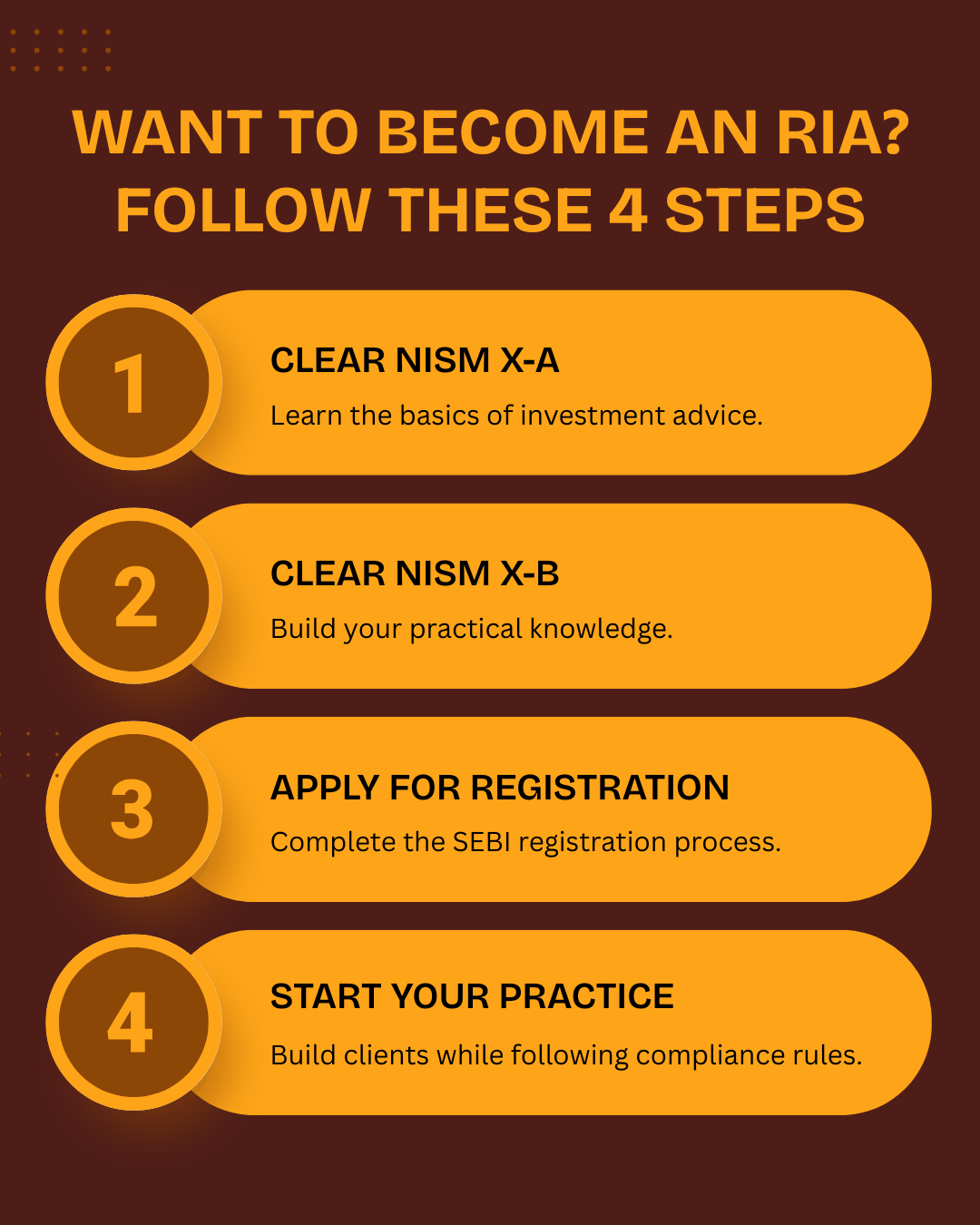
Time And Effort Reality
From community feedback and exam research:
Many candidates can clear each NISM level in 10-20 focused days of study if they already understand the basics.
Serious aspirants still treat these exams as professional qualifiers, not casual weekend tests.
On income, the range is wide:
Entry roles can start close to RM-style pay, while established RIAs with strong books and planning skills can grow into much higher bands over time.
RIA Vs Other Paths: How To Think About Options
When comparing SEBI RIA to Mutual Fund Distributor, bank RM, research analyst or CFA-focused roles, three questions help:
| Consideration/Question | RIA Perspective |
|---|---|
| Do you want to charge advice fees, or depend mainly on commissions/salary? | RIA gives you more control over your fee model. |
| Do you want legal responsibility for suitability and documentation? | RIA makes that responsibility explicit; other roles often keep it diffused. |
| Do you want long‑term positioning in India’s move towards regulated, fee‑based advice? | RIA is directly aligned with that trend. |
Your Practical Journey: From Aspirant To SEBI RIA
Step 1: Lock In The Investment Advisor Certification Plan
Decide upfront that you will:
Attempt NISM Series X‑A first.
Follow with NISM Series X‑B within a realistic timeframe.
Treat these as professional qualifiers, not side exams, and aim for scores comfortably above the pass mark.
For a more detailed view of benefits, profiles and long-term scope once IA certification is done, revisit:
SEBI Investment Advisor (IA) Certification Examination - Benefits & Career ScopeStep 2: Use Structured Prep
Effective prep usually combines:
Official workbook reading for syllabus coverage.
Topic-wise notes in your own words.Timed mock tests with negative marking to simulate exam pressure.
Caselet practice to train interpretation and time management.
The goal is simple: make the real exam feel like one more mock, not a shock.
Step 3: Handle SEBI Registration Cleanly
After clearing X-A and X-B:
Check current eligibility and fee rules on SEBI and NISM sites.
Prepare all documents carefully (education, experience, compliance declarations).
Factor your client-linked deposit plan into your financial setup.
Because fee figures and small conditions may evolve, always work from the latest official source, not cached blogs.
Step 4: Build A Practice That Matches Your Comfort With Capital And Responsibility
Start with a manageable client base.
Use your early phase to:Build systems for data, documentation and reporting.
Test how you explain risk and planning to different client profiles.
Decide whether you prefer PTIA‑style, solo RIA, or team‑based setup.
As you grow, plan each deposit slab step-up in advance instead of letting it surprise you.

Prof. Sheetal Kunder
Yes. These NISM exams remain the standard certifications for core advisory roles under SEBI’s RIA framework.
No. It is refundable regulatory capital held under lien. It is not an expense, but money you must park based on your client volume.
Yes. The PTIA category is specifically designed for qualified individuals who want to advise a limited client base alongside a primary non-securities job.
PAIA certifications support sales-focused or non-core advisory roles. X-A/X-B are for full advisers who design and sign advice for clients.
They make the path clearer and more professional. Obligations are more visible, but planning your exams, capital and practice becomes easier when you see the full framework.
 Launch your Graphy