There are no items in your cart
Add More
Add More
| Item Details | Price | ||
|---|---|---|---|

Sun Aug 16, 2026
Investment advisor registration in the SEBI style comes with a few upfront costs, most notably a client-linked deposit and some regulatory fees, but understanding these numbers early actually works in your favor. Knowing what's coming and why makes the whole process far more manageable, and it lets you plan a first year that sets your practice up for genuine, steady growth rather than financial guesswork.
Knowing your numbers before you start your investment advisor registration SEBI journey gives you a quiet advantage. Fees and deposits stop feeling like hurdles and start feeling like a simple checklist you tick off with confidence.
Advisers who've gone through this process consistently describe the same shift. Once they understood exactly what they were paying for and why, the registration timeline felt far less intimidating, and the paperwork turned from an obstacle into a series of clear, achievable steps.
A well-planned budget also frees up energy for what actually grows a practice, meeting people, building trust, and sharpening advisory skills, rather than worrying about money at every turn.
This upfront clarity matters more than most first-time applicants realize. Many people delay their registration simply because they're unsure what the total cost looks like, and that uncertainty tends to be far more stressful than the actual numbers turn out to be.
The full picture of where your investment goes when registering as an adviser is worth seeing clearly upfront. Every cost maps to something specific that either builds credibility or protects clients.
These aren't random charges scattered across the process. Each one builds a piece of the professional identity that clients eventually come to trust, and that trust is what carries a practice forward over time.
Seeing the full breakdown also helps with a common source of anxiety, the feeling that costs might keep appearing unexpectedly. Once you know these four categories cover essentially everything, the financial side of registration stops feeling like a moving target.
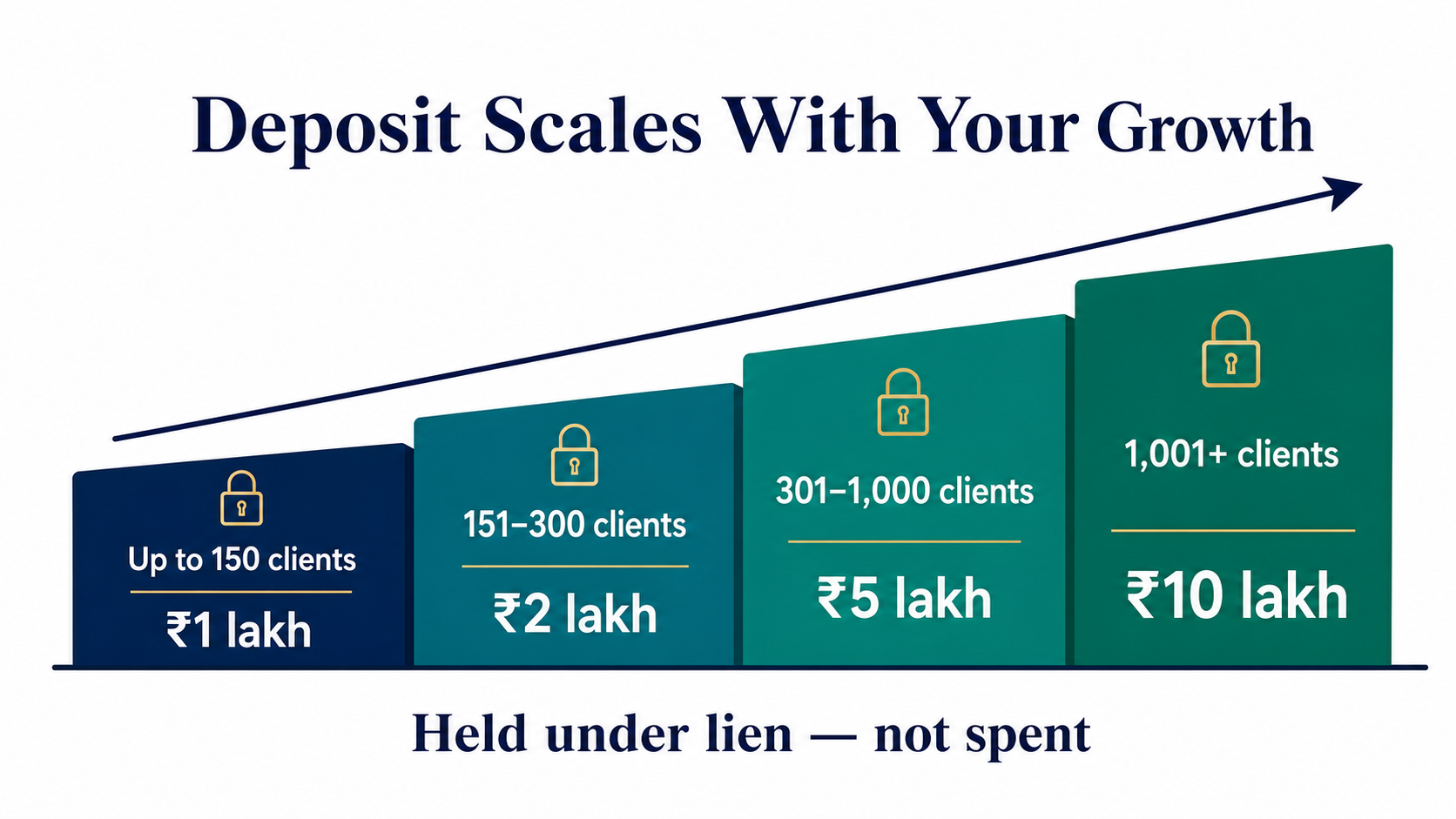
The deposit tends to draw the most questions from new applicants, and once its mechanics are clear, it turns out to be one of the more reasonable parts of the whole process.
The current slabs scale with client count:
This money never actually leaves your ownership. It can sit as a fixed deposit or in liquid and overnight mutual fund units, simply held under lien while registration stays active. It functions less like an expense and more like a security deposit that becomes fully accessible again once it's no longer needed.
For most people starting out solo, the base slab is genuinely achievable, especially set against the older net worth requirement that used to apply. It's a rule that became more accessible over time, not less.
SEBI's move toward this scaled deposit approach actually benefits new advisers more than the old system did.
The earlier net worth rule held everyone to the same bar regardless of client count, which meant someone just starting out with a handful of clients faced the same threshold as someone running a much larger practice.
The newer model ties deposit size to actual client count, which means:
This structure rewards steady growth. A larger deposit simply reflects a larger, more successful client base, rather than acting as a barrier before anything has even started.
It also means someone testing the waters with a handful of clients doesn't need to commit large sums of capital before knowing whether advisory work suits them. The deposit grows only once the practice has already proven itself worth growing.
Choosing how to hold the deposit is a small decision that's worth thinking through properly, since it affects both liquidity and returns during the years it stays locked.
A few practical points to weigh:
Whichever option is chosen, keeping documentation of the lien arrangement organized makes annual reviews and slab adjustments far smoother.
None of this needs to be complicated. Most advisers pick whichever option their bank or the lien-holding institution makes easiest to set up, and revisit the choice only if their situation changes significantly.
A few standard fees beyond the deposit keep the system running smoothly, and each one stays fairly modest on its own.
None of these fees are designed to be a burden. Spread across a five-year cycle, they leave a long, stable runway after the first registration before the next renewal comes up, plenty of time to build a genuinely profitable practice before these costs need attention again.
It helps to think of these fees the way a professional license fee works in other fields. They're the cost of maintaining recognized, credible status, not a recurring drain that eats into monthly income.
Compliance often gets treated as a chore, but it's genuinely one of the best tools for building a trustworthy, professional practice.
Good habits that double as compliance and client-trust builders:
Clients notice when an adviser is organized and transparent. Documentation isn't just something SEBI wants to see, it's something that makes clients feel genuinely well taken care of.
A program like the Fydaa Young Investment Advisor Entrepreneurship Program builds these habits into training from day one, so they feel natural rather than like extra paperwork tacked onto the real work.
Beyond the baseline requirements, a few extra documentation habits pay off significantly further down the line, especially once a practice has grown beyond a handful of clients.
Worth building into a regular routine:
These habits take very little time to build early on, and they save enormous stress later if a client ever questions a past recommendation or if a routine regulatory review comes up.
Since advisers earn directly from clients, getting comfortable with pricing early on is one of the most empowering steps in this whole journey.
A few fee models worth considering:
A fair, confident price set from day one actually builds more client trust, not less. A well-thought-out fee signals that an adviser takes their own advice seriously, and that confidence tends to be contagious.
Many new advisers also find it helpful to offer a smaller, simpler entry-level plan alongside their full advisory service. This gives hesitant first-time clients an easy way to start working together, while the more comprehensive fee models remain available as the relationship deepens.
A few patterns tend to catch new applicants off guard, and being aware of them ahead of time makes the whole registration process smoother.
Common slip-ups worth watching for:
None of these are difficult to fix once known. They only become a problem when they surprise someone mid-process, usually at a moment when attention is already stretched across studying, documentation, and early client conversations.
A little planning goes a long way toward making the first year feel steady rather than stressful.
A simple approach that works well for most new advisers:
Advisers who plan this way tend to walk into their first client meetings with far more confidence, simply because the financial side is already handled and out of their headspace.
It also helps to build a small buffer into the first-year budget, beyond just the minimum required fees and deposit. Unexpected administrative costs, whether related to travel for client meetings or basic tools like a CRM subscription, tend to show up in the early months and are easier to absorb with a little breathing room built in.

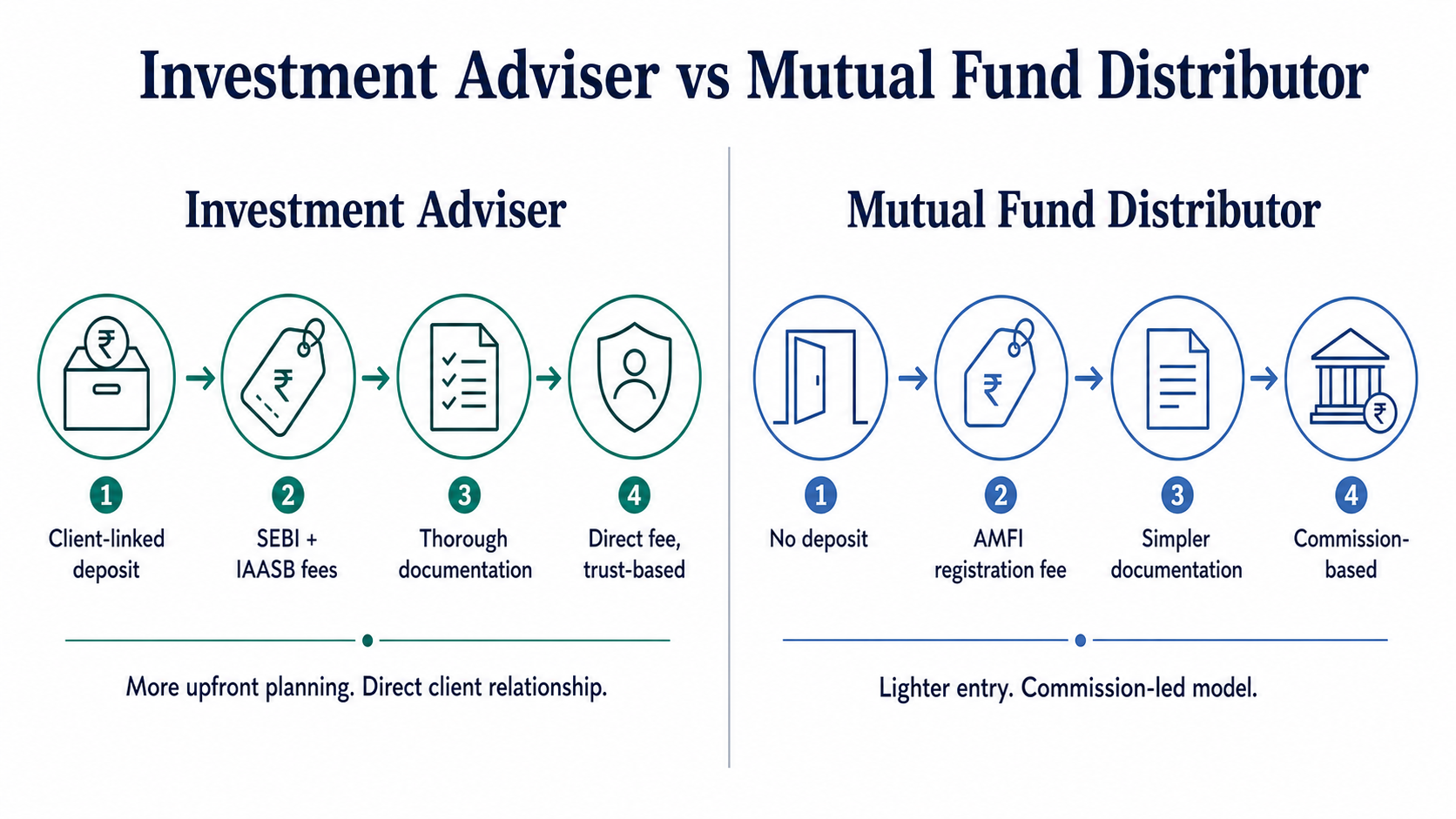
Understanding how the adviser path compares to becoming a mutual fund distributor helps put both costs in perspective, since both are valid, rewarding careers in their own way.
Distribution offers a lighter entry point that suits many people well. The adviser path asks for a bit more upfront investment and diligence, but in return it builds a direct, fee-based relationship with clients rooted entirely in trust rather than product commissions, something a growing number of Indian investors are actively seeking today.
Walking into registration already comfortable with the financial and compliance side of things becomes much easier through a structured training program.
Good programs typically help with:
This kind of preparation turns the entire cost and compliance conversation from something intimidating into something genuinely manageable.
Once the first year is behind you, the financial rhythm of the practice tends to settle into something far more predictable. It helps to look a little further ahead so nothing catches you off guard once things are running smoothly.
Worth keeping on the radar for years two through five:
This kind of forward planning turns registration from a one-time hurdle into a steady, well-managed part of running a long-term advisory career.
Investment advisor registration SEBI style involves some real upfront planning, a deposit, a few fees, and a commitment to solid documentation, but none of it needs to feel overwhelming. Understanding what each cost is for, and how the deposit actually protects one's own interests, turns the whole process into a smart investment in a career built on trust and direct client relationships. With the right preparation, the first year becomes a confident, well-planned start rather than a guessing game, and that confidence carries a practice forward for years to come.

Prof Sheetal Kunder
SEBI® Research Analyst. Registration No. INH000013800 M.Com, M.Phil, B.Ed, PGDFM, Teaching Diploma (in Accounting & Finance) from Cambridge International Examination, UK. Various NISM Certification Holders. Ex-BSE Institute Faculty. 18 years of extensive experience in Accounting & Finance. Faculty Development Programs and Management Development Programs at the PAN India level to create awareness about the emerging trends in the Indian Capital Market, and counsel hundreds of students in career choices in the finance area
Plan for the NISM X-A exam fee, SEBI's application and registration fees, a BSE IAASB membership fee, and a client-linked deposit starting at one lakh rupees for up to 150 clients
Yes. It stays yours fully, held under lien as a bank fixed deposit or in liquid or overnight mutual fund units, and remains accessible once your registration ends
Your first registration covers five years, after which a simple renewal fee to SEBI keeps you active for another five-year cycle
It's a good sign. You simply move up to the next slab, which reflects the healthy growth of your practice
Clear documentation of risk profiles, transparent conflict disclosures, and genuinely suitable recommendations all build the kind of trust that keeps clients coming back
Distribution has a lighter entry cost with no deposit, while advisory registration involves more upfront planning but offers a direct, fee-based relationship with clients
Set your deposit aside early, treat one-time fees as a single upfront investment, and give yourself a realistic runway to build your first clients
Yes, good programs prepare you for exactly what to expect financially and help you build strong documentation and pricing habits from the very beginning
 Launch your Graphy