SEBI investment adviser registration is one of the most-searched financial compliance terms in India, and it is also one of the most misunderstood. Every month, people who work at SEBI-registered Research Analyst firms land on IA registration pages looking for NISM 25A information because the terminology around SEBI's certification requirements overlaps in confusing ways. If that is why you are here, Section 3 of this guide explains exactly where NISM 25A fits and why it applies to RA firms rather than Investment Advisers.
If you are genuinely looking to register as an Investment Adviser with SEBI, this guide covers the full process: who qualifies, what the SEBI IA Regulations 2013 require, how to apply, what documents you need, what the fees are, and what happens if you practise as an IA without a valid SEBI certificate. For the broader context on NISM certifications and SEBI compliance for RA firms, read the NISM Series 25A complete guide Official Reference: NISM official website, nism.ac.in
Who Is an Investment Adviser Under SEBI?
A person is classified as an Investment Adviser under SEBI regulations if they provide investment advice for consideration, whether directly or indirectly, to clients or a group of clients. This definition is broader than most people expect and captures a significant number of individuals who do not think of themselves as IAs.
Under the SEBI (Investment Advisers) Regulations, 2013, an Investment Adviser is defined as any person who, for consideration, is engaged in the business of providing investment advice to clients or other persons or groups of persons. The key elements are advice, consideration (payment), and business activity.
Types of Investment Advisers
SEBI recognises two broad categories:
- Individual Investment Advisers: Natural persons who provide investment advice directly to clients on a fee basis. This includes independent financial planners, wealth managers, and fee-only advisers operating under their own names or as sole proprietorships.
- Non-Individual Investment Advisers: Entities such as companies, LLPs, and partnership firms that provide investment advisory services. They are subject to higher net worth requirements and more detailed compliance structures.
Who Does Not Need IA Registration
Understanding who falls outside the IA definition is as important as knowing who falls inside it. The following do not require SEBI IA registration:
- Stockbrokers, portfolio managers, and mutual fund distributors providing incidental advice within their registered activity
- Advocates, solicitors, or legal practitioners providing investment advice incidental to their professional practice
- Members of recognised professional bodies providing advice incidental to their primary profession
- Research Analysts registered with SEBI who provide research reports and recommendations (they require separate RA registration and, for their support staff, NISM 25A certification)
- Employees of SEBI-registered entities providing investment advice as part of their employment
The line between who needs IA registration and who does not has been tightened significantly by SEBI since the 2013 regulations were introduced. If you are providing fee-based personalised financial advice as a primary business activity, you almost certainly fall within the definition.
SEBI Investment Adviser Regulations 2013: Key Requirements
The SEBI (Investment Advisers) Regulations, 2013, set the baseline legal framework for all Investment Advisers operating in India. They have been amended several times since the original notification, with the most significant amendments coming in 2020 and subsequent SEBI circulars further clarifying the operational requirements.
Qualification Requirements
SEBI sets minimum academic and professional qualifications for IA registration. As of the current regulations:
Individual IAs:
A professional qualification or postgraduate degree or postgraduate diploma (minimum two years) in finance, accountancy, business management, commerce, economics, capital market, banking, insurance, or actuarial science from a university or institution recognised by the central government or any state government, foreign university, or from NISM, or any other institution recognised by SEBIOR a graduate in any discipline with an experience of at least five years of experience in activities related to advice in financial products or securities, funds, assets, or portfolio management
Non-Individual IAs:
The principal officer must meet the above qualification criteria for individual IAs
All persons associated with investment advice must meet the qualification criteria or be working towards compliance
Certification Requirements
This is where NISM certifications enter the picture. For IA registration, SEBI requires:
NISM Series X-A: Investment Adviser (Level 1) certification for individuals providing basic investment advisory services
NISM Series X-B: Investment Adviser (Level 2) certification for individuals providing advice on all financial products, including complex instruments
For non-individual entities, the principal officer must hold the relevant NISM certification
Important: NISM Series 25A is not required for Investment Adviser registration. It is a separate requirement for Persons Associated with Research Services (PARS) at SEBI-registered Research Analyst firms. If you are looking for NISM 25A information in the context of IA registration, see Section 3 below.
Net Worth Requirements
The minimum net worth requirement is Rs 5 lakh for Individual Investment Advisers and Rs 50 lakh for Non-Individual Investment Advisers. Net worth must be evidenced by a certificate from a chartered accountant and must be maintained at all times, not just at the point of registration.
Why NISM 25A Is Mandatory for SEBI RA Firms, Not IA Registration
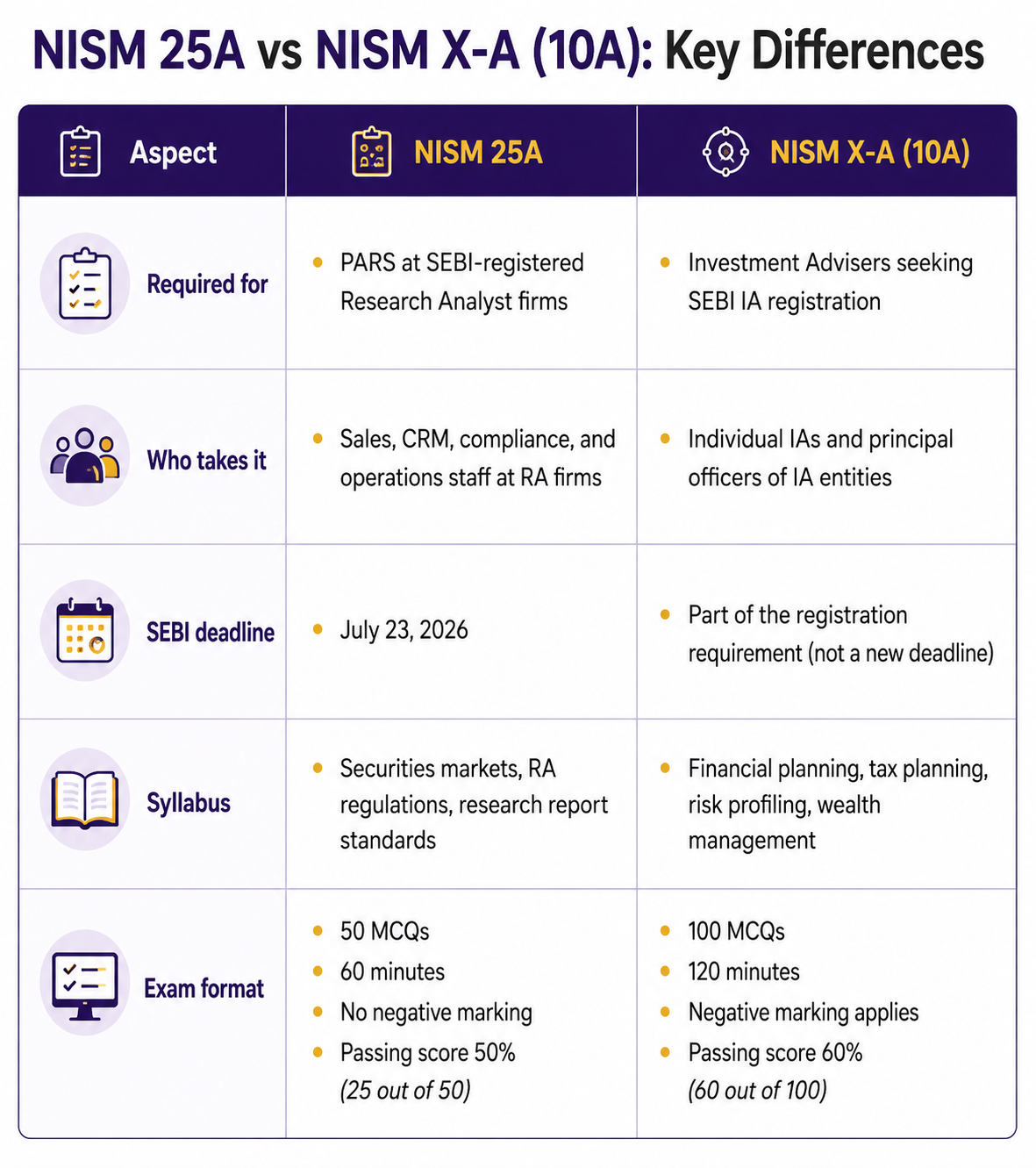
This section exists because candidates frequently confuse the two requirements. NISM 25A and NISM X-A (10A) are both SEBI-mandated NISM certifications, both became significantly more prominent in 2025 and 2026, and both involve SEBI-registered financial services firms. The similarity ends there.
Where the Confusion Comes From
SEBI's Research Analyst Regulations and Investment Adviser Regulations both use the phrase "persons associated" in their compliance requirements. When SEBI issued the circular mandating NISM 25A for research services staff, some firms and candidates interpreted it as part of the broader IA registration requirement. It is not.
NISM 25A applies exclusively to Persons Associated with Research Services (PARS) at firms that hold SEBI Research Analyst registration. If your firm holds IA registration but not RA registration, your staff do not need NISM 25A. If your firm holds RA registration and employs people in research services roles, those people need NISM 25A by July 23, 2026 regardless of whether they also hold any IA-related credentials.
For PARS who need to clear NISM 25A, the
NISM 25A exam pattern and marking scheme covers everything about the exam structure, and the
how to register for NISM 25A guide walks through the registration process step by step.
Step-by-Step Process to Register as an Investment Adviser with SEBI
SEBI IA registration is done entirely online through the SEBI Intermediary Portal. The process has multiple stages and the typical timeline from application submission to certificate issuance runs between four to eight weeks, depending on document completeness and SEBI's processing queue.
Step 1: Clear NISM Certification
Before applying for SEBI IA registration, clear the required NISM certification. Individual IAs need NISM Series X-A as a minimum. If you plan to advise on all financial products, NISM Series X-B is also required. The NISM certificate must be valid at the time of application and must remain valid throughout your registration.
Visit nism.ac.in to register, complete the mandatory e-learning module (this step is required before you can schedule the exam), and schedule your exam. NISM exams for IA certification are taken at NISM test centres.
Step 2: Meet Minimum Qualification Requirements
Before submitting your application, verify that you meet the academic qualification requirements. Have the following ready:
- Degree or diploma certificates as per the qualification criteria
- Experience certificate if applying on the basis of work experience rather than educational qualification
- Chartered accountant certificate confirming net worth (Rs 5 lakh for individuals, Rs 50 lakh for non-individuals)
- Any gap or inconsistency in qualification documentation is the most common reason for application delays.
- Get the CA net worth certificate issued within the last three months before submission.
Step 3: Submit Application on SEBI Intermediary Portal
- Go to the SEBI Intermediary Portal at siportal.sebi.gov.in
- Create a new applicant account using PAN, email, and mobile number
- Select "Investment Adviser" as the registration category
- Fill in all fields in the application form: personal details, qualification details, business details, and net worth details
- Upload all required documents (see Section 5 for the full document list)
- Submit the application. An application number is generated immediately on submission.
- SEBI may issue a clarification letter (deficiency letter) within 30 days if any information is incomplete. Respond within the time specified in the letter.
Step 4: Pay Registration Fees
After your application is reviewed and found to be complete, SEBI generates a fee payment notice. Pay the applicable registration fee through the portal. Do not pay before receiving the payment notice. Fees paid before SEBI's confirmation of application completeness are not automatically adjusted.
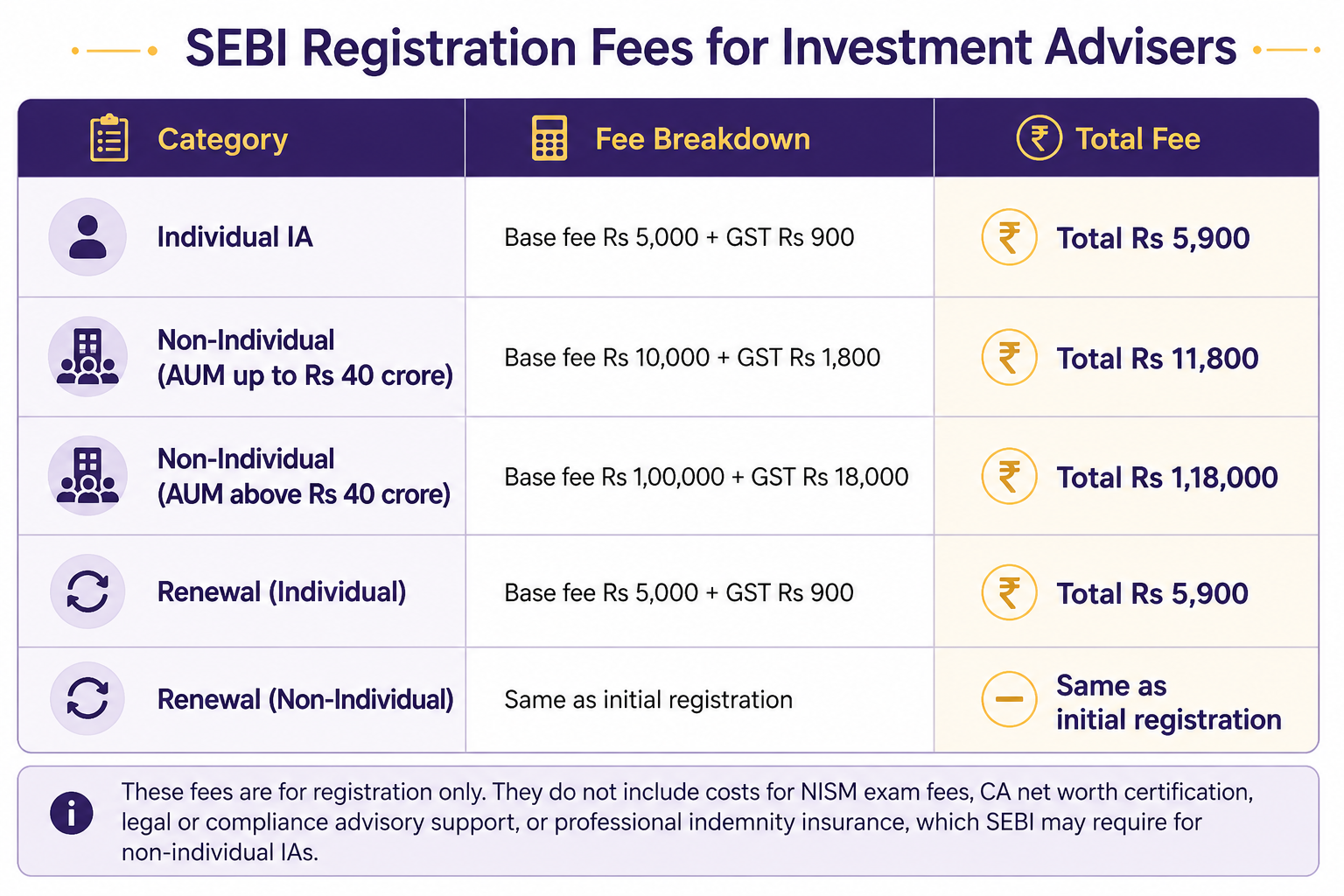
Registration fees by category:
- Individual (direct advice): Rs 5,000
- Non-Individual (entities with AUM up to Rs 40 crore): Rs 10,000
- Non-Individual (entities with AUM above Rs 40 crore): Rs 1,00,000
GST applies at 18% on registration fees. Keep the fee payment receipt as it is required for future renewal filings.
Step 5: Receive Certificate of Registration
Once SEBI processes the application and payment, the certificate of registration is issued electronically. Download and store a copy immediately. The certificate specifies:
Your SEBI registration number
Category of registration (individual or non-individual)
Date of registration
Validity period
The registration is valid for five years and must be renewed before expiry. Add a calendar reminder well before the renewal deadline. An expired IA registration means you cannot legally continue advisory activities until renewal is completed.
Documents Required for SEBI IA Registration
Missing even one document is enough to trigger a deficiency notice and extend your registration timeline by weeks. Prepare this checklist before beginning the application.
Individual Investment Adviser
- PAN card - Self-attested copy
- Aadhaar card - Self-attested copy
- Passport-size photograph - Recent, as per portal specifications
- NISM certification certificate - NISM X-A at minimum; X-B if applicable
- Academic qualification certificate - Degree, diploma, or postgraduate certificate as applicable
- Experience certificate - Required only if applying on a work experience basis
- Net worth certificate - From a practising CA, issued within 3 months of application
- Bank account proof - Cancelled cheque or bank statement
- Address proof for business premises - Utility bill, lease agreement, or ownership document
- Declaration of absence of criminal record - As per SEBI application format
- NISM certificate of completion for e-learning module - Separate from the exam certificate
- Non-Individual Investment Adviser (Company or LLP)
- All individual documents for the principal officer, plus:
- Certificate of incorporation or LLP agreement - From the MCA portal
- Memorandum and Articles of Association - For companies
- Board resolution authorising application - For companies
- List of directors/partners - With PAN and address details
- Net worth certificate for the entity - Rs 50 lakh minimum, CA-certified
- NISM certificates for all persons providing investment advice - Not just the principal officer
- Shareholding pattern - For companies with more than one shareholder
SEBI Registration Fees for Investment Advisers
Compliance Requirements After Registration
Getting the certificate is the start, not the finish. SEBI IA regulations impose ongoing compliance obligations that registered IAs must maintain at all times. A lapse in any of these is grounds for suspension or cancellation of registration.
Client Documentation Requirements
- Know Your Client (KYC): Every client must be KYC-verified before receiving investment advice. This means Aadhaar-based eKYC or physical KYC through a SEBI-registered KYC Registration Agency.
- Risk Profile Assessment: IAs must assess each client's risk profile, financial situation, investment objectives, and time horizon before providing any advice. This must be documented and updated periodically.
- Investment Policy Statement: A written record of the advice given to each client, the basis for that advice, and how it aligns with the client's risk profile must be maintained for every engagement.
- Fee Disclosure: The IA must disclose fees to the client in writing before the engagement begins. SEBI prohibits IAs from receiving commissions or any form of incentive from product manufacturers in addition to client fees. The IA model is fee-only.
Reporting and Record-Keeping
Maintain records of all client interactions, advice given, risk assessments, and fee receipts for a minimum of five years
File an annual compliance report with SEBI confirming adherence to IA regulations
Renew the NISM certification before it expires and update SEBI records accordingly
Submit the financial statements of the entity annually (for non-individual IAs)
Grievance Redressal
Registered IAs must have a documented client grievance redressal process. Client complaints must be acknowledged within 24 hours and resolved within 30 days. SEBI's SCORES portal is the escalation mechanism if the client is not satisfied with the IA's resolution. All SCORES complaints against a registered IA are tracked and visible to SEBI.
Professional Indemnity Insurance
Non-individual IAs with a certain level of assets under advisory are required to maintain professional indemnity insurance. Check the current SEBI circular for the applicable threshold and coverage requirement, as this has been revised in recent years.
Continuing Professional Education
NISM certifications are valid for a defined period. Before expiry, the IA must either renew the certification by re-sitting the exam or complete a SEBI-approved Continuing Professional Education (CPE) programme. An expired NISM certification while holding active SEBI IA registration is a compliance violation.Penalties for Practising Without SEBI Registration
Providing investment advice for consideration without holding a valid SEBI IA registration is a serious regulatory offence. SEBI has increased enforcement activity in this area significantly since 2022, particularly targeting unregistered advisers operating through social media, WhatsApp groups, Telegram channels, and YouTube.
Applicable Penalties
Under the SEBI Act and the IA Regulations, SEBI can impose:
- Providing investment advice without registration: Up to Rs 1 crore per violation or three times the profit made
- Misrepresenting credentials or SEBI registration status: Penalty plus disgorgement of client fees received
- Providing advice after registration has expired or been suspended: Treated as practising without registration
- Failure to maintain required records: Penalty and possible suspension
- Non-disclosure of fees or conflicts of interest: Penalty and possible cancellation of registration
SEBI Enforcement Actions
SEBI has been issuing interim orders, show cause notices, and final orders against unregistered investment advisers at a significant pace over the past three years. Orders are publicly listed on the SEBI website and are permanent records. A SEBI enforcement order against an individual makes future registration applications significantly more difficult and can disqualify the applicant entirely, depending on the nature of the violation.
The most common scenario SEBI targets is someone who charges a fee for tips, model portfolios, or personalised stock recommendations through a paid Telegram or WhatsApp group without holding IA registration. The fee does not need to be large. Even a subscription fee of Rs 500 per month for stock tips to 50 clients constitutes providing investment advice for consideration and requires SEBI IA registration.
If your current activity might fall within the IA definition but you are unsure, the safest step is to consult a SEBI-registered compliance professional before continuing the activity. The penalty for getting this wrong is significantly higher than the cost of clarifying it upfront.


 Launch your Graphy