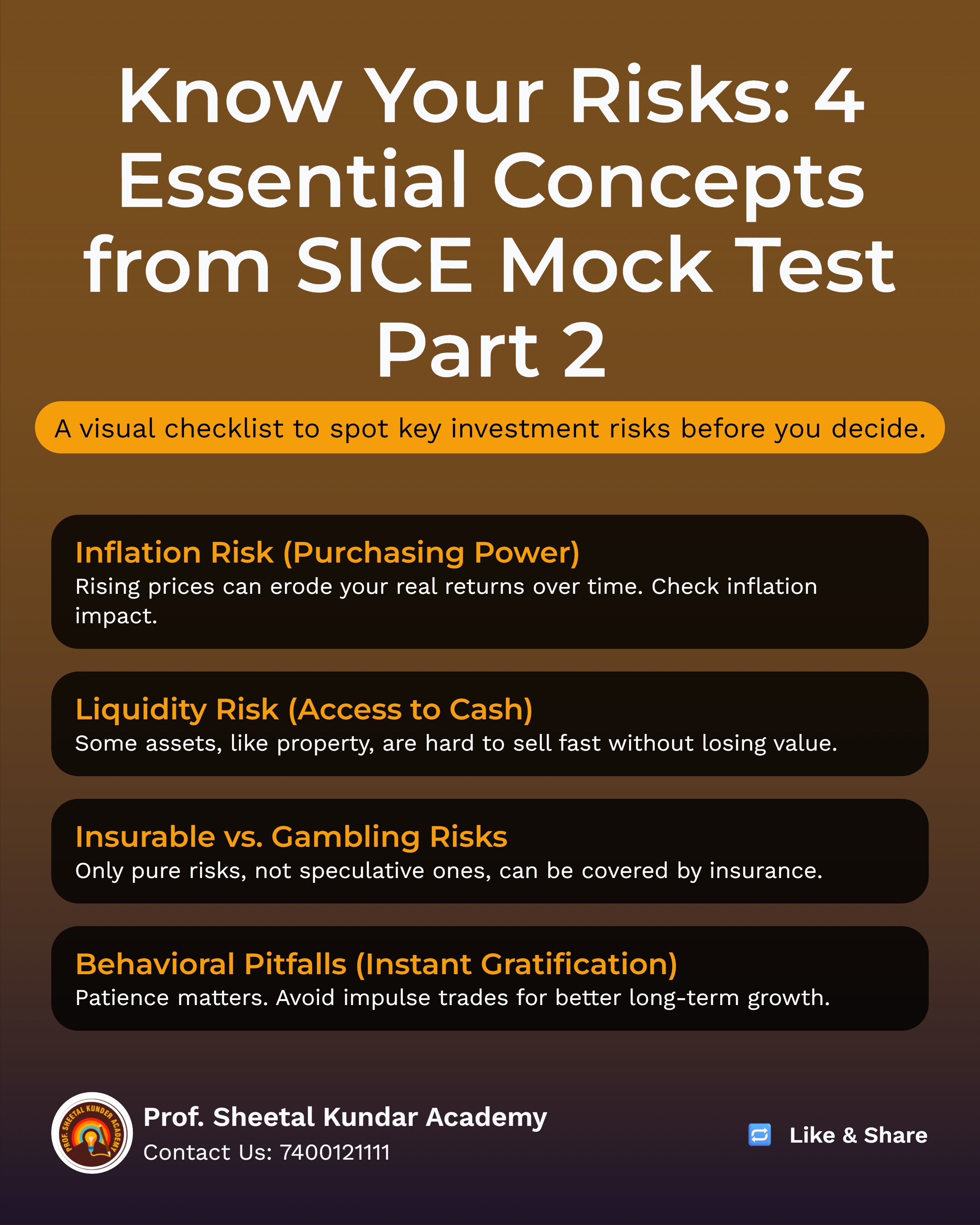
Q1. What is inflation?
- Correct answer: Rise in the general price level of goods and services.
- Explanation: Inflation erodes purchasing power; lower portfolio real returns delay or shrink corpus growth.
- Exam cue: Always compare nominal returns to inflation for real return.
Q2. Which risk cannot be insured?
- Correct answer: Losses from gambling.
- Explanation: Insurable risks are fortuitous and measurable (e.g., accidents, earthquakes, floods); speculative acts like gambling are not insurable.
- Exam cue: Speculative risk ≠ insurable risk.
Q3. If regular expenses exceed regular income, what should one do?
- Correct answer: Either borrow or sell assets.
- Explanation: First cut discretionary spends, but if essential outflows exceed inflows, bridge via prudent borrowing or asset sales.
- Exam cue: Align cash flow via budget; consider cost of borrowing vs asset liquidation.
Q4. Strategy to reduce investment risk by investing across avenues
- Correct answer: Diversification.
- Explanation: Spread across asset classes and within them to lower concentration risk and stabilize outcomes.
- Exam cue: “All eggs in one basket” = concentration risk.
Q5. Liquidity risk can be managed by
- Correct answer: Mapping cash flow needs to investment tenures.
- Explanation: Time goals decide product choice; short‑term needs use liquid/short duration products, long‑term can use growth assets.
- Exam cue: Horizon–product fit reduces forced exits.
Q6. Ability to convert investments into cash with ease is called
- Correct answer: Liquidity.
- Explanation: Listed equities/ETFs/MFs are relatively liquid; real estate is typically illiquid.
- Exam cue: Liquidity = speed + fair price realization.
Q7. At which life stage do longer life span and inflation pose high financial risk?
- Correct answer: Retirement.
- Explanation: Active income stops while expenses continue; plan a corpus that beats inflation for decades.
- Exam cue: Sequence‑of‑returns risk + longevity risk matter post‑retirement.
Q8. You often miss flights but do not buy insurance—this is
- Correct answer: Risk retention.
- Explanation: By not transferring (insuring) the risk, the financial impact remains with the traveler.
- Exam cue: Transfer via insurance vs retention by choice.
Q9. Know the time horizon; how to estimate annual rate to double money?
- Correct answer: Rule of 72 (72 ÷ years).
- Explanation: A thumb rule for compounding; for precise planning, use exact CAGR math.
- Exam cue: Handy for quick feasibility checks.
Q10. Market with strong demand and rising stock prices
- Correct answer: Bull market.
- Explanation: Rising sales/profits fuel optimism and higher equity prices.
- Exam cue: Bull = rising, Bear = falling.
Q11. Role of Depository Participant (DP) in securities market
- Correct answer: Safeguards and maintains securities in electronic form.
- Explanation: DPs interface between investors and depositories (NSDL/CDSL) for demat and transfers.
- Exam cue: DP = agent of depository for investor services.
Q12. During due diligence, an investor should consider
- Correct answer: Examining cash flow statement, income statement, and balance sheet.
- Explanation: Also evaluate business model, competition, management quality, and macro sensitivity.
- Exam cue: Avoid ignoring business model or peer comparisons.
Q13. What is SEBI SCORES?
- Correct answer: An online platform for investors to file complaints against SEBI‑registered intermediaries and track resolution status.
- Explanation: Ensures time‑bound handling, status visibility, and escalation if needed.
- Exam cue: Use official grievance mechanisms for redressal.
Q14. When a market index value goes up, what does it imply?
- Correct answer: Investors are feeling positive about the market.
- Explanation: Index gains reflect weighted advances in constituent stocks, signaling improving sentiment.
- Exam cue: Index is an aggregate signal, not a guarantee for each stock.
Q15. Hybrid funds typically invest in
- Correct answer: A combination of equity and debt securities.
- Explanation: Asset mix manages risk/return; sub‑types vary by equity allocation.
- Exam cue: Check scheme category and Riskometer for fit.
Q16. Where can investors buy and sell REIT units?
- Correct answer: On the stock exchange.
- Explanation: Listed REITs trade like shares/ETFs during market hours, enabling liquidity.
- Exam cue: REIT income = rentals + potential appreciation.
Q17. Confirmation of trades done during the day for/on behalf of a client is called
- Correct answer: Contract note.
- Explanation: Shows order details, price, time, charges; statutory proof for trades.
- Exam cue: Verify promptly for accuracy.
Q18. Are derivatives low‑risk or high‑risk products?
- Correct answer: High risk.
- Explanation: Leverage, margining, and path‑dependence can amplify losses; requires strong risk controls.
- Exam cue: Options/futures demand clear strategies and limits.
Q19. Before investing, an investor should be aware of
- Correct answer: The risks involved.
- Explanation: Understand downside, volatility, liquidity, and suitability before expected returns or branding.
- Exam cue: Suitability first; returns later.
Q20. What is not traded on stock exchanges?
- Correct answer: Fixed deposits.
- Explanation: ETF units, listed company shares, and many debentures are exchange‑traded; bank FDs are not.
- Exam cue: Distinguish primary bank products vs marketable securities.
Q21. Main advantage of ETFs over regular mutual funds
- Correct answer: Higher daily liquidity and lower fees.
- Explanation: ETFs trade intra‑day and usually carry lower expense ratios than many active funds.
- Exam cue: Track index; mind tracking error and bid‑ask spreads.
Q22. IPO tip claims shares will double on listing—what should you do?
- Correct answer: Do your own homework; check fundamentals before investing.
- Explanation: Avoid tip‑driven decisions; assess business quality, valuations, risk.
- Exam cue: Hype ≠ investment thesis.
Q23. A pool of investments is called
- Correct answer: Mutual fund.
- Explanation: AMCs pool investor money into schemes for professional management per stated objectives.
- Exam cue: Read scheme documents for mandate and risks.
Q24. What returns do equity mutual funds offer?
- Correct answer: Dividends and capital appreciation.
- Explanation: NAV gains and distributed dividends form total return; taxation differs by component.
- Exam cue: Focus on long‑term, post‑tax, real returns.
Q25. From where can you buy securities of listed companies?
- Correct answer: Stock brokers (members of stock exchanges).
- Explanation: Registered trading members route orders to exchanges and handle settlement.
- Exam cue: Always transact via registered intermediaries.
Q26. What does a mutual fund’s NAV represent?
- Correct answer: Realizable value of the assets of the fund (per unit, net of liabilities/expenses).
- Explanation: NAV ≈ per‑unit market value after expenses; it updates per valuation norms.
- Exam cue: NAV is not “cheap/expensive” by itself—look at portfolio, not price alone.
Q27. Settlement of funds and securities as per running account authorization should occur
- Correct answer: At least once in 30 days or 90 days as opted by the investor.
- Explanation: Periodic settlement ensures idle balances are returned and accounts reconciled.
- Exam cue: Choose frequency and monitor statements.
Q28. Typical outcome for remaining investors when a Ponzi scheme collapses
- Correct answer: The promoter disappears with all the money.
- Explanation: Schemes pay old investors from new inflows until inflows stop and collapse occurs.
- Exam cue: “High return, no risk, hurry” = red flags.
Q29. Which is an objective of SEBI?
- Correct answer: Regulating the securities market.
- Explanation: SEBI regulates markets and protects investors; use its mechanisms for redressal and transparency.
- Exam cue: Know regulator roles and escalation paths.
Q30. You receive an email claiming a ₹1 crore lottery asking for personal and bank credentials—this is
- Correct answer: Phishing.
- Explanation: Never share credentials; report and delete suspicious communications.
- Exam cue: Use official portals; enable 2FA and strong hygiene.
Q31. Passive mutual funds are designed to
- Correct answer: Provide returns similar to the market index.
- Explanation: They replicate index constituents/weights; slight variance is tracking error.
- Exam cue: Costs and tracking error shape net results.
Q32. Investing all savings only in stocks is the only way to get rich—correct?
- Correct answer: No; diversify and explore other avenues too.
- Explanation: Asset allocation across equity, debt, gold, etc., balances risk and goals.
- Exam cue: Allocation > selection for long‑term outcomes.
Q33. Inherited 10,000 large‑cap shares; registrar not transferring despite attempts—what recourse?
- Correct answer: File a complaint on SEBI’s SCORES platform.
- Explanation: Official redressal provides tracking and timelines; RTA must respond.
- Exam cue: Maintain documentation for transmission requests.
Q34. Missed encashing dividends from FY15–16; can the company pay now?
- Correct answer: No; after 7 years, unclaimed amounts move to IEPF—recover via IEPF claim.
- Explanation: Unclaimed dividends and shares are transferred to IEPF; investors must claim from IEPF.
- Exam cue: Track dividends/corporate actions; update bank/KYC promptly.
Q35. Markets are rapidly falling—should long‑term investments be sold?
- Correct answer: No; avoid panic selling if fundamentals are intact.
- Explanation: Volatile phases like pandemics can reverse; focus on quality and horizon, not fear.
- Exam cue: Time in market and discipline drive compounding.
Q36. Newly‑listed company shows quick gains; news and social posts look positive—hold purely on news?
- Correct answer: No; do your own research beyond media/social narratives.
- Explanation: Momentum can reverse; assess fundamentals, valuations, and risks before decisions.
- Exam cue: Validate tips; use documented thesis and exit rules.


 Launch your Graphy