There are no items in your cart
Add More
Add More
| Item Details | Price | ||
|---|---|---|---|

{{DATE}}
India’s capital markets are entering a phase of structural maturity. Over the last two decades, traditional investment instruments such as equity mutual funds, debt mutual funds, fixed deposits, and direct equities have become widely accepted by retail and institutional investors. However, as markets evolve, investors are increasingly exposed to volatility, consolidation phases, and complex global macroeconomic factors.
During prolonged sideways or volatile markets, conventional products often struggle to deliver consistent risk-adjusted returns. At the same time, retail participation in Futures & Options (F&O) trading has surged, resulting in significant financial losses due to unstructured and speculative trading behaviour.
Structured Investment Funds (SIFs) have emerged as a regulated, professionally managed, and structured solution to these challenges. As discussed in the podcast conversation between Prof. Sheetal Kunder and Nitin Manapure, SIFs represent India’s first serious step toward creating a regulated alternative investment framework, comparable in intent—though not identical - to hedge funds in developed markets.
Structured Investment Funds are multi-asset investment products that combine traditional securities with derivative-based strategies under a predefined, rule-based framework. Unlike discretionary trading or speculative F&O activity, SIFs are designed with clear structure, risk controls, and regulatory oversight.
SIFs may use a combination of the following instruments:
Traditional mutual funds perform well during strong market trends but face challenges during:
In such conditions, return generation becomes inconsistent despite professional fund management.
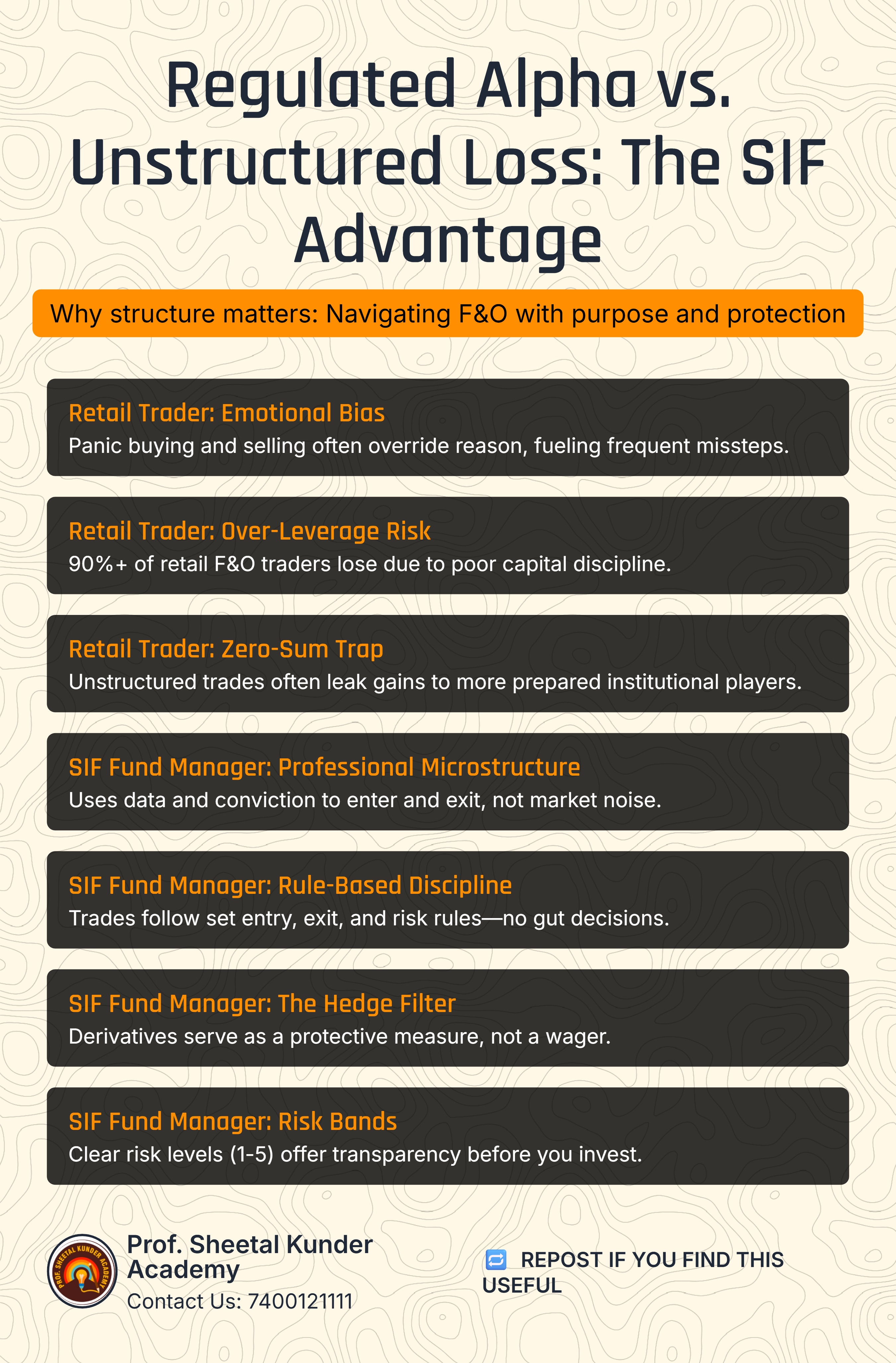
As highlighted in the discussion, Indian retail investors collectively lose tens of thousands of crores annually in unstructured derivatives trading. Key reasons include:
Derivatives are zero-sum instruments—when retail investors lose, large institutional participants often gain.
Before SIFs, investors seeking higher or differentiated returns often turned to:
These options lacked transparency, accountability, and investor protection.
SIFs were introduced to fill this structural gap.
Unlike single-asset products, SIFs allocate across:
This diversification reduces dependency on any single market outcome.
In SIFs, derivatives are used to:
This is fundamentally different from speculative retail F&O trading.

Each SIF strategy operates within predefined parameters, including:
This eliminates emotional decision-making and ensures consistency.
SIFs are managed by experienced fund managers who:
This professional oversight is central to SIF's credibility.
While SIFs are often referred to as India’s hedge fund equivalent, important distinctions exist:
| Parameter | Structured Investment Funds | Hedge Funds |
|---|---|---|
| Regulation | SEBI-regulated | Lightly regulated |
| Transparency | High | Limited |
| Risk Controls | Predefined | Discretionary |
| Investor Protection | Strong | Variable |
| Accessibility | Broader | Restricted |
SIFs aim to offer sophisticated strategies without excessive opacity or uncontrolled risk.
SEBI plays a central role in ensuring that SIFs operate within a controlled and transparent framework by enforcing:
This regulatory backbone differentiates SIFs from unregulated alternatives.
One of the most important safeguards is the requirement that distributors clear the NISM Series XIII – Common Derivatives Certification.
This ensures distributors:
Certification acts as a quality filter across the distribution ecosystem.
SIFs cannot be sold solely on personal relationships. They require:
Technical explanation
Risk profiling
Suitability assessment
Certified distributors are trained to handle these responsibilities.
Distributors play a critical role in:
Explaining volatility
Communicating downside risks
Aligning products with investor goals
This education-driven approach builds long-term trust.
Certification helps ensure:
Accurate product representation
Ethical distribution practices
Protection of investor interests
This strengthens industry credibility.
SIF distribution is still at an early stage. The number of certified professionals remains limited, creating:
Competitive advantage
Market differentiation
Higher professional credibility
Certification and SIF exposure enhance:
Technical knowledge
Advisory capability
Professional positioning
This supports long-term career development.
SIFs are suitable for investors who:
Have moderate to high risk appetite
Seek diversification beyond mutual funds
Understand market volatility
Have a medium to long-term investment horizon
They are not meant for short-term speculation.
While structured, SIFs still involve risks such as:
Market risk
Strategy execution risk
Volatility risk
However, these risks are managed through structure, diversification, and professional oversight, unlike direct trading.
As Indian markets mature:
Demand for alternative investments will rise
Institutional and HNI participation will increase
Product innovation will expand
SIFs are expected to become a core portfolio component, not a niche offering.
Structured Investment Funds mark a significant evolution in India’s investment ecosystem. They combine:
Regulatory protection
Professional fund management
Structured derivative strategies
Certified distribution
For investors, SIFs offer diversification and resilience across market cycles.
For professionals, they represent an opportunity to lead in a rapidly evolving financial landscape.
As emphasized in the discussion, SIFs are not about chasing returns—they are about structured, disciplined, and regulated investing. This positions them as a cornerstone of the future of Indian capital markets.

Prof. Sheetal Kunder
 Launch your Graphy