There are no items in your cart
Add More
Add More
| Item Details | Price | ||
|---|---|---|---|

PMS, or Portfolio Management Services, means a professional manages your money on your behalf, deciding how much goes into equity, how much into debt, and when to rebalance. The entry point for traditional PMS today is ₹50 lakh, which has kept it mostly limited to affluent investors.
The PMS industry has grown fast even within that limit:
SEBI's consultation paper proposes a comprehensive review of the Portfolio Managers Regulations, 2020, and the MF-PMS category is one part of it. Here's what's proposed:
Public comments closed 13 August 2026. As of today, SEBI hasn't notified a final regulation, so every figure above remains proposed, not confirmed.
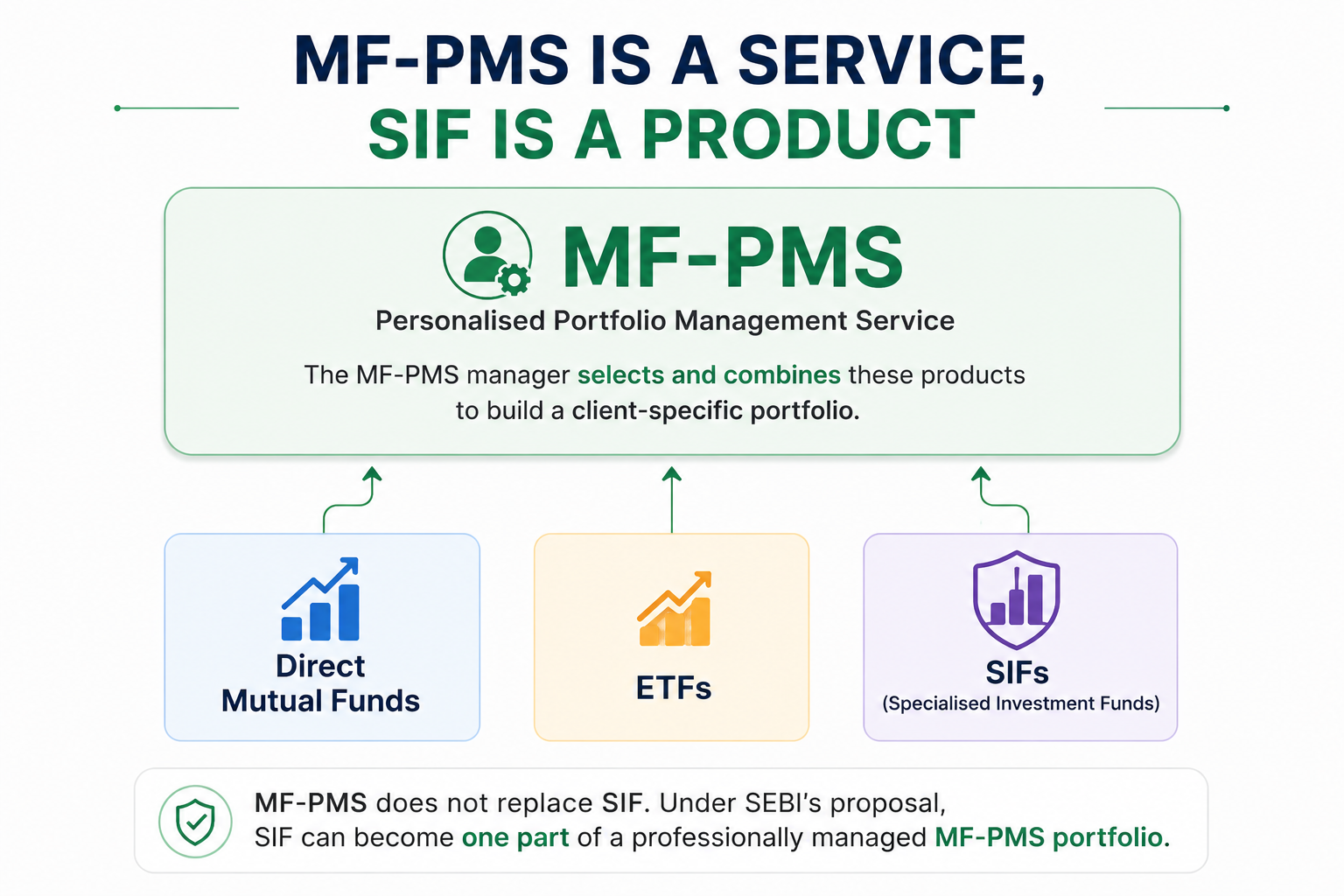
Before going further, it's worth slowing down for a second and keeping two things separate in your head, because they sound almost identical on the surface, but they're doing completely different jobs. Mixing them up is the easiest way to misread everything that follows in this piece.
Under the proposed framework, SIF doesn't get replaced by MF-PMS. It becomes one of the ingredients an MF-PMS manager can choose to use.
A few things worth being precise about before reading further into what this could mean:
The easy assumption is that MF-PMS will eat into SIF, since both are chasing the same investor looking to go beyond plain mutual funds, but that assumption misses something important about how the proposed structure actually works.
MF-PMS can invest in SIF, so a portfolio manager can allocate part of a client's money to SIF as one piece of a bigger portfolio, not as a rival product. That changes how SIF gets bought:
SIF doesn't have to compete with MF-PMS, it can become part of it, but only if fund houses prove real value instead of leaning on marketing lines like "we use derivatives." The next test for SIF isn't awareness, that part will happen on its own. It's relevance, whether the strategy earns its place once a professional is the one deciding where the money goes.
MF-PMS invests only in direct mutual fund plans, and direct plans pay no trail commission to distributors, that's the entire point of a direct plan.
So if a client moves from a regular plan into MF-PMS, a distributor's ongoing commission from that relationship can disappear.
Some industry coverage of the proposal also reports a firewall provision, restricting a firm from running both an MFD business and an MF-PMS business for the same client.
This detail comes from secondary industry reporting rather than SEBI's consultation paper directly, so treat it as reported, not confirmed, until SEBI's final framework is out.
What is clear from SEBI's own proposal is the fee structure: MF-PMS charges a fixed management fee capped at 2.5% of AUM, paid directly by the client rather than built into a distributor's trail commission.
That alone points toward a fee-based model that looks different from how most MFDs currently earn.
Almost every investor has heard of mutual funds by now. Affluent investors generally know what PMS is too, even if they've never used it.
SIF is still different, it's new territory for most people, including plenty of investors who are already active in the market and comfortable making their own decisions elsewhere.
That gap is exactly where a distributor's role becomes valuable, not less valuable, the way some people assume as digital investing grows.
NISM-Series-V-D, the Mutual Fund - Specialized Investment Fund Distributors Certification Examination launched in July 2026, gives MFDs a dedicated certification pathway covering both mutual fund and SIF distribution, distinct from the tougher NISM Series XIII route that was previously the only way in.
Here's the pattern that tends to play out once a distributor actually gets certified:
None of that chain starts if the distributor doesn't understand SIF first, which is really the whole point of getting certified before trying to have the conversation.
If you're still weighing whether it's worth the time, a NISM V-D mock test can give you a quicker sense of where you stand than reading through the syllabus first.
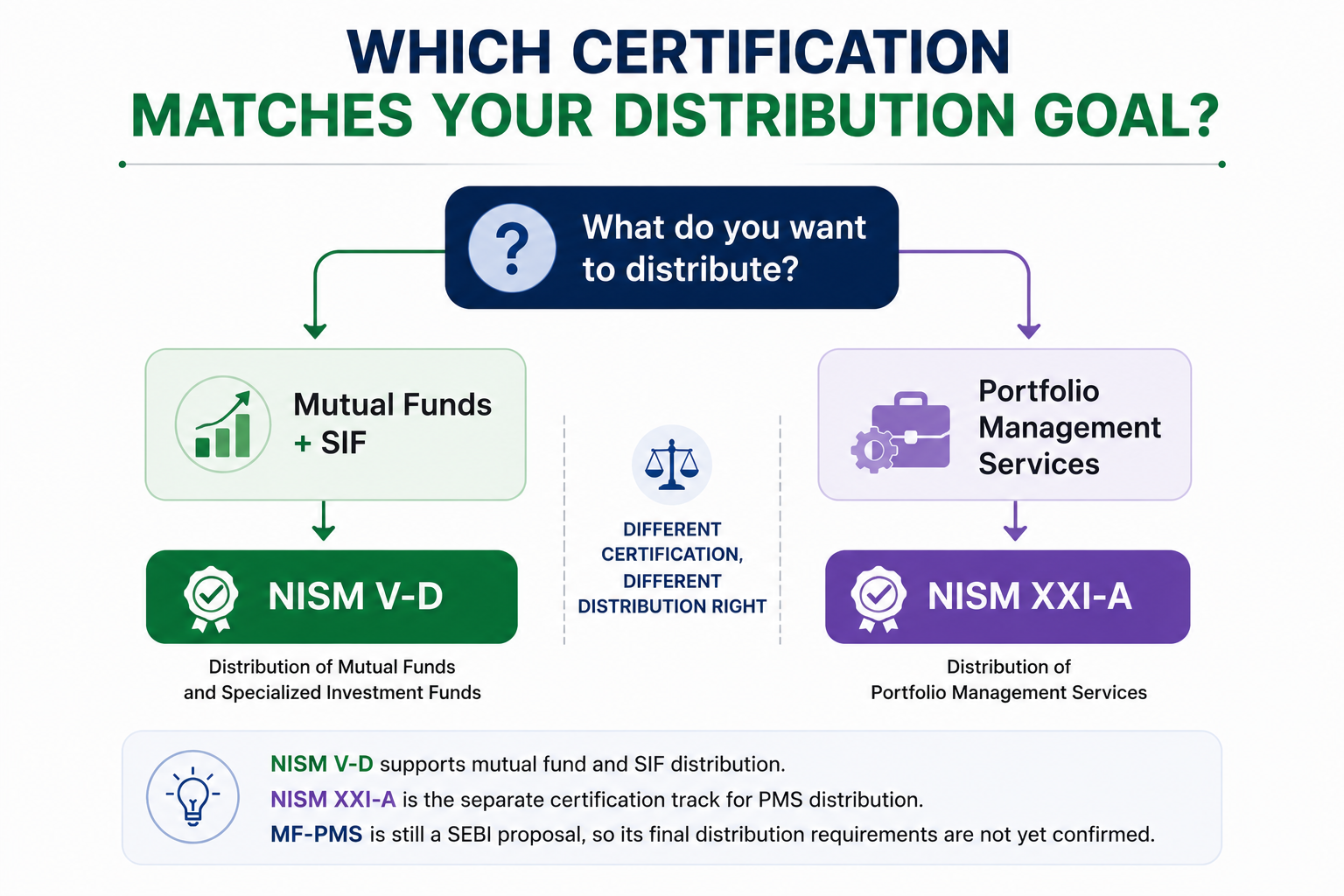
One thing worth being precise about: clearing NISM V-D does not let you distribute PMS or MF-PMS. That's a separate certification.
If the proposed MF-PMS framework is finalized and its distribution runs through the existing PMS distributor framework, NISM XXI-A would be the relevant certification.
NISM V-D itself does not authorize PMS or MF-PMS distribution, and that's true regardless of how the proposal eventually turns out.
If SIF distribution is your near-term goal, V-D is the right certification. If PMS or MF-PMS distribution becomes part of your plan later, particularly if you work with HNI or affluent clients, that's the separate XXI-A track.
There's no mandatory sequence here, but a natural professional progression is emerging for MFDs who want to grow beyond plain mutual fund distribution:
SEBI's MF-PMS proposal isn't really a threat to SIF. It's a test of whether SIF is good enough to earn a permanent seat inside professionally managed portfolios, and that test depends on more than regulation.
It depends on distributors who understand SIF well enough to explain it clearly, fund houses that build strategies genuinely different from a regular mutual fund, and portfolio managers who see SIF as useful rather than redundant.
For mutual fund distributors, the near-term move isn't chasing PMS distribution rights or waiting for MF-PMS to become final.
It's making sure you can talk about SIF with real confidence, since NISM V-D already gives you that certification today, no proposal required.
MF-PMS itself stays exactly what it is right now: a 2026 proposal, not a rule, until SEBI notifies otherwise. Track it if it affects your business, but don't let it slow down the SIF conversation you can already have with your clients this week.

Prof. Sheetal Kunder
SEBI® Research Analyst. Registration No. INH000013800 M.Com, M.Phil, B.Ed, PGDFM, Teaching Diploma (in Accounting & Finance) from Cambridge International Examination, UK. Various NISM Certification Holders. Ex-BSE Institute Faculty. 18 years of extensive experience in Accounting & Finance. Faculty Development Programs and Management Development Programs at the PAN India level to create awareness about the emerging trends in the Indian Capital Market, and counsel hundreds of students in career choices in the finance area.
MF-PMS is a proposed Portfolio Management Services category that invests only in direct mutual funds, ETFs and SIF, with a proposed ₹25 lakh minimum instead of the usual ₹50 lakh. SEBI proposed it in a consultation paper released 23 July 2026, not yet final regulation.
No to both. It's a consultation paper released 23 July 2026, feedback closed 13 August 2026. No final regulation exists, so no portfolio manager can legally offer MF-PMS yet.
Traditional PMS lets a portfolio manager invest directly in stocks, bonds and other securities, with a ₹50 lakh minimum. Proposed MF-PMS restricts investment to direct mutual funds, ETFs and SIF, at a lower ₹25 lakh minimum.
SIF sits under the same regulatory framework as mutual funds but allows more concentrated, theme-based strategies. The ₹10 lakh minimum, well above most mutual funds, keeps it aimed at investors comfortable with more risk.
Yes. SIF is explicitly part of the proposed MF-PMS investment universe alongside direct mutual funds and ETFs, so a portfolio manager running an MF-PMS mandate could allocate to SIF as part of a client's portfolio.
Not necessarily. Since SIF is part of MF-PMS's own investment universe, MF-PMS could actually increase SIF's relevance by making it a standard building block inside professionally managed portfolios, rather than something investors have to seek out on their own.
₹25 lakh for clients, and ₹2 crore net worth for portfolio managers wanting to offer it, both proposed figures, down from ₹50 lakh and ₹5 crore respectively for traditional PMS.
No. NISM V-D covers mutual fund and SIF distribution only. Distributing PMS, including MF-PMS if it's finalized, requires a separate certification, NISM Series XXI-A.
If you work with clients who are ready to think beyond plain mutual funds, or if SIF questions are already coming up in client conversations, V-D gives you a dedicated, current certification path to answer them credibly.
NISM Series XXI-A is the Portfolio Management Services (PMS) Distributors Certification Examination, mandatory for anyone distributing PMS on behalf of a SEBI-registered portfolio manager. It's a separate certification from NISM V-A or V-D, with 100 questions, a 2-hour duration, and a 60% passing score.
 Launch your Graphy