There are no items in your cart
Add More
Add More
| Item Details | Price | ||
|---|---|---|---|

Tue Feb 10, 2026
In the heat of a military operation, an attacking force never moves in isolation. To successfully take an objective, you need a "Supporting Team" a unit that stays on the ground, provides cover fire, and ensures the attacking party can move forward safely
For the Colonel, Asset Allocation isn't just a financial term; it is the "backbone" of any long-term mission
In sports like basketball, volleyball, or boxing, a player must always have one leg firmly on the ground to maintain stability
Stability Over Speed: While the "attacking" assets (Equity) capture the headlines, the "supporting" assets (Debt/Fixed Income) provide the platform that allows you to stay in the game when markets turn hostile
The DSOPF/VPF Anchor: For defence personnel, the Defence Services Officers Provident Fund (DSOPF) or a Voluntary Provident Fund (VPF) serves as this stable leg. With a 7.1% compounding rate, it acts as a low-risk instrument that protects the overall portfolio
The Civilian Equivalents: For those in the civilian sector, this stability is found in EPF, PPF, FDs, or RD accounts

Colonel Anand uses a specific tactical example to explain the role of Debt in a portfolio
The Suppression Mission: In an attack, the supporting team uses machine guns or rocket launchers to suppress the enemy
Preventing Panic Redemptions: When the equity markets are down for a phase of 2-3 years, you cannot - and should not -redeem from your equity funds
Safe Withdrawal Zone: Having a well-funded "supporting team" (Debt) means you have a safe pool of money to draw on during a crisis, allowing your "attacking team" (Equity) time to recover and win the long-term war
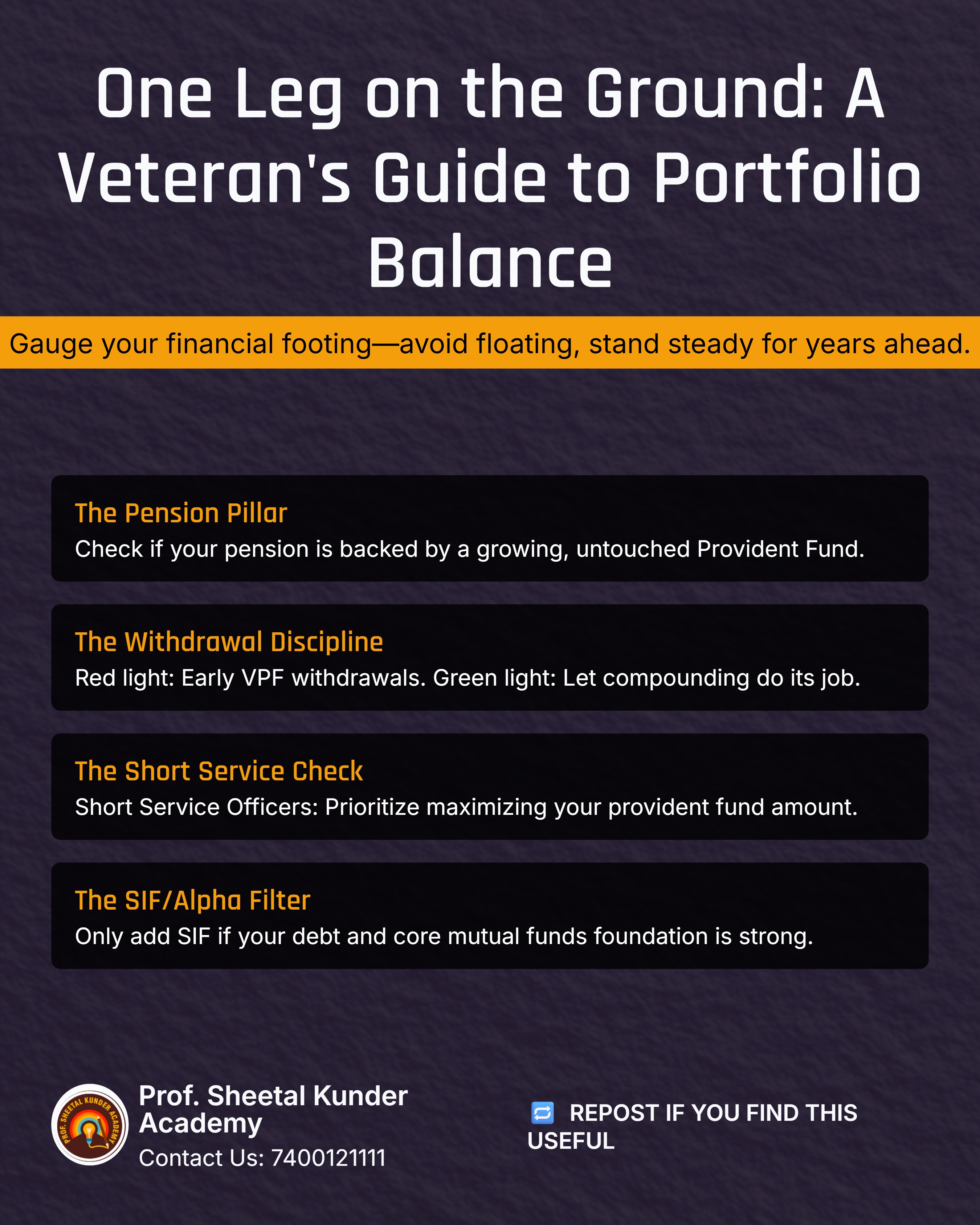
A common challenge in asset allocation is the temptation to liquidate safe assets to chase a "hot" market or a speculative plot of land
Asset allocation is not a "one-size-fits-all" product; it is a customized roadmap based on your life stage
Short Service Officers vs. Permanent Commission: The Colonel highlights that Short Service officers, who may serve only 10-14 years, have a different roadmap because they won't receive a pension
The Asset Mix: A successful portfolio must be split across different classes from the start of the service
Skin in the Game: To truly understand the "supporting" role of new products, Colonel Anand has put his own money into a Specialized Investment Fund (SIF) to test its behavior before advising others- ensuring his "tactical advice" is grounded in reality
In the end, asset allocation is about discipline and focus
Prof. Sheetal Kunder
SEBI® Research Analyst. Registration No. INH000013800 M.Com, M.Phil, B.Ed, PGDFM, Teaching Diploma (in Accounting & Finance) from Cambridge International Examination, UK. Various NISM Certification Holders. Ex-BSE Institute Faculty. 18 years of extensive experience in Accounting & Finance. Faculty Development Programs and Management Development Programs at the PAN India level to create awareness about the emerging trends in the Indian Capital Market, and counsel hundreds of students in career choices in the finance area
 Launch your Graphy