There are no items in your cart
Add More
Add More
| Item Details | Price | ||
|---|---|---|---|

Sun Feb 1, 2026
The NISM Series XIII – Common Derivatives Certification is often perceived as a difficult or intimidating examination, especially by mutual fund distributors, AMC employees, and finance professionals who do not come from an active trading background. However, as highlighted in the detailed discussion between Prof. Sheetal Kunder and Nitin Manapure, the real challenge of this exam does not lie in complex mathematics or advanced trading strategies.
The true difficulty lies in the lack of conceptual clarity.
This exam is designed not to test memorisation, shortcuts, or question-bank familiarity, but to assess whether a candidate genuinely understands how derivatives work, how risks are structured, and how these instruments behave across different market conditions.
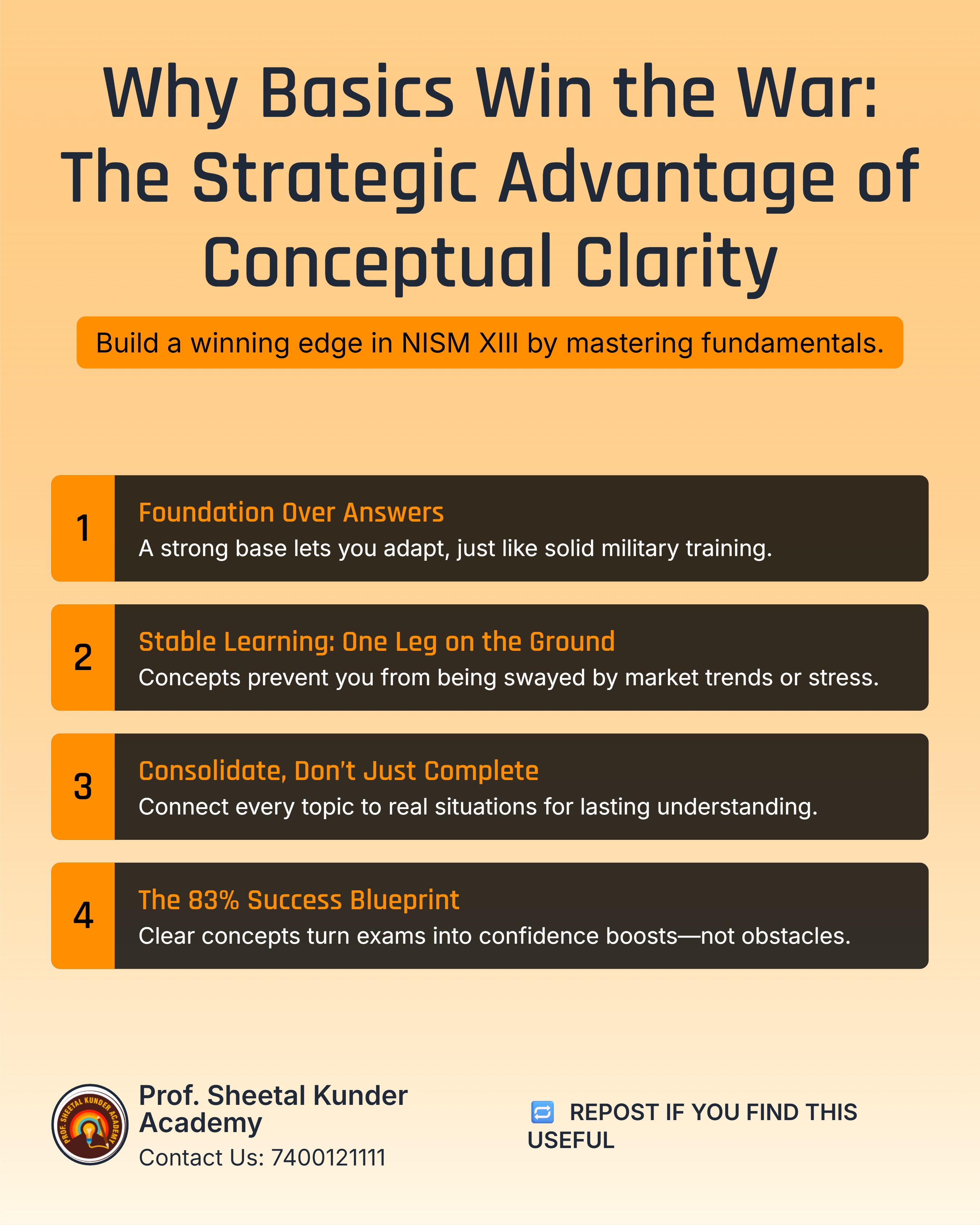
This blog explores why conceptual learning is essential for clearing NISM Series XIII and how a concept-first approach transforms both exam performance and professional competence.
Rote learning refers to:
Memorizing answers
Remembering formulas without understanding logic
Solving question banks mechanically
Depending heavily on mock tests for learning
While this approach may work in memory-based exams, it fails completely in technical certifications like NISM Series XIII.
The Common Derivatives exam is concept-driven, not recall-driven. Questions are rarely direct. Instead, they are framed to test whether the candidate understands:
Cause-and-effect relationships
Risk implications
Instrument behavior under different scenarios
Without understanding concepts, candidates are unable to handle:
Twisted statements
Negative phrasing
Combination-based questions
As discussed in the podcast, this is the primary reason why even experienced professionals struggle.
Most questions fall into formats such as:
“Which of the following statements is incorrect?”
“Identify the correct combination of statements”
“Which statement best explains…”
These questions are intentionally designed to confuse candidates who rely on memorization.
Common traps include:
Reversing logic in statements
Mixing correct and incorrect definitions
Using familiar terminology in misleading contexts
Only candidates with conceptual clarity can confidently eliminate incorrect options.
Many aspirants fear the exam because they assume it involves heavy calculations. In reality:
Numericals are limited
Patterns are repetitive
Most numericals test understanding, not speed
As mentioned in the discussion, there are only 6–7 common numerical patterns across the exam.
Interest Rate Derivatives (IRD) are considered the toughest section not because of calculations, but because:
Candidates lack exposure to bond markets
Questions are highly conceptual
Statements are framed in a twisted manner
Memorization fails completely here; understanding is the only solution.
Random learning includes:
Watching scattered YouTube videos
Jumping between topics
Attempting mock tests prematurely
This creates fragmented knowledge and exam anxiety.
As emphasized by Nitin Manapure, preparation must follow this order:
Equity Derivatives
Currency Derivatives
Interest Rate Derivatives
This sequence mirrors increasing complexity and builds confidence gradually.
One of the most powerful analogies used in the discussion compares NISM certification to a driving license:
You may know how to drive
But without a license, you cannot drive legally
Similarly, you may have market exposure, but without conceptual clarity and certification, you cannot responsibly distribute derivatives-based products.
In driving:
You learn rules first
Then controls
Then practice
In derivatives:
Learn concepts first
Understand risk mechanics
Then attempt questions
Skipping this order leads to failure.
Audio-visual learning improves:
Concept retention
Long-term recall
Logical association
As discussed, many candidates recall concepts better when they have seen and heard explanations, rather than just reading text.
Structured video lectures replicate classroom learning by:
Building continuity
Reinforcing concepts
Reducing cognitive overload
This is especially important for abstract topics like derivatives.

Mock tests should be attempted:
After completing a topic
After understanding concepts
As a diagnostic tool
Taking mock tests before learning creates fear and confusion.
Mock tests help:
Identify weak areas
Improve time management
Build exam temperament
They are not learning tools, but assessment tools.
Conceptual clarity:
Reduces fear
Builds confidence
Improves decision-making
Candidates stop panicking when faced with unfamiliar phrasing.
As discussed, when concepts are clear:
Questions “start talking to you”
Elimination becomes easier
Guesswork reduces significantly
Confidence directly impacts performance.
With conceptual clarity, candidates can:
Quickly attempt easy questions
Skip confusing ones initially
Mark for review
This optimizes time usage.
The recommended strategy is:
Attempt 110–120 questions
Expect 10–15 incorrect answers
Still comfortably clear the 60% cutoff
This is achievable only with understanding, not memorization.
SEBI mandates NISM Series XIII to ensure:
Products are sold responsibly
Risks are explained clearly
Mis-selling is minimized
Conceptual clarity is essential for investor protection.
Certified professionals are accountable for:
What they sell
How they explain products
Whether clients understand risks
This accountability starts with conceptual learning.
Conceptual clarity enables professionals to:
Explain derivatives confidently
Handle client questions
Build trust
Certified, conceptually strong professionals gain:
Market credibility
First-mover advantage in SIF distribution
Long-term career relevance
The NISM Series XIII – Common Derivatives exam is not designed to be tricky or unfair. It is designed to ensure that professionals understand what they are dealing with.
Rote learning may help in passing some exams, but it fails in technical certifications like NISM XIII. Conceptual learning, structured preparation, and disciplined study are the only sustainable paths to success.
As emphasized throughout the discussion, clearing the exam is not just about scoring 60%. It is about becoming a responsible, knowledgeable, and confident professional in India’s evolving derivatives and SIF ecosystem.

Prof. Sheetal Kunder
 Launch your Graphy