There are no items in your cart
Add More
Add More
| Item Details | Price | ||
|---|---|---|---|

Mon Dec 8, 2025
If you’re a Mutual Fund Distributor (MFD) with a huge AUM book or an employee at a principal AMC (like ICICI, SBI, etc.), you’re hearing one term constantly: SIF (Specialised Investment Funds).
SIF is more than just a new product - it’s the new engine driving AUM growth and generating better returns for clients. That's why the NISM Series 13 (Common Derivatives) certification is no longer optional; it's a mandatory career move.
Here is why clearing NISM 13 is essential for your future: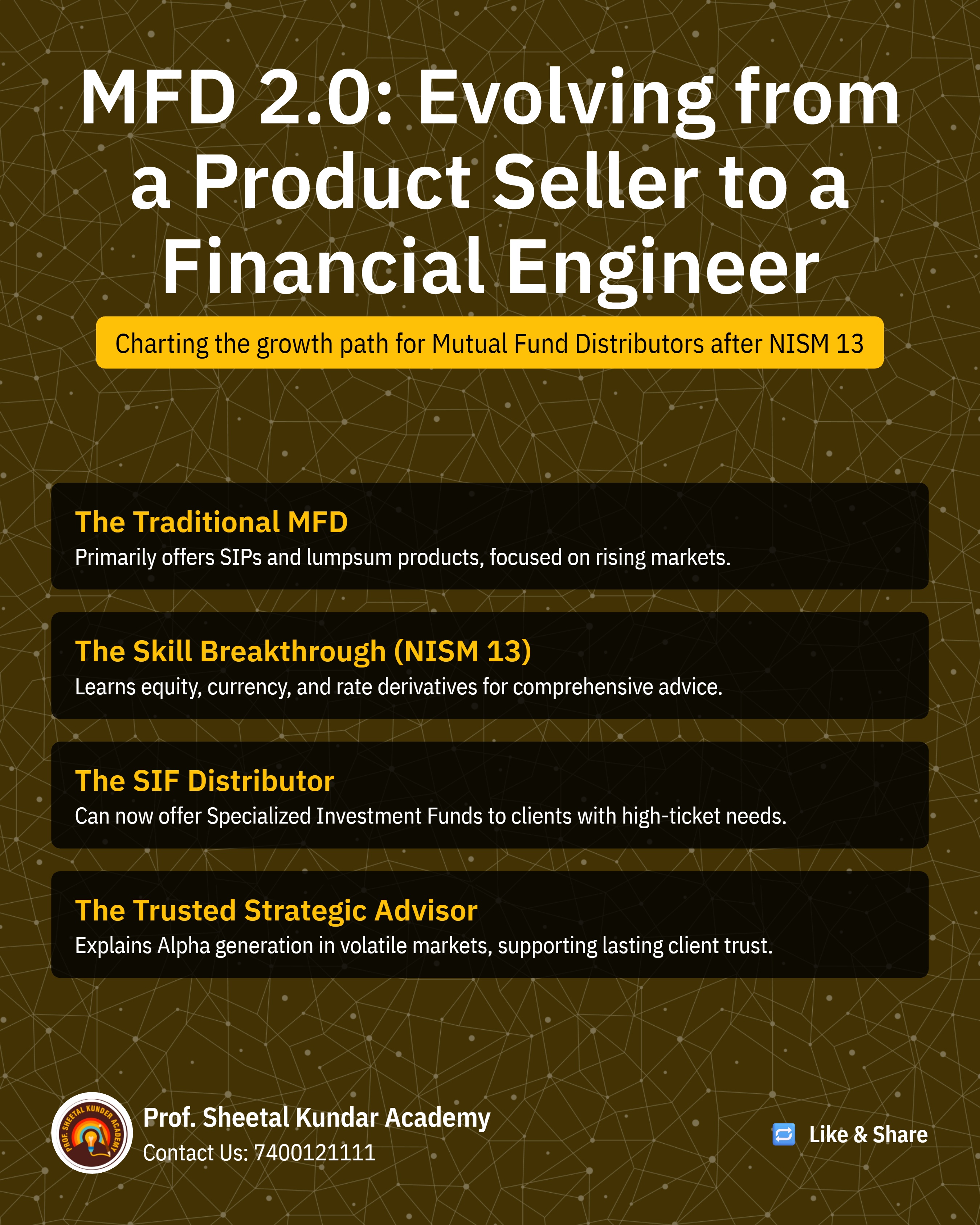
1. SIF: The Future of Returns Generation
The SIF is fundamentally different from traditional SIPs and lump-sum investments because it uses derivatives to generate "alpha" (extra return).
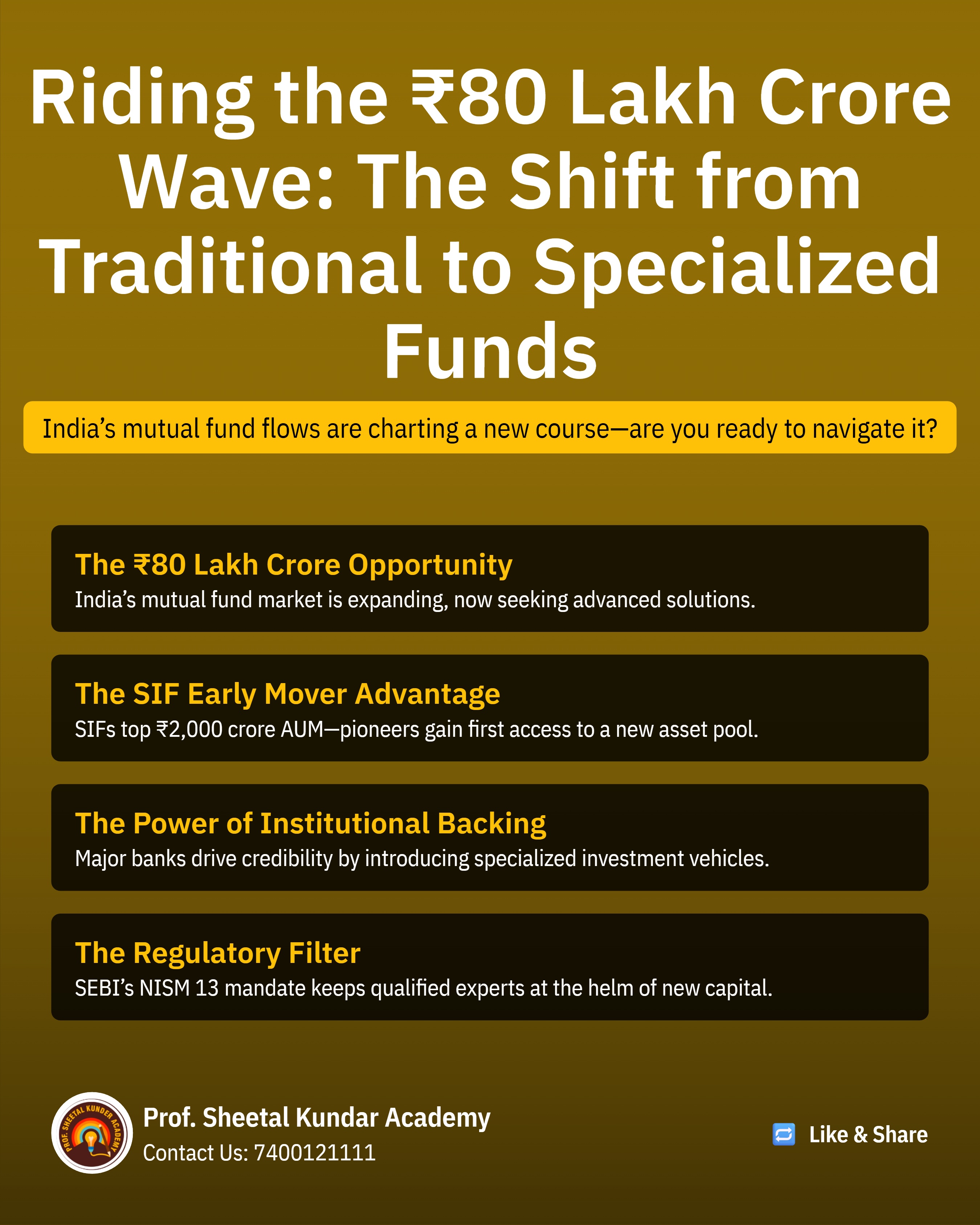
The financial industry is betting big on SIF:
For professionals, NISM 13 isn't just an entry barrier (which SEBI intentionally made difficult); it’s a competitive edge:

Prof. Sheetal Kunder
A Specialised Investment Fund uses derivatives to pursue alpha through a long-short approach, holding long positions in names expected to outperform and short positions in names expected to lag. A standard mutual fund is largely long-only and depends on the market rising, while a SIF is built to work across rising, falling, and sideways markets.
Total SIF AUM crossed Rs. 12,255 crore by April 2026, barely a year into the category, with two early NFOs collecting Rs. 1,420 crore between them. Against an industry of about Rs. 80 lakh crore, this base is still small, which is why fund houses expect it to keep expanding.
An entity selling or distributing mutual fund products can offer SIF products only after passing the NISM Series XIII Common Derivatives Certification Examination. Without it you cannot legally participate in one of the fastest-growing categories in Indian mutual funds, regardless of the size of your existing book.
The general minimum is Rs. 10 lakh per investor at the PAN level, with a separate accredited-investor route that can lower this for those who qualify. SIFs suit HNI clients who want regulated, multi-strategy derivative exposure beyond standard equity or debt funds
Because SIF tickets start at Rs. 10 lakh, each certified conversation moves far more AUM than a typical SIP or lump-sum sale. This lifts both your personal revenue and the company's overall book from a smaller number of well-handled client conversations.
Through options and other derivatives, a SIF manager can position to benefit from price swings in both directions rather than only from a rising market. This is difficult for an individual investor to execute and is one of the core reasons clients consider a professionally managed SIF.
Aim for a steady 85 to 90 percent rather than the 60 percent pass mark. With 25 percent negative marking, four wrong answers cancel one correct answer, so a higher mock score gives you the buffer needed to absorb exam-day uncertainty.
The certificate is valid for three years. Renewal requires either re-sitting the full examination or completing an approved Continuing Professional Education programme before expiry, and an expired certificate counts as no certification for SEBI compliance.
 Launch your Graphy