There are no items in your cart
Add More
Add More
| Item Details | Price | ||
|---|---|---|---|

Sat Jul 25, 2026
SEBI introduced the SIF framework in December 2024, but only 3.7 percent of mutual fund distributors ever cleared NISM XIII to sell it. The 25 percent negative marking and irrelevant currency derivatives content kept most MFDs away. With SIF assets growing 790 percent in nine months and only 6,000 certified distributors against 3.21 lakh ARN holders, SEBI needed a fix. NISM V-D is that fix.
The SIF Framework: Where This Story Begins
SEBI introduced the Specialized Investment Fund framework in December 2024, positioning it as a category between mutual funds and portfolio management services.
The mismatch was not in the product design itself. SIFs were structured carefully, borrowing the trust and NAV based transparency that mutual funds already had. The mismatch was in who was allowed to sell them, and that question turned out to be far harder to solve than the product structure itself.
The XIII Barrier: Why Most MFDs Stayed Away
To distribute SIFs, SEBI required distributors to hold NISM Series XIII, the Common Derivatives Certification, in addition to their existing V-A mutual fund certification.
This created friction almost immediately.
Currency derivatives, in particular, became a sticking point. Most MFDs never touch currency hedging in their client conversations, yet a meaningful portion of the XIII syllabus and question paper was devoted to it. Candidates spent weeks studying content that had almost zero application to the SIF products they were actually trying to get certified for.
Those who came from a pure mutual fund background often turned to tools they were familiar with, such as a nism 5a book, nism 5a notes, or a nism 5a question bank, and tried to treat XIII the same way as the NISM VA exam. That approach did not translate well, because derivatives require conceptual understanding rather than simple pattern recognition.
If you are trying to understand this shift from the ground up, a structured mutual fund distributor course is a practical starting point, since it builds the base knowledge that the newer certification path now assumes you already have.
The result was predictable. Distributors either avoided SIF distribution entirely or attempted XIII without adequate preparation, and pass rates reflected that mismatch. Many candidates who did attempt XIII treated it as an optional, low-priority certification rather than a core part of their business, which meant preparation quality stayed inconsistent across the distributor community.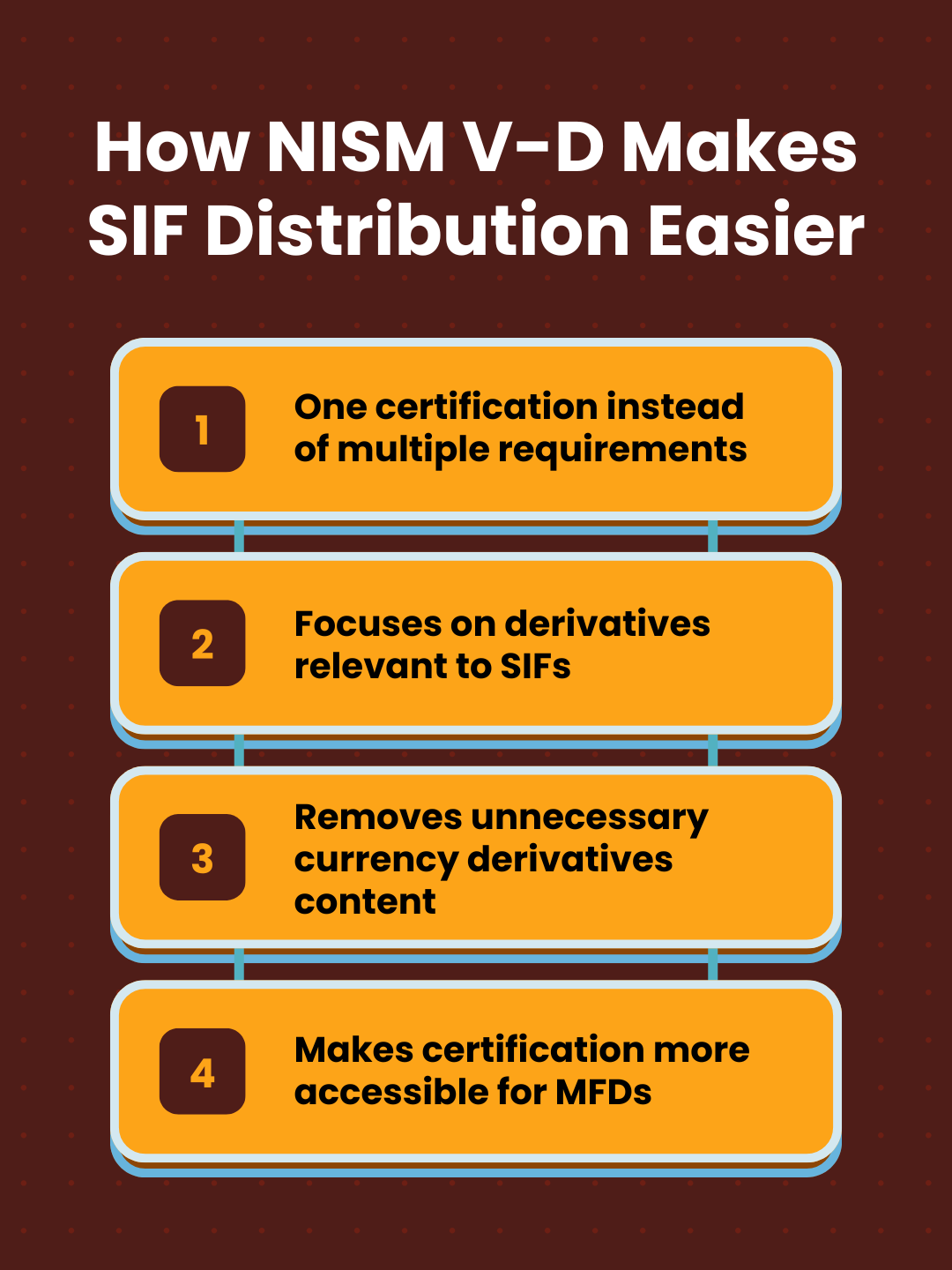
The Number That Forced SEBI's Hand: 3.7 Percent
The clearest evidence of the problem sits in a single statistic.
For a product category that SEBI wanted to scale, a 96.3 percent exclusion rate among the very people meant to distribute it was not a sustainable position. It meant that even if every AMC in the country launched a SIF product tomorrow, there simply were not enough certified distributors on the ground to explain these products to clients, answer questions, and process transactions at scale.
This gap also had a geographic dimension. Since XIII pass rates skewed toward distributors already working in derivatives-adjacent roles, certification concentrated in a handful of financial hubs, leaving large parts of the country with almost no certified SIF distributors at all. From a regulatory perspective, this created a situation where access to new products was constrained by geography rather than investor need.
Industry Pushback Meets Explosive AUM Growth
While the distributor gap stayed wide, SIF assets did not wait.
This pushback did not happen in isolation. It coincided with SEBI's own internal data on derivative-linked risk, which added a second layer to the argument. AMCs pointed out that they were sitting on strong product demand from HNIs and accredited investors, but had no practical way to expand distribution beyond their existing relationship managers, since the broader MFD network remained largely uncertified.
Some AMCs began running internal training programs to push more of their empanelled distributors toward XIII, but even these efforts moved slowly against the exam's difficulty and irrelevant content. It became clear that internal AMC-level fixes could not solve a structural certification design problem.
For many distributors, XIII preparation looked like a patchwork of nism 5a mock test with answers and external question banks, none of which were tailored to the real conceptual gaps that made XIII hard. The issue was not the absence of material but the absence of a syllabus that matched what MFDs actually needed to know to sell SIFs responsibly.
The Investor Protection Angle: 91 Percent Retail Losses
SEBI's research on individual participation in equity derivatives found that around 91 percent of retail F&O traders lost money over multi-year study periods.
This statistic mattered for two reasons.
This is an important distinction for anyone trying to understand SEBI's reasoning. The regulator was not softening its stance on derivatives literacy. It was correcting a design flaw where the wrong derivatives content was being tested on the wrong audience, while the actual risk area, long-short and interest rate exposure inside SIFs, received no dedicated focus at all.
NISM V-D: SEBI's Answer
On July 14, 2026, NISM announced NISM-Series-V-D: Mutual Fund – Specialized Investment Fund Distributors Certification Examination, with registrations opening July 22, 2026.
V-D resolves the core tension in three ways.
This is not a cosmetic rebrand. It is a direct structural response to the 3.7 percent certification rate, the 96.3 percent exclusion gap, and the retail-risk data that made a derivatives requirement non-negotiable in the first place.
The timeline itself signals urgency. NISM moved from announcement to live registration in just eight days, a notably fast turnaround for a certification change of this scale. This pace reflects how pressing the distributor shortage had become relative to the pace of SIF AUM growth.
Why V-D's Design Choices Make Sense Given This History
Each specific change in V-D traces back directly to a documented problem with the old pathway.
From a preparation perspective, this also means that typical tools MFDs use for the NISM VA exam, such as nism 5a notes, a nism 5a book, or a nism 5a question bank, now make more sense again. The syllabus for V-D aligns more closely with what those resources cover on the mutual fund side, and the derivative content V-D adds is anchored directly to SIF use cases rather than to unrelated currency markets.
What This Regulatory History Means Going Forward
Understanding why V-D exists changes how you should think about it.
This also means the certification landscape is unlikely to see another abrupt shift in the near term, since V-D was specifically designed to close the gap that made the previous structure unworkable. Distributors preparing for V-D today are preparing for what is likely to remain the standard pathway into SIF distribution for the foreseeable future.
If you want a clear breakdown of exactly how V-D's syllabus and exam pattern work, that is worth exploring as your next step before you sit for the exam.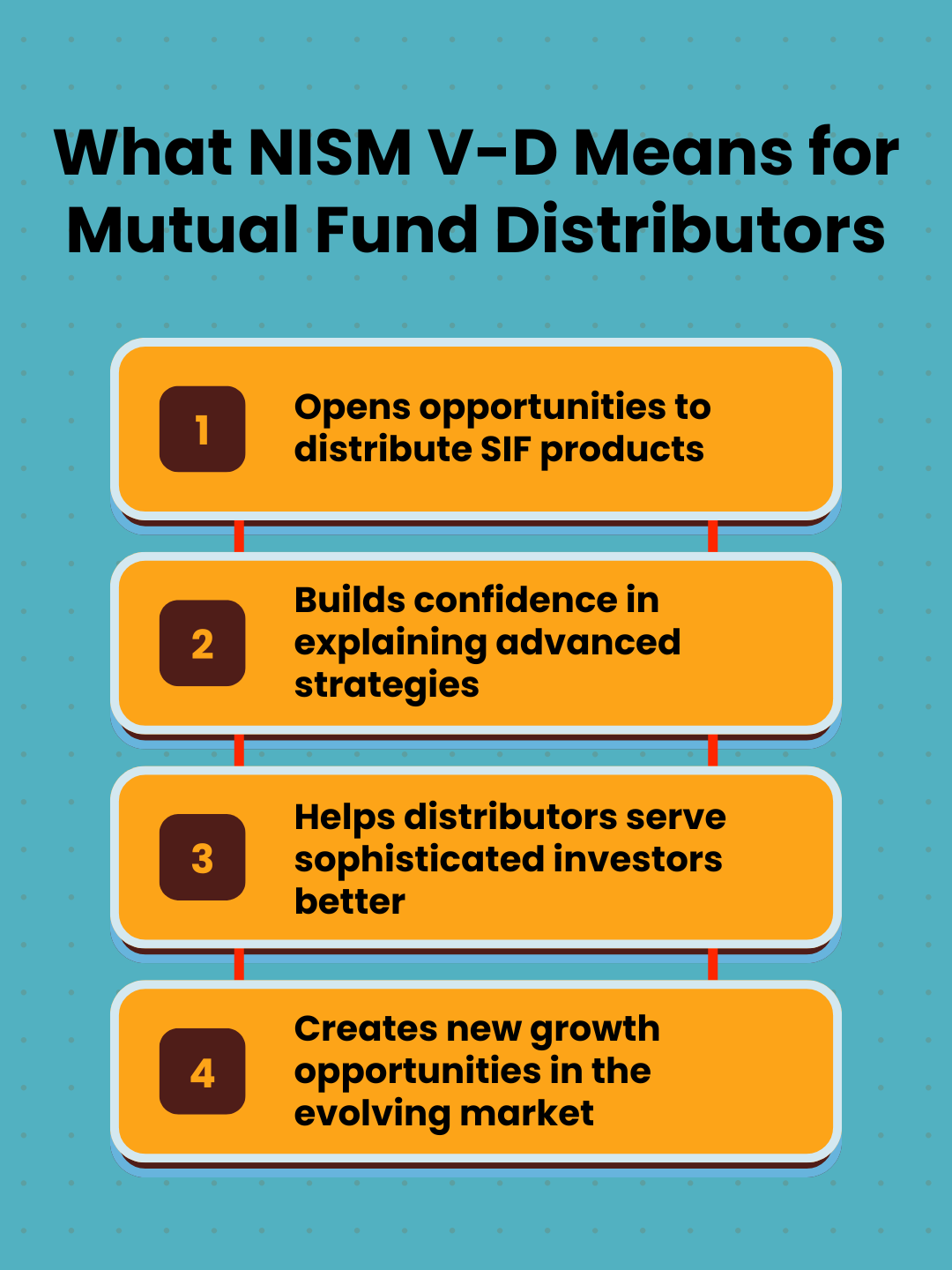
What Distributors Should Do With This Context
Knowing the regulatory backstory is useful, but it also has practical implications for how you approach your own certification decision.
Start building familiarity with V-D now, so you are ready to move as SIF distribution widens beyond the initial circle of early adopters.

Prof. Sheetal Kunder
SEBI® Research Analyst. Registration No. INH000013800 M.Com, M.Phil, B.Ed, PGDFM, Teaching Diploma (in Accounting & Finance) from Cambridge International Examination, UK. Various NISM Certification Holders. Ex-BSE Institute Faculty. 18 years of extensive experience in Accounting & Finance. Faculty Development Programs and Management Development Programs at the PAN India level to create awareness about the emerging trends in the Indian Capital Market, and counsel hundreds of students in career choices in the finance area
NISM XIII required MFDs to study currency derivatives in depth despite its limited relevance to SIF products, and carried a 25 percent negative marking penalty, both of which discouraged mutual fund distributors from attempting it.
SEBI introduced the Specialized Investment Fund framework in December 2024, positioning it between mutual funds and portfolio management services.
SEBI's research found that around 91 percent of retail equity derivatives traders lose money over multi-year periods, which shaped SEBI's position that anyone distributing a derivative-linked product like a SIF must be certified on relevant derivative concepts first.
Only around 6,000 out of 3.21 lakh total ARN holders had cleared NISM XIII, a certification rate of just 3.7 percent.
SIF assets under management grew by approximately 790 percent within nine months of the category's launch, even as the certified distributor base stayed limited.
Yes. V-D retains equity and interest rate derivative concepts relevant to SIFs, but removes currency derivatives, which had little practical relevance for SIF distribution.
No. V-D applies 10 percent negative marking per wrong answer, compared to the 25 percent penalty under NISM XIII.
No. Distributors who already hold both V-A and XIII are exempt from V-D, since their existing certifications already cover the same knowledge areas.Still unclear on how this regulatory shift affects your own certification path. Get in touch to map out exactly what you need to clear next.
 Launch your Graphy