There are no items in your cart
Add More
Add More
| Item Details | Price | ||
|---|---|---|---|

Sun Feb 1, 2026
Over the last decade, India’s capital markets have witnessed rapid growth in participation, especially in derivatives such as Futures & Options (F&O). While increased participation reflects growing financial awareness, it has also exposed a critical weakness in the ecosystem—lack of structured knowledge among retail participants and intermediaries.
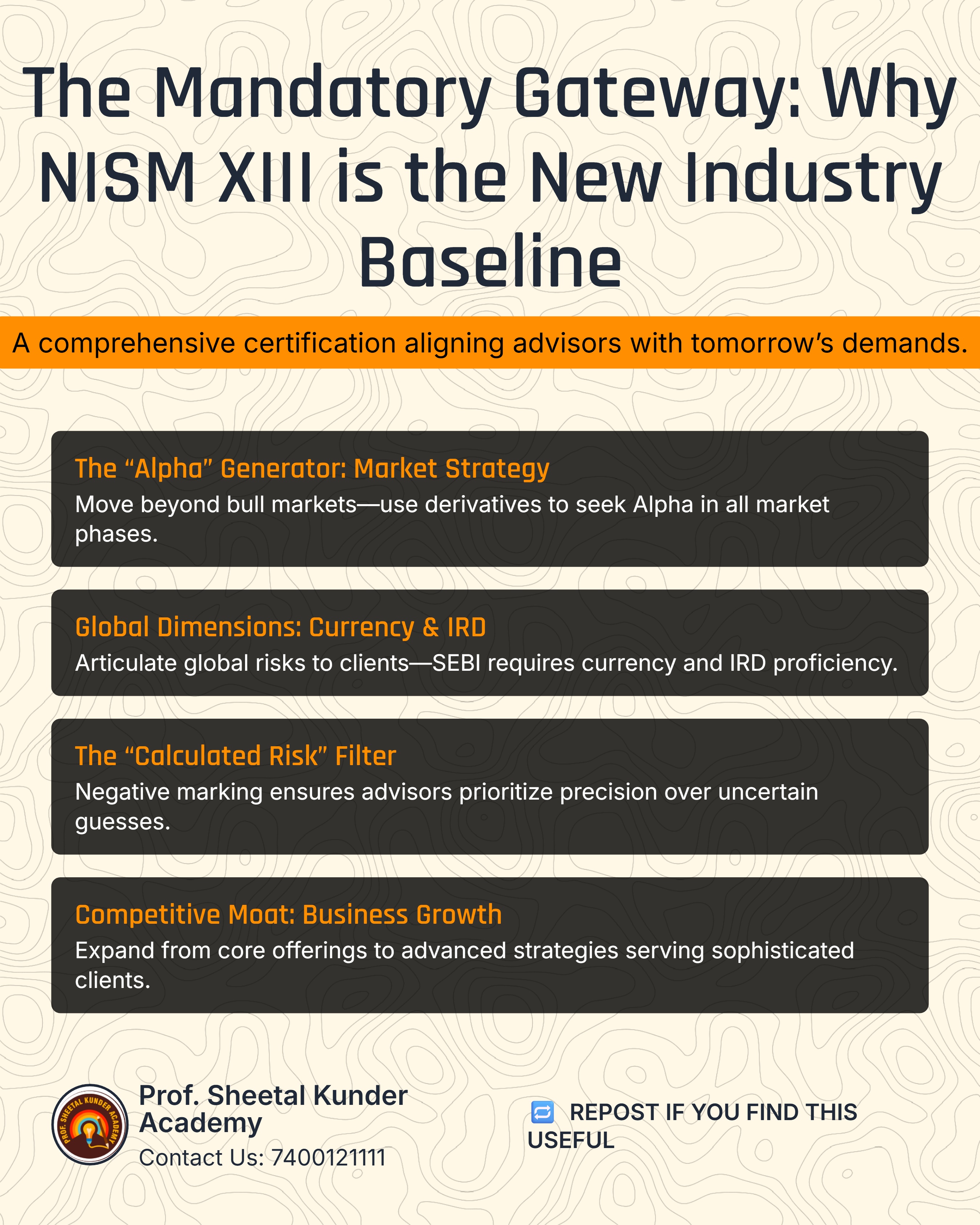
The NISM Series XIII – Common Derivatives Certification was introduced by SEBI not as an academic formality, but as a regulatory safeguard. As discussed in the detailed conversation between Prof. Sheetal Kunder and Nitin Manapure, this certification plays a pivotal role in ensuring that derivatives-linked products, especially Structured Investment Funds (SIFs), are distributed responsibly.
This blog explores why SEBI made NISM Series XIII mandatory, the market realities that led to this decision, and how the certification strengthens investor protection, professional accountability, and long-term market stability.
India has one of the largest retail participation bases in F&O trading globally. However, data consistently shows that a majority of retail traders incur losses.
As highlighted in the discussion:
Retail investors lose tens of thousands of crores annually
Losses are concentrated among under-informed participants
Derivatives trading has become speculative rather than strategic
Derivatives are inherently zero-sum instruments—when one party loses, another gains.
Retail losses are often offset by gains made by:
Large institutional investors
Foreign Institutional Investors (FIIs)
Global financial institutions
These entities have:
Advanced systems
Professional risk management
Structured strategies
This asymmetry created a pressing regulatory concern.
It is important to clarify what SEBI does not intend:
SEBI does not aim to stop derivatives trading
SEBI does not guarantee profits
SEBI does not restrict innovation
Instead, SEBI focuses on frameworks, safeguards, and accountability.
SEBI’s responsibilities include:
Investor protection
Market integrity
Fair practices
Intermediary regulation
Mandatory certification is a natural extension of this mandate.
Unlike traditional mutual funds, derivatives involve:
Leverage
Volatility
Non-linear payoffs
Complex risk dynamics
Selling or advising on derivatives without understanding these aspects leads to mis-selling and investor harm.
Many mutual fund distributors:
Have strong product knowledge in equity and debt
Lack exposure to derivatives mechanics
Are unfamiliar with currency and interest rate markets
NISM Series XIII bridges this gap.

Structured Investment Funds introduced:
Derivatives-based strategies
Multi-asset exposure
Advanced risk management
This made certification non-negotiable for distributors.
SIFs cannot be sold using:
Relationship trust alone
Past mutual fund experience
Generic return narratives
They require technical explanation and risk disclosure, which certification ensures.
NISM Series XIII covers:
Equity derivatives
Currency derivatives
Interest rate derivatives
This holistic coverage ensures that professionals understand the entire derivatives ecosystem, not just equity F&O.
As emphasized in the discussion:
The exam is concept-driven
Questions are application-based
Memorization does not work
This aligns with SEBI’s goal of knowledge-based regulation.
Mandatory certification:
Filters out unprepared intermediaries
Encourages serious professionals
Raises industry standards
This benefits both investors and ethical distributors.
Certified professionals are better equipped to:
Explain risks clearly
Set realistic expectations
Avoid exaggerated claims
This reduces disputes and regulatory issues.
While investor awareness is improving:
Product complexity is increasing faster
Retail investors still rely on intermediaries
SEBI focuses on educating intermediaries, who then educate investors.
Certification creates accountability:
Professionals are responsible for advice
Misrepresentation carries consequences
Ethical standards are enforced
This strengthens trust in the system.
Distributors are now expected to:
Upgrade technical skills
Understand derivatives logic
Explain structured products confidently
This marks a shift from volume-based distribution to knowledge-based advisory.
Certification provides:
Higher credibility
Competitive differentiation
Access to new product categories
Professionals who adapt early gain long-term advantages.
As discussed in the podcast:
30–40 days of structured preparation is sufficient
The exam tests basics, not advanced trading
A 60% score is achievable with concept clarity
Fear often comes from misinformation, not reality.
The driving license analogy is crucial:
A license does not make you an expert driver
It ensures you understand rules and safety
Similarly, NISM XIII ensures minimum professional competence.
SEBI could have:
Restricted retail participation
Banned certain products
Raised investment thresholds
Instead, it chose education and certification, reflecting a progressive regulatory approach.
Globally:
Derivatives distribution requires certification
Intermediaries are heavily regulated
Investor protection is paramount
NISM Series XIII aligns India with these standards.
A qualified intermediary ecosystem:
Builds investor confidence
Encourages responsible innovation
Reduces systemic risk
This supports sustainable market expansion.
Going forward:
More advanced certifications may emerge
Product complexity will increase
Regulatory expectations will rise
NISM Series XIII is the foundation, not the endpoint.
SEBI’s decision to make NISM Series XIII mandatory is rooted in practical market realities, not theoretical compliance. Rising retail losses, complex derivative products, and the introduction of Structured Investment Funds demanded a knowledge-first regulatory approach.
Mandatory certification:
Protects investors
Disciplines the market
Elevates professional standards
Enables responsible innovation
As emphasized in the discussion, NISM Series XIII is not a hurdle—it is a license to operate responsibly in India’s evolving derivatives ecosystem.

Prof. Sheetal Kunder
 Launch your Graphy