There are no items in your cart
Add More
Add More
| Item Details | Price | ||
|---|---|---|---|

Sat Aug 1, 2026
SEBI’s own consultation paper shows NISM X-A’s pass percentage is close to one in four candidates, the weakest among all NISM certifications. Coaching sites that claim 90 percent plus success usually talk about a filtered subset of their best‑prepared students, not the national picture. This article unpacks that gap, how X-A actually fits into SEBI’s investment adviser pathway, and what you should track instead of headline pass rates.
Table of contents

Click here to enrol for FREE into Financial Planning Masterclass: https://www.profsheetalkunderacademy.com/courses/Financial-Planning-Masterclass
The confusion goes away once you look at what each number actually measures.
| Label people use | What is really measured | Typical number you hear |
| “NISM X-A pass rate” (regulator data) | All candidates nationwide who sat X-A in a year | Around 26 percent |
| “Average NISM pass rate” (generic articles) | Several modules combined, rough estimate | 50–60 percent |
| “Our success rate” (coaching) | Students who completed a course and met internal criteria | 90–95 percent or higher |
Coaching numbers usually treat only a filtered group as “students” when calculating success:
This is why you can see “26 percent national pass percentage” and “95 percent success with us” in the same week and both can technically be true.
Is NISM X-A really that hardTo judge difficulty you have to look at how the exam is built, not just the pass rate.From NISM’s official exam details for Investment Adviser Level 1:
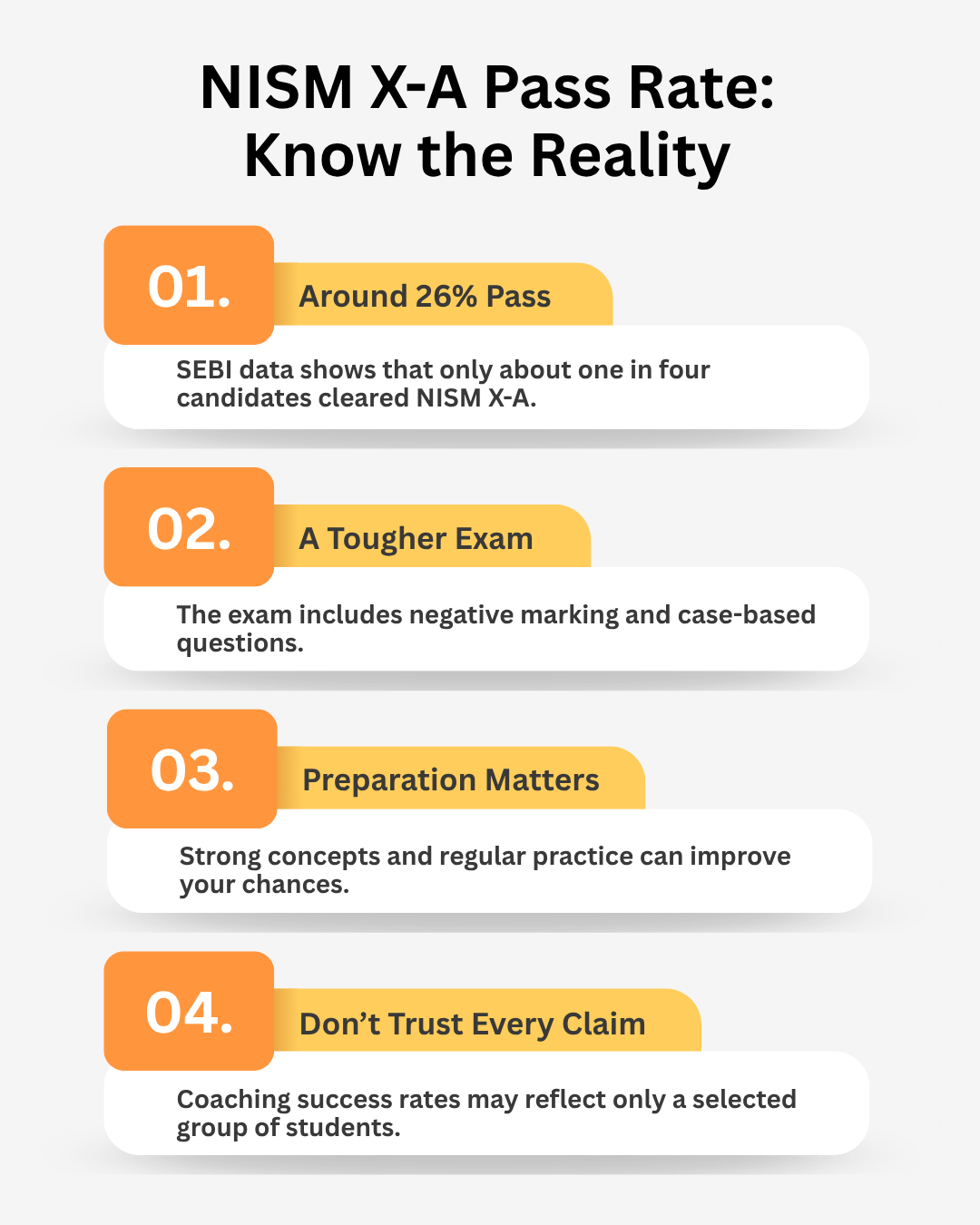
This combination makes X-A unforgiving in three ways.
Why coaching numbers and SEBI numbers don't match
Coaching pages and regulator data rarely line up, and that's simply because they're counting different groups of people, not because either side is wrong.
Training providers usually track only students who stayed through the full course and were ready by their own internal benchmark. Anyone who dropped off midway, delayed the exam, or attempted early against advice typically isn't part of that tally.SEBI's data, on the other hand, includes every single candidate who sat the exam that year, regardless of how much or how little they prepared going in.
That's the real takeaway here, not the specific percentages on either side: before you lean on any provider's numbers to plan your own prep, ask what population they're actually describing, and whether your own study routine looks anything like the "filtered" group behind that number.
How NISM X-A compares to other NISM series exams
X-A sits in the stricter bracket among NISM certifications. It carries a 60 percent passing score with 25 percent negative marking per wrong answer, the same combination used in exams like VIII (Equity Derivatives) and XV (Research Analyst). Compare that with V-A (Mutual Fund Distributors) or XXI-B (Portfolio Managers), both of which pass at 50 percent with no negative marking at all. What sets X-A apart even within that stricter group is the case-based format, 9 caselets layered on top of 90 MCQs, a structure most distributor-facing exams skip entirely. A single misread detail in a caselet can cost marks across two or three linked questions instead of just one.
Trainers who've cleared multiple NISM modules consistently point to the caselets and time pressure, not the core syllabus, as what separates X-A from something like V-A. Professionals with strong finance backgrounds have described needing a second, more structured attempt at X-A even after clearing other modules comfortably on the first try. The practical takeaway: don't prepare for X-A the way you'd prepare for a distributor exam. Budget real time specifically for caselet practice, since that's the format gap most candidates underestimate going in.
How NISM X-A fits SEBI investment adviser requirements
NISM X-A is not just another certificate. It is embedded inside SEBI’s framework for who can give investment advice for a fee.
From SEBI’s investment adviser regulations and circulars:
NISM X-A vs other entry-level finance exams
| Path | Core exam | Typical marketing line | What actually matters |
| SEBI adviser track | NISM X-A as base | “Can be cracked in 10–20 days” (often claimed in videos) | Real pass percentage near one in four, plus regulatory responsibilities after you qualify |
| Mutual fund distribution | NISM V-A or successor | “High pass rate, simple and direct questions” | In some versions pass mark is 50 percent, and there may be no negative marking, so under‑prepared attempts still often pass |
| Generic “stock market courses” | Provider’s own tests | “Everyone gets a certificate” | Certificates usually have no SEBI standing and cannot be used for registration |
Why does any of this matter for your career? Because jobs are changing faster than exam marketing.On the regulatory side:
Part-time investment advisers and the pass-rate question
SEBI’s newer Part‑Time Investment Adviser (PTIA) route changes how you should think about exam difficulty.
Key features of PTIA:
How to judge your own chances
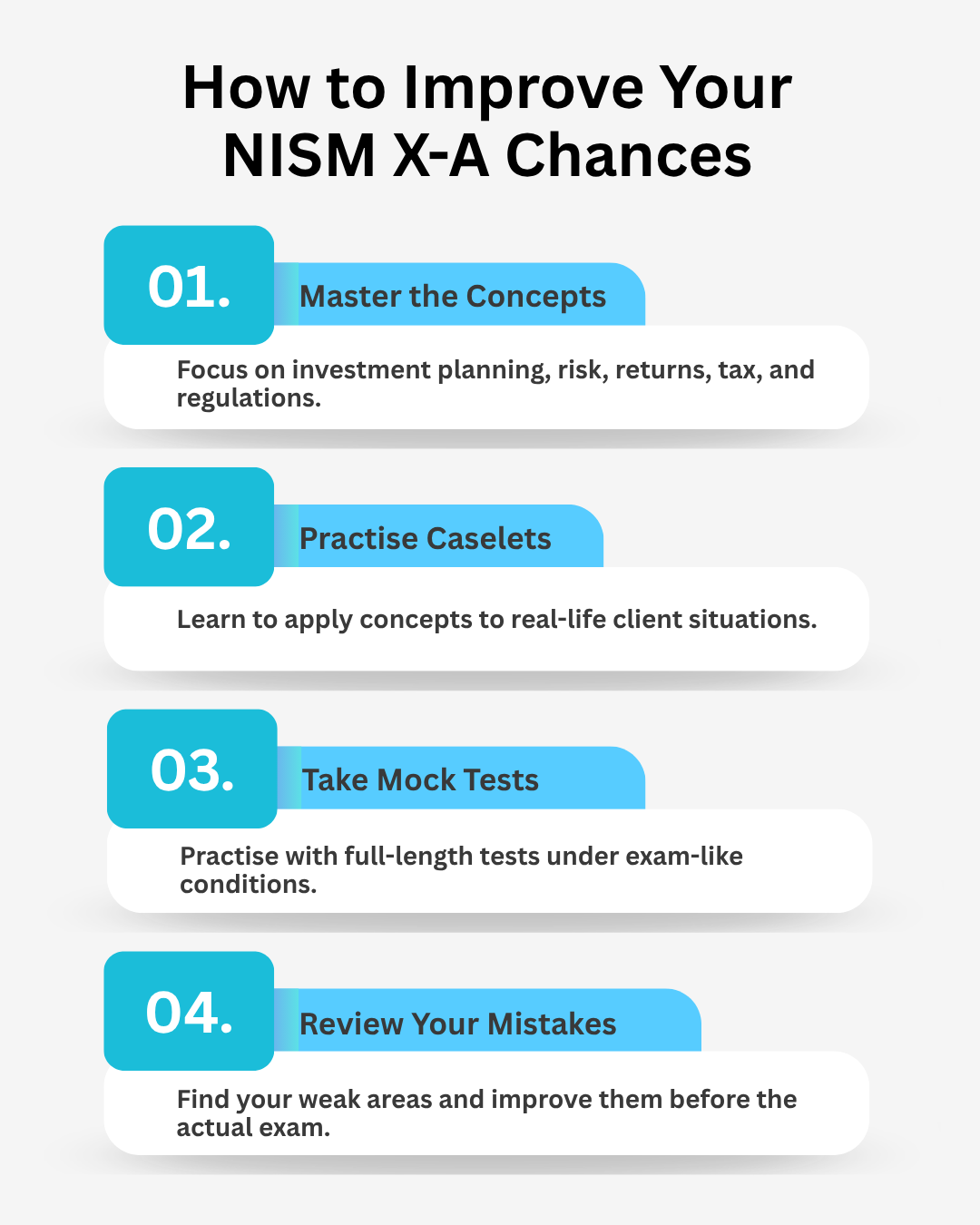
Instead of trying to guess whether you will be in the 26 percent who pass or the 74 percent who do not, use three concrete checks.
1. Your scores in realistic, timed mock tests
A good mock for X-A should:
2. Your accuracy on caselets versus regular MCQs
Caselets are where many candidates bleed marks.
3. Your ability to explain answers aloud
Memorising answers can push your mock score up but leaves you exposed in the real exam when the same concept is asked in a different way.A simple test:
Knowing that NISM X-A has the lowest pass percentage among NISM modules should change how you study.

Click here to enrol for FREE into Financial Planning Masterclass: https://www.profsheetalkunderacademy.com/courses/Financial-Planning-Masterclass
Stage 1: Concept sweep
Headline pass rates measure different populations, and that's the real point. SEBI's figure counts everyone who sat the exam; a coaching site's figure counts only its most test-ready students. If you're serious about advisory work, the question isn't whether X-A is too risky; it's whether you're willing to prepare at the level it demands.

Prof. Sheetal Kunder
SEBI® Research Analyst. Registration No. INH000013800 M.Com, M.Phil, B.Ed, PGDFM, Teaching Diploma (in Accounting & Finance) from Cambridge International Examination, UK. Various NISM Certification Holders. Ex-BSE Institute Faculty. 18 years of extensive experience in Accounting & Finance. Faculty Development Programs and Management Development Programs at the PAN India level to create awareness about the emerging trends in the Indian Capital Market, and counsel hundreds of students in career choices in the finance area
SEBI’s consultation on investment advisers states that NISM X-A’s pass percentage for the most recent year it analysed was about 26 percent, and that this was the lowest pass percentage among all NISM certifications.
Those comments usually come from candidates who already had a finance background and could devote focused time. Others with similar experience have written publicly about failing X-A on their first attempt, which shows how uneven preparation quality is across the candidate pool.
Yes. SEBI allows graduates from any discipline to pursue investment adviser registration, and NISM X-A is built to test concepts from the ground up. Non‑finance candidates usually need more time on basics like risk, return and time value of money, but they clear the exam regularly when they prepare systematically.
Not if you approach it like a licensing exam. The low pass percentage mostly reflects under‑prepared attempts. With realistic mocks, proper caselet practice and understanding of SEBI’s adviser framework, you are aiming to be part of the minority who get through, not a random entry in the 74 percent who do not.
More important than any advertised success percentage are three checks: how closely your mocks match the current NISM pattern and negative marking, how honest a resource is about who it counts in its “pass rate,” and whether your preparation connects directly to SEBI’s adviser requirements rather than stopping at “just clear one exam.”
 Launch your Graphy